TL;DR:
- After infidelity, making recovery decisions requires a structured approach focused on safety, accountability, and gradual trust rebuilding. Recognizing the importance of honest self-reflection, emotional processing, and professional support helps guide couples through stages from crisis stabilization to growth or separation. Progress is measured by specific behaviors and emotional safety, with patience and consistent actions being key to genuine healing.
The aftermath of infidelity can feel like the ground has disappeared beneath you. Emotions collide. Questions multiply. And the pressure to figure out what to do next arrives before you’ve had a chance to breathe. This guide to making recovery decisions is built for exactly that moment. It won’t tell you what to choose. It will give you a structured, compassionate framework for making choices that reflect your values, protect your wellbeing, and give your healing the best possible foundation. Whether you’re considering repair or separation, the quality of your decisions matters more than their speed.
Key takeaways
| Point | Details |
|---|---|
| Stabilize before deciding | The first 72 hours after disclosure are a crisis period. Avoid irreversible decisions until emotions settle. |
| Responsibility precedes repair | Trust rebuilding cannot begin until the person who cheated takes full, undefended ownership of the harm caused. |
| Actions outweigh apologies | Consistent, transparent behavior over time does more to restore trust than any single conversation. |
| Repair and separation are both valid | A healthy outcome does not always mean staying together. Safety, respect, and growth matter most. |
| Progress needs benchmarks | Identifying clear signs of healing helps you know whether decisions are working or need to change. |
The mindset you need before making recovery decisions
Before any recovery decision strategies can work, your internal starting point has to be honest. That’s not a criticism. It’s a clinical reality.
If you’re the person who was unfaithful, taking full responsibility without minimizing or blame-shifting is the single most important prerequisite. Not because your partner needs a confession. But because real repair is impossible when accountability is conditional. Phrases like “I only did this because you never…” shut down healing before it starts.
If you’re the betrayed partner, the prerequisite looks different. Your job right now is not to manage anyone else’s emotions or rush toward forgiveness. It’s to give yourself permission to feel what you actually feel. Rage, grief, and numbness are all reasonable responses. You do not need to make them smaller.
Both people in the relationship need to understand that recovery decision-making is not a single conversation. It’s a series of choices made over weeks and months. Here’s what the foundation requires:
- Honest self-reflection. The person who cheated needs to understand, as specifically as possible, why the affair happened. This is not about excuses. It’s about preventing repetition.
- Space for processing. Pushing your partner to “move on” faster than they’re ready to is one of the most common ways repair collapses early.
- Empathy as a practice. Not a feeling you wait to have, but something you actively demonstrate through listening, patience, and follow-through.
- Transparency from the start. Consistent and accountable behavior is not optional. It is the baseline condition for any real progress.
Pro Tip: Write down your answers to two questions before any recovery conversation: “What do I actually want?” and “What am I willing to do or change to get there?” Clarity about your own position reduces reactive decision-making.
A step-by-step framework for rebuilding trust
This is the core of any recovery decision-making guide worth following. The process moves through phases. Skipping phases doesn’t speed up healing. It delays it.
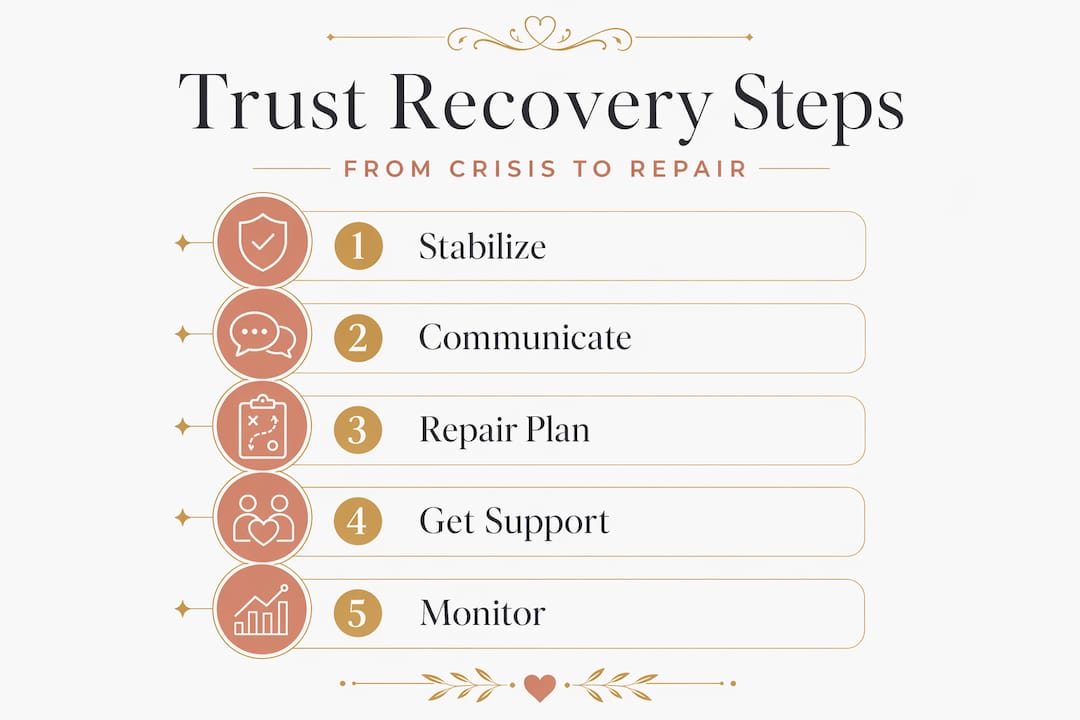
Step 1: Manage the immediate crisis
The 72-hour window post-disclosure is a genuine crisis period. During this time, prioritize basic self-care: sleep, food, and distance from major decisions. If children are involved, their stability comes before any adult resolution conversations.
Step 2: Establish communication agreements
Decide together what you will and will not discuss, and when. Some couples need full disclosure of affair details. Others find that level of detail re-traumatizing. There is no single right answer. What matters is that both people agree on what the communication rules are.
Step 3: Craft a relationship repair plan
A repair plan is not a contract. It’s a set of specific, agreed behaviors. It might include: no contact with the affair partner, shared location access for a defined period, weekly check-in conversations, and a commitment to couples therapy. Marriage therapy helps couples work through the underlying reasons for betrayal and rebuild communication in a structured way.
Step 4: Engage professional support
A trained therapist, especially one who specializes in betrayal trauma, brings tools and perspective that no self-help resource can fully replicate. This is not a sign of weakness. It’s a sign that you take the repair seriously. Aftertheaffair recommends exploring rebuilding trust strategies alongside professional support for the best outcomes.
Step 5: Monitor and adapt
Recovery is not linear. Build in regular check-ins to ask: Is this plan working? Are behaviors actually changing? Do we need to adjust anything? Decisions made in month one may need revision by month four.
| Phase | Focus | Signs it’s working |
|---|---|---|
| Crisis stabilization | Safety and basic functioning | Emotions are less volatile; both partners are present |
| Early repair | Accountability and communication | Honest conversations are happening regularly |
| Trust building | Consistent behavior over time | Betrayed partner feels safer; fewer emotional triggers |
| Growth | Renewed connection and shared vision | Both partners report increased closeness and clarity |
Pro Tip: Review your repair plan every 30 days. Write down what’s shifted, what hasn’t, and one specific thing each person will do differently. This keeps decisions active rather than assumed.
Common mistakes that derail recovery decision-making
Even people who are genuinely committed to repair make predictable errors. Knowing them in advance is the best defense.
The biggest misconception is that a strong apology closes the wound. It doesn’t. Words alone do not rebuild trust. What betrayed partners actually need is to see reliable, transparent behavior repeated over time. When the person who cheated believes that saying “I’m sorry” once should be enough, they stop doing the consistent work that trust actually requires.
Other common pitfalls include:
- Defensive reactions to hard questions. When a betrayed partner asks painful questions about the affair, defensiveness signals that self-protection is more important than the partner’s healing. It destroys progress fast.
- Secrecy about anything related to the affair. If the betrayed partner discovers that information was withheld, even something that felt minor, it resets the trust clock entirely.
- Ignoring emotional triggers. Certain dates, places, songs, or situations will activate grief and anger in the betrayed partner, sometimes months later. Dismissing these as overreactions is a serious mistake.
- Neglecting self-care. Both partners absorb enormous stress during recovery. Without deliberate self-regulation, emotional flooding makes productive decision-making almost impossible.
Self-regulation and compassionate assertiveness are not soft skills in this context. They are the practical tools that keep hard conversations from becoming destructive ones.
“Recovery is not measured by the absence of pain. It’s measured by whether both partners feel safer, more honest, and more connected than they did the month before.”
The effects of infidelity on anxiety are well-documented and significant. Recognizing that anxiety spikes are a normal part of recovery, rather than a sign that repair is failing, helps both partners respond with more patience.
What healthy progress actually looks like
Understanding the benchmarks of recovery helps you make better decisions, because you’re measuring against something real rather than guessing.
Here’s the distinction that matters most when you’re assessing whether your recovery decisions are working:
| Healthy progress | Stalled or deteriorating recovery |
|---|---|
| Honest conversations are happening without shutdown | Topics are avoided or met with anger or silence |
| The betrayed partner reports feeling emotionally safer | Fear and hypervigilance are unchanged or worsening |
| The person who cheated initiates accountability actions | Accountability only happens when prompted |
| Both partners report some moments of genuine connection | Emotional distance is widening |
| Conflict leads to resolution, not repeated cycling | The same argument happens repeatedly with no change |
The decision to repair or separate should center on specific, observable behaviors, not on character judgments. Asking “Has their behavior actually changed?” is more useful than “Can I trust this person?” because the first question has an evidence-based answer.
Separation can itself be a healing path when the person who cheated remains unrepentant or refuses to do the consistent work repair requires. Healing is not synonymous with staying together. For some people, regaining independence and self-worth after betrayal is the most honest and healthy decision they can make.
Setting realistic expectations matters too. A realistic trust repair timeline typically spans one to three years for meaningful recovery. Couples who expect to feel fully healed in three months often interpret normal setbacks as failure, which leads to premature or reactive decisions.
My take on what actually moves recovery forward
In my experience working with people after betrayal, the most transformative shifts rarely come from dramatic gestures or pivotal conversations. They come from small, boring, consistent actions repeated when it would be easier not to.
I’ve seen couples survive extraordinarily painful affairs and build something genuinely stronger. And I’ve seen couples where the pain was far less severe but the repair still failed. The difference almost never came down to the severity of the affair. It came down to whether one or both partners confused talking about change with actually making it.
The thing I keep coming back to is this: repair conversations focused on specific behaviors work far better than conversations focused on identity. Saying “I need you to check in with me when you’re working late” is something a partner can actually do. Saying “I need you to be a trustworthy person” leaves both of you stuck. One is a request. The other is a judgment.
What I want readers to take from this is both simple and hard. Be patient with the process. Be honest about what you’re seeing. And give yourself credit for still trying. That choice, the one to keep showing up, is more meaningful than most people give it credit for.
— S.J.Howe

Take your next step with the right support
Recovery after infidelity requires more than good intentions. It requires structured, practical tools designed for exactly what you’re facing.
Aftertheaffair offers an evidence-informed infidelity recovery checklist that walks you through seven concrete steps for healing and trust rebuilding, whether you’re working toward repair or processing separation. For couples committed to rebuilding their connection, the relationship growth resources provide psychological frameworks and practical strategies grounded in real clinical experience. Both repair and separation are treated as legitimate outcomes, because at Aftertheaffair, the goal is your healing, not a predetermined result.
FAQ
What is the first step in making recovery decisions after infidelity?
The first step is stabilizing the crisis. Avoid major, irreversible decisions in the immediate days after disclosure. Focus on basic self-care and emotional safety before any repair or separation conversations begin.
How long does trust rebuilding actually take?
Trust rebuilding after infidelity typically takes one to three years of consistent effort. Progress depends on the transparency and accountability of the person who cheated and the willingness of both partners to engage honestly in the process.
Can a relationship recover without couples therapy?
Some couples do recover without formal therapy, but professional support significantly improves outcomes. Marriage therapy helps couples identify the underlying causes of betrayal and rebuild communication more effectively than most people can manage alone.
How do you know when recovery decisions are actually working?
Look for specific behavioral evidence: the betrayed partner reports feeling emotionally safer, honest conversations are happening regularly, and the person who cheated is initiating accountability without being prompted. Progress is measured in behavior, not feelings alone.
Is separation a failure of the recovery process?
No. Separation can be a healthy outcome when the person who cheated is unrepentant or unwilling to change. Recovery means healing and rebuilding self-worth. It does not always mean the relationship continues.
Recommended
- How to Guide Clients After Infidelity for Healing – After the Affair Series
- Questions to ask after discovering infidelity
- Step-by-step infidelity recovery: Heal, grow, rebuild
- How to navigate post-affair decisions: 5 key steps