TL;DR:
- Affair and infidelity topologies distinguish physical, emotional, and silent cheating, shaping emotional damage and recovery paths. Recognizing the specific type helps in choosing targeted trauma-informed support, as each topology triggers different wounds and healing needs. Understanding these categories allows betrayed partners to process grief clearly and rebuild trust with a tailored approach.
Affair and infidelity topologies are defined categories of unfaithful behavior that distinguish physical affairs, emotional affairs, and silent cheating from one another. Understanding these distinctions matters because betrayal is the leading cause of relationship breakups, and the type of affair shapes both the emotional damage and the recovery path. Research shows about 27.5% of people report emotional infidelity as their experience, while 35% describe non-sexual but trust-breaking behaviors like secret messaging. Aftertheaffair draws on clinical frameworks and depth psychology to help people recognize which category applies to their situation, because naming the pattern is the first step toward addressing it.
- What are the main affair and infidelity topologies?
- How do affair patterns differ by gender and psychology?
- What is the impact of different infidelity topologies on relationships?
- How can you recognize and address different affair types?
- Key Takeaways
- Why categorizing affair types changed how I think about healing
- FAQ
What are the main affair and infidelity topologies?
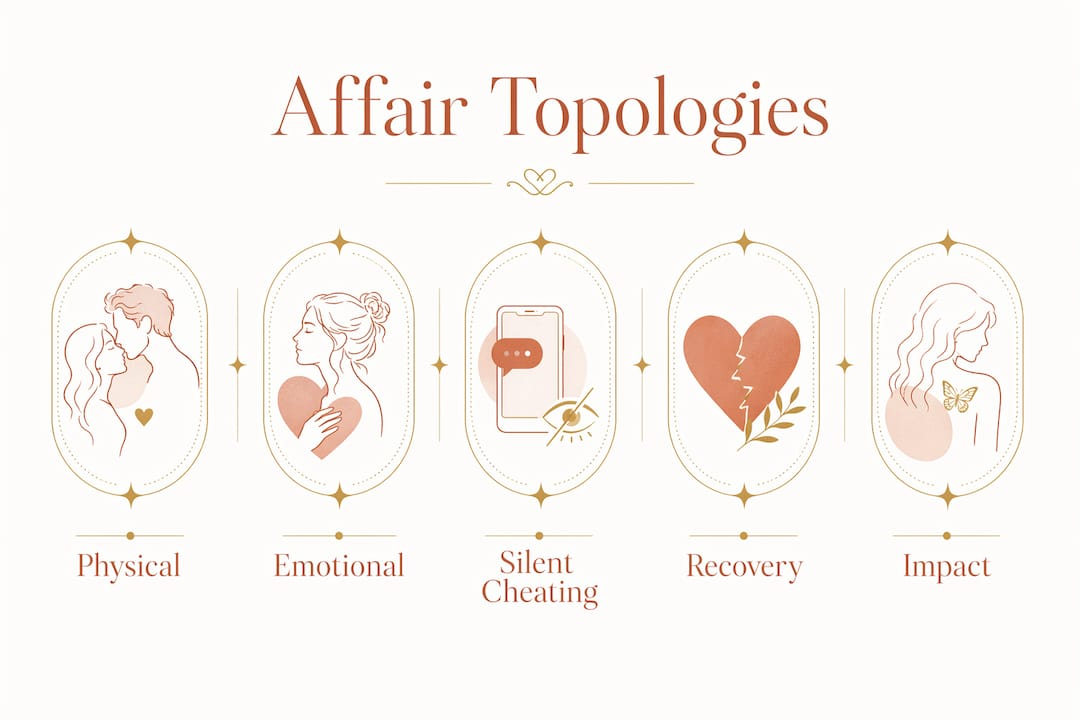
Infidelity researchers and clinicians use the term “affair topology” to describe the structural type of a betrayal. Think of it as a map of cheating behaviors, each with its own boundaries, emotional weight, and consequences. Three core categories cover most relationship betrayals.
Physical affairs involve sexual contact outside the primary relationship. They may be a single encounter or an ongoing arrangement. The defining feature is bodily intimacy combined with secrecy. Physical affairs are often easier to identify because the evidence is concrete, but that clarity does not reduce the emotional damage.
Emotional affairs involve deep emotional intimacy with someone outside the relationship, without physical contact. Secret sharing, daily texting, and a sense of emotional priority given to the outside person all qualify. Emotional affairs signal unmet connection needs and poor relational boundaries. Many people find emotional affairs harder to recover from than physical ones, precisely because the betrayed partner struggles to name what was lost.
Silent cheating covers hidden behaviors that breach trust without a direct affair partner. Secret apps, hidden social media accounts, excessive pornography use, and covert financial relationships all fall here. About 35% of people report experiencing non-sexual but trust-breaking behaviors as infidelity. Silent cheating often links to intimacy fears or compulsive patterns rather than romantic pursuit.
| Type | Core feature | Emotional weight | Recovery focus |
|---|---|---|---|
| Physical affair | Sexual contact outside relationship | High, concrete betrayal | Rebuilding physical trust and safety |
| Emotional affair | Intimate bond without physical contact | High, often harder to name | Addressing unmet attachment needs |
| Silent cheating | Hidden behaviors, no direct partner | Moderate to high, diffuse | Identifying compulsion or avoidance patterns |
Pro Tip: If you are unsure which category applies, ask this question: “Was something hidden from me that would have changed how I felt about the relationship?” A yes answer confirms a breach of trust, regardless of physical contact.
How do affair patterns differ by gender and psychology?
Gender shapes which topology appears most often, and why. Approximately 80% of female affairs combine both physical and emotional intimacy, often connected to long-term self-abandonment within the primary relationship. Women in this pattern frequently describe feeling invisible or emotionally starved before the affair began. The outside relationship becomes a place where they feel seen.
Male affairs tend to be more compartmentalized. They are more often purely physical, treated as separate from the primary relationship rather than a replacement for it. This does not mean male affairs cause less damage. It means the psychological architecture is different, which changes what recovery requires.
Depth psychology offers a framework that applies across genders. Affairs may represent an eruption of the shadow self, revealing suppressed desires or emotions that the conscious self cannot integrate. The affair partner is not the cause of the betrayal. They function as a screen onto which the unfaithful partner projects a suppressed version of themselves.
“The affair partner often is not the cause but a screen for the unfaithful partner’s own internal conflict. The affair is a projection of the shadow self, a part of the person they have not yet been able to acknowledge or integrate consciously.”
This framing removes some of the obsessive focus on the affair partner and redirects attention to the internal work the unfaithful partner needs to do. Affair partners often seek power or healing for early life wounds, which helps explain their role in the triangle without excusing the behavior.
- Female affairs: most often combine emotional and physical intimacy, linked to self-abandonment
- Male affairs: more often compartmentalized and physical, treated as separate from primary bond
- Both genders: the affair partner functions as a psychological projection, not the root cause
- Depth psychology frames the affair as a shadow eruption requiring internal integration
- Recovery differs by gender because the underlying need driving the affair differs
What is the impact of different infidelity topologies on relationships?
The impact of cheating is not uniform. The topology of the affair determines which wounds run deepest and which recovery tools work best. Betrayal through infidelity is the leading cited reason for relationship breakups, and it carries long-term mental health risks including depression, anxiety, and PTSD.
The betrayed partner’s brain responds to discovery as a threat event. Betrayal induces a neurological reality collapse, causing the betrayed partner to lose their perception of their partner, their self-identity, and their worldview of the relationship. This is not metaphor. The brain treats the closest attachment figure as a source of danger, triggering chronic hypervigilance and distorted perception of ordinary behaviors.
Emotional affairs produce a specific wound: the betrayed partner often feels replaced in the most personal sense. Physical contact can be minimized as “just sex,” but learning that your partner shared their inner world with someone else attacks the foundation of intimacy itself. Emotional affairs indicate unmet attachment needs, while silent cheating suggests intimacy fears or addiction patterns. Each topology points to a different root cause and requires a different therapeutic response.
Pro Tip: If you are experiencing hypervigilance after betrayal, such as checking your partner’s phone repeatedly or reading threat into neutral behavior, this is a neurological response, not a character flaw. Trauma-informed therapy addresses this directly. Resources on complex trauma after betrayal explain what is happening in your nervous system.
The long-term risks are real but not inevitable. People who receive targeted support matched to their affair topology recover faster and more completely than those who use a generic approach. The type of affair you experienced is not just a detail. It is a clinical variable.
How can you recognize and address different affair types?
Recognizing the topology of a betrayal requires looking at four variables: secrecy level, duration, emotional involvement, and whether a specific outside person was involved. A one-night physical encounter differs structurally from a two-year emotional affair, and both differ from years of hidden pornography use. Getting this clear is not about ranking pain. It is about choosing the right recovery path.
Digital technology has made infidelity easier to conduct and easier to conceal. This means couples need explicit conversations about what fidelity means to them, including digital and emotional boundaries. What one partner considers harmless texting, the other may experience as a breach. These conversations are not signs of distrust. They are the foundation of a shared definition.
- Identify the type by asking: Was there physical contact? Was there emotional intimacy? Were behaviors hidden?
- Assess duration: a single event and a long-term pattern require different responses
- Note whether a specific person was involved or whether the behavior was compulsive and directionless
- Avoid demanding a full account of every detail. Interrogating minute details traps betrayed partners in trauma cycles rather than supporting healing
- Seek support matched to the topology: emotional affair recovery differs from recovery after a physical affair
Setting boundaries after betrayal works best when they are specific and tied to the affair type. After a silent cheating pattern, boundaries around device use and transparency are central. After an emotional affair, boundaries around outside friendships and communication frequency matter most. After a physical affair, rebuilding physical safety and trust in the body of the relationship takes priority.
Pro Tip: Before your first therapy session, write down which category you believe applies and what specific behaviors crossed your boundary. This gives your therapist a clear starting point and saves weeks of exploratory work. Aftertheaffair’s guide on healing after infidelity includes a structured self-assessment to help you do exactly this.
Rebuilding trust after betrayal also benefits from understanding how to communicate after an affair. The conversation structure matters as much as the content. Couples who approach this with a framework rather than raw emotion make measurable progress faster. For those navigating the decision of whether to stay or leave, the stages of healing resource from Aftertheaffair maps the process clearly.

Key Takeaways
Naming the specific topology of an affair is the most direct route to choosing a recovery approach that actually matches the wound.
| Point | Details |
|---|---|
| Three core topologies | Physical, emotional, and silent cheating each carry distinct causes and recovery needs. |
| Gender patterns matter | Female affairs most often combine emotional and physical intimacy; male affairs tend to be compartmentalized. |
| Neurological impact is real | Betrayal triggers identity collapse and hypervigilance, which require trauma-informed support. |
| Avoid detail interrogation | Demanding a full account of the affair increases trauma rather than resolving it. |
| Match recovery to topology | Emotional affairs, physical affairs, and silent cheating each require different therapeutic responses. |
Why categorizing affair types changed how I think about healing
When I first started working with people after betrayal, I noticed something consistent. The ones who struggled longest were not necessarily those who experienced the most severe affairs. They were the ones who could not name what had happened to them. They kept circling the same questions: “Was it really that bad?” “Does it count if there was no sex?” That uncertainty was its own kind of damage.
Categorizing affair types is not about creating a hierarchy of pain. It is about giving people a language for their experience. Once someone can say “this was an emotional affair, and that means my partner chose someone else as their primary emotional confidant,” the grief becomes specific. Specific grief can be processed. Vague betrayal just festers.
What depth psychology adds to this picture is genuinely useful. The idea that affairs erupt from unintegrated shadow does not excuse the unfaithful partner. It does, however, redirect the recovery conversation away from “how could you do this to me” and toward “what was happening inside you that made this feel necessary.” That shift is where real change becomes possible.
I also think the concept of silent cheating deserves more attention than it gets. Many people in this situation spend years wondering if they are overreacting, because there was no affair partner to point to. The hidden behavior was real. The breach of trust was real. The topology framework validates that experience directly.
The most important thing I have observed is this: people do not need to restore the old relationship. They need to build a new one, with clearer foundations. That process starts with understanding exactly what broke and why. Topology gives you that map. What you do with it is up to you.
— S.J.Howe
Aftertheaffair’s resources for infidelity recovery
Knowing the type of affair you experienced is one thing. Having a structured path forward is another.
Aftertheaffair offers the 7-step infidelity recovery checklist as a practical starting point, covering the key phases from initial crisis through to rebuilding trust. For those working on the relationship itself, the relationship growth guide addresses how couples move from surviving betrayal to building something stronger. Therapists and counselors supporting clients through this process will find the clinical guidance resource particularly useful. Each resource is matched to a specific stage of recovery, so you are not reading general advice. You are reading what applies to where you are right now.
FAQ
What are the main types of affairs in infidelity research?
The three main categories are physical affairs, emotional affairs, and silent cheating. Each differs in the nature of the betrayal, the emotional impact, and the recovery approach required.
Is an emotional affair as damaging as a physical one?
Emotional affairs are frequently described as more painful than physical ones because they involve the loss of emotional intimacy, not just physical fidelity. Research links emotional affairs to unmet attachment needs, which makes the wound feel more personal.
What is silent cheating?
Silent cheating refers to hidden behaviors that breach trust without a direct affair partner, such as secret messaging, hidden accounts, or compulsive pornography use. About 35% of people identify non-sexual trust-breaking behaviors as infidelity.
Why do women’s affairs differ from men’s affairs?
Approximately 80% of female affairs combine physical and emotional intimacy, often linked to long-term self-abandonment. Male affairs tend to be more compartmentalized and physical, reflecting different underlying needs.
Should I ask my partner for all the details of the affair?
Clinical experience advises against it. Interrogating minute details traps betrayed partners in trauma cycles and hinders healing. Accepting the fact of the betrayal and focusing on recovery is more effective than treating it as a mystery to solve.
Recommended
- How to Recognize Each Type of Affair – After the Affair Series
- Recognize the Affair Type – After the Affair Series
- Are Certain Personality Types More Likely to Cheat?
- Repeated infidelity: causes, impacts & recovery in 2026 – After the Affair Series