TL;DR:
- Discovering a partner’s affair fractures your sense of safety and activates trauma responses similar to PTSD. Recognizing betrayal trauma symptoms helps validate your experience and guides effective healing, which can take 18 to 24 months with proper support. Structured therapeutic and emotional strategies, including attachment-focused therapy, are crucial for genuine recovery and rebuilding trust.
- Key Takeaways
- Recognizing betrayal trauma and emotional symptoms
- Preparing to manage emotions: Foundations for healing
- Step-by-step strategies for managing difficult emotions
- Common pitfalls and mistakes in emotion management post-affair
- Why standard advice falls short and what actually works
- Frequently asked questions
The moment you discover a partner’s affair, something inside you fractures. Shame, rage, and intrusive mental images don’t just appear occasionally; they flood your entire day, making it nearly impossible to eat, sleep, or think clearly. Betrayal trauma symptoms include emotional flooding, intrusive thoughts, hypervigilance, dissociation, and rage cycles that mirror PTSD but operate in the relational space you once felt safest. This article walks you through exactly how to recognize what you’re experiencing, build a practical foundation for healing, and apply step-by-step strategies that actually work. As you navigate this journey, remember that rebuilding after betrayal is possible and essential for emotional restoration.
Key Takeaways
| Point | Details |
|---|---|
| Validate betrayal trauma | Recognizing the symptoms and causes of betrayal trauma is the first step toward healing after infidelity. |
| Set realistic recovery timelines | Expect a healing process that may take up to two years, with challenging trigger stages along the way. |
| Adopt attachment-focused therapy | Relational therapies like EFT deliver better results for betrayal trauma than standard PTSD strategies. |
| Avoid common mistakes | Delaying full disclosure and ignoring emotional triggers can worsen trauma and prolong recovery. |
| Use stepwise emotional strategies | Applying actionable steps and proven tools helps stabilize intense emotions and accelerate your healing. |
Recognizing betrayal trauma and emotional symptoms
Betrayal trauma is a specific psychological injury that occurs when someone you depend on for safety and security violates that trust at its core. It isn’t simply heartbreak or sadness. It attacks your nervous system, your sense of reality, and your ability to trust your own perceptions. Understanding what you’re dealing with is the essential first step because you cannot manage what you haven’t named.
The betrayal trauma symptoms that survivors commonly experience include:
- Emotional flooding: waves of intense emotion that feel completely uncontrollable, often triggered by small reminders
- Intrusive thoughts: unwanted, repetitive mental images or questions about the affair that break into daily life without warning
- Hypervigilance: a constant, exhausting state of alertness where you scan for threats, check phones, or monitor your partner’s movements obsessively
- Dissociation: feeling detached from your body or emotions, as though you’re watching your life from a distance
- Rage cycles: explosive anger followed by guilt or numbness, often cycling rapidly through the day
- Shame: a deep belief that you are somehow responsible, not good enough, or fundamentally flawed
These symptoms are not signs of weakness. They are your nervous system’s logical response to a profound threat.
“Betrayal trauma is not just emotional pain. It is a relational injury that activates the same neurological alarm systems as life-threatening events, which is why survivors often meet the clinical criteria for PTSD even when the betrayal involved no physical danger.”
Compare betrayal trauma to ordinary grief or workplace stress and you’ll immediately see why generic coping advice often misses the mark:
The stages of healing after infidelity are not linear, but research offers a general timeline worth understanding:
| Feature | General stress or grief | Betrayal trauma |
|---|---|---|
| Source | External loss or pressure | Internal relational rupture |
| Trust impact | Minimal | Severe and lasting |
| Physical symptoms | Fatigue, sadness | Hypervigilance, dissociation |
| Safety threat | Perceived | Felt as real and ongoing |
| Triggers | Situational | Relational and unpredictable |
| Treatment approach | General coping skills | Attachment-focused therapy |
What makes betrayal trauma especially disorienting is that your subjective experience carries more weight than the objective facts. Research confirms that subjective perception of betrayal independently predicts PTSD, depression, and dissociation, meaning how intensely you feel betrayed matters more than the duration of the affair or the number of incidents involved. Your pain is real and valid regardless of what anyone tells you about how “bad” it objectively was.
Learning how to begin processing trauma after infidelity starts with accepting that your symptoms make complete sense given the injury you’ve suffered.
Preparing to manage emotions: Foundations for healing
Once you recognize betrayal trauma, preparing a foundation ensures emotional management isn’t just reactive but thoughtfully structured. One of the most damaging things you can do right now is expect yourself to “be over it” in a few weeks. That expectation will crush you every time you still feel rage at month four or dissolve into tears at month nine.
| Healing stage | Approximate timeline | What to expect |
|---|---|---|
| Acute crisis | Weeks 1-6 | Emotional shock, numbness, disbelief, physical symptoms |
| Trigger storm | Months 2-8 | Intense triggers, intrusive thoughts, highest discouragement |
| Processing and meaning-making | Months 6-18 | Gradually regaining equilibrium, working through the “why” |
| New normal | Months 18-24+ | Rebuilding identity, making relationship decisions with clarity |
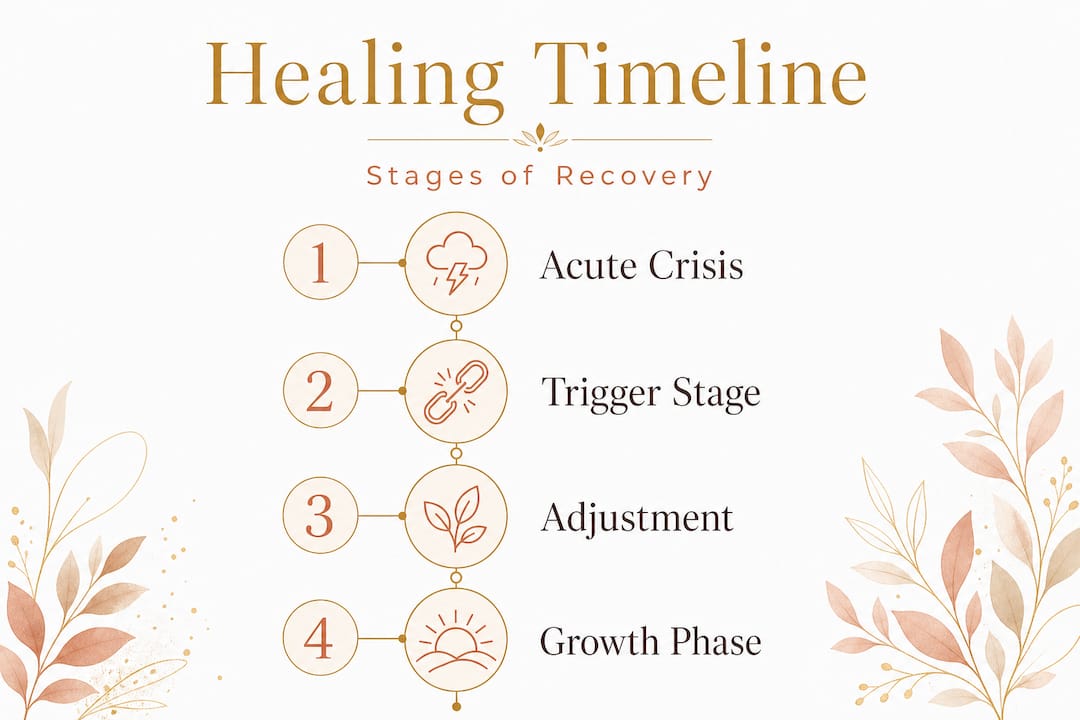
The rebuilding trust timeline benchmark consistently shows that recovery takes 18 to 24 months to reach a new normal, with the trigger stage being the hardest point where discouragement peaks. Knowing this in advance prevents you from catastrophizing your progress.
Here are the initial steps to stabilize your emotional state before attempting deeper processing:
- Secure physical basics: Sleep, nutrition, and hydration affect your emotional regulation capacity more than almost any therapeutic tool. Protect these ruthlessly.
- Identify one or two safe people: Choose individuals who can listen without judgment, without pushing you toward decisions before you’re ready.
- Create a crisis plan for flooding: Identify in advance what you’ll do when emotions spike suddenly. Walk outside, call someone, or use a grounding exercise. Having the plan before you need it reduces reactive decisions.
- Set boundaries on affair details for now: You may want all the information immediately, but absorbing too much too fast can compound trauma.
- Limit major life decisions: Do not make permanent choices about your relationship, living situation, or finances in the acute crisis phase.
Pro Tip: Push for full disclosure of the affair details in a structured, therapist-supported setting as early as possible. Discovering new details weeks or months later causes “staggered re-traumatization,” resetting your nervous system back to crisis level every time a new piece surfaces.
Step-by-step strategies for managing difficult emotions
With a foundation in place, let’s get into concrete strategies for regaining emotional control, one step at a time.
- Practice grounding techniques during flooding episodes. When a wave of emotion hits, try the 5-4-3-2-1 method: name five things you can see, four you can touch, three you can hear, two you can smell, and one you can taste. This pulls your attention back to the present moment and interrupts the nervous system’s alarm response.
- Use structured journaling to externalize intrusive thoughts. Set a timer for 20 minutes. Write every thought as it comes, including the angry, shameful, and repetitive ones. When the timer goes off, close the journal. This technique creates a container for intrusive content rather than letting it spill through the entire day.
- Implement scheduled “worry windows.” Designate a 30-minute window each day for thinking about the affair. When intrusive thoughts arrive outside that window, acknowledge them and redirect: “I’ll think about that during my worry window.” This reduces the all-day mental occupation that exhaustion you.
- Engage in body-based regulation. Betrayal trauma is stored in the body, not just the mind. Regular movement, whether walking, swimming, or yoga, helps release the physical tension that accumulates alongside emotional pain.
- Enter therapy that is calibrated to relational trauma. Standard PTSD frameworks like CBT or exposure therapy are measurably less effective than relational therapies like Emotionally Focused Therapy (EFT) for attachment-based betrayal trauma. This distinction matters enormously when choosing support.
- Build a support ecosystem, not just a single support person. One person cannot carry everything. Consider combining individual therapy, a support group, trusted friends, and structured self-help resources.
Additional tools that support emotional recovery include:
- Emotionally Focused Therapy (EFT): specifically designed to address attachment injuries and relational ruptures
- EMDR (Eye Movement Desensitization and Reprocessing): helpful for processing traumatic memories once initial stabilization is achieved
- Somatic therapy: works directly with the body’s trauma storage
- Trauma-informed couples counseling: if you’re considering reconciliation
- Self-paced recovery programs and books: structured resources for between-session processing
Pro Tip: When selecting a therapist, specifically ask whether they have training in attachment theory or relational trauma. A therapist with only general counseling experience may inadvertently minimize your symptoms or push a timeline that doesn’t match the reality of betrayal trauma recovery.
For a fuller breakdown of daily coping after infidelity or a structured betrayal recovery guide, detailed resources can significantly accelerate your progress.
Common pitfalls and mistakes in emotion management post-affair
Even with good strategies, pitfalls can derail your recovery. Understanding the most common mistakes in advance gives you a genuine advantage.
Mistakes that most commonly disrupt healing:
- Delaying or avoiding full disclosure: If your partner reveals information piece by piece over weeks or months, each new detail re-traumatizes you from the beginning. Partial disclosure is not kindness. It prolongs the crisis.
- Minimizing your own trauma: Telling yourself “other people have it worse” or “it was just emotional, not physical” dismisses the legitimacy of your pain and blocks genuine processing.
- Using emotional avoidance as a coping strategy: Throwing yourself into work, alcohol, or numbing behaviors creates the illusion of management while allowing the trauma to fester underneath.
- Skipping the trigger stage or labeling it as failure: The trigger stage feels like going backward, but it is a necessary phase of integration. Many people interpret heightened triggering at months three to six as proof that they will never heal.
- Making permanent decisions in the acute crisis phase: Decisions made in crisis rarely reflect your actual values or long-term needs.
- Pressuring yourself to forgive on a timetable: Forgiveness, if it comes, is a byproduct of genuine healing, not a strategy to rush it.
“The trigger stage is the point where discouragement peaks and where most people make the decision to give up on recovery entirely, precisely when they are closest to a turning point. Understanding that the 18 to 24 month timeline is normal prevents premature exit from the healing process.”
Understanding the importance of full disclosure is not just about honesty. It is a clinical and practical requirement for avoiding staggered trauma. Review the affair recovery disclosure steps if you’re unsure how to structure that conversation safely.
Why standard advice falls short and what actually works
Here is what most articles won’t tell you: the standard advice circulating in self-help culture, “practice self-care,” “journal your feelings,” “give it time,” is not wrong, but it is radically insufficient for betrayal trauma. And following insufficient advice while expecting sufficient results is one of the most discouraging experiences a survivor can have.
Betrayal trauma is not fundamentally an individual wound. It is a relational one. It happened inside a relationship, inside an attachment bond, and it dismantled the nervous system’s baseline assumption of safety within that bond. You cannot fully heal it alone, and individual-focused therapies that treat it like generalized PTSD often miss the relational dimension entirely.
This is why Emotionally Focused Therapy consistently outperforms standard anxiety or trauma interventions for affair recovery. EFT works directly with attachment needs, the emotional logic underneath the rage, the grief, and the hypervigilance. It doesn’t just teach coping skills. It restructures the emotional patterns that betrayal has destabilized.
The uncomfortable truth is that many survivors spend years in individual therapy processing the same material without moving forward because the therapy is addressing the symptom rather than the attachment injury. That’s not the therapist’s fault if they haven’t been trained in relational trauma. It’s simply a mismatch between the tool and the problem.
What actually drives lasting relationship growth after infidelity is a combination of relational therapeutic support, structured disclosure handled compassionately, genuine transparency after betrayal from the partner who caused the harm, and a realistic timeline that doesn’t punish you for still feeling pain at month twelve.
Pro Tip: If you’re currently in therapy and feeling stuck, it is entirely appropriate to ask your therapist whether they have specific training in attachment-based or relational trauma approaches. That single question could redirect your entire recovery trajectory.
Explore resources for your healing journey
You don’t have to piece together your recovery from scattered blog posts and generic advice. Structured, evidence-informed guidance designed specifically for betrayal trauma survivors makes an enormous difference, especially during the hardest stages.
At After the Affair, we’ve built resources that meet you exactly where you are, whether you’re still in the acute crisis phase or working through what your relationship means to you now. Our recovery books walk through survival, decision-making, transformation, and growth in a sequence that mirrors the actual stages of healing. If you’re looking for a starting point, explore the stages of healing after infidelity or dive into a structured betrayal recovery guide to get a clear, compassionate roadmap for where you are right now.
Frequently asked questions
What are the most common emotional symptoms after an affair?
Emotional flooding, intrusive thoughts, hypervigilance, rage cycles, dissociation, and shame are the most frequently reported symptoms, closely resembling relational PTSD in both intensity and impact on daily functioning.
How long does recovery from betrayal trauma usually take?
Recovery typically follows an 18 to 24 month timeline to reach a new normal, with the trigger stage, usually between months two and eight, being the hardest and most discouraging phase of the process.
Are PTSD therapies effective for betrayal trauma?
Standard individual PTSD therapies are less effective than relational approaches like Emotionally Focused Therapy because betrayal trauma is an attachment injury that requires relational, not just individual, intervention.
Can personal perception impact emotional trauma severity?
Yes, significantly. Your subjective perception of betrayal predicts trauma severity, depression, and dissociation independently of the objective facts of the affair, meaning your pain does not require external validation to be real.
Recommended
- Therapist tips for affair recovery: heal and rebuild trust
- Effective tips for emotional healing after infidelity
- Effective tips for emotional healing after infidelity
- How to Guide Clients After Infidelity for Healing – After the Affair Series