TL;DR:
- Recovering from infidelity requires a structured and patient process centered on emotional safety, accountability, and consistent effort over time. Building trust involves ongoing regulation of emotions, clear boundaries, and small, meaningful actions rather than single conversations or quick fixes. Long-term healing typically spans two to four years and demands sustained commitment and specialized support.
- Key Takeaways
- Understanding relationship repair after betrayal
- Preparing to repair your relationship after infidelity
- Step-by-step approach to repairing your relationship after infidelity
- Common challenges and realistic timelines in repairing after infidelity
- Verifying progress and sustaining repair long term
- Why most relationship repair advice misses the mark after infidelity
- Frequently asked questions
Discovering a partner’s infidelity is one of the most disorienting experiences a person can face. The ground shifts. What felt certain no longer is. Knowing how to repair relationship trust after that kind of betrayal is not simply a matter of saying the right things or having one honest conversation. It requires a structured, patient process built on emotional safety, accountability, and consistent action over time. This guide walks you through exactly that process, grounded in research and clinical experience, so you can move forward with clarity instead of guesswork
Key Takeaways
| Point | Details |
|---|---|
| Repair is a process | Effective relationship repair after infidelity requires repeated, consistent behavior change over months or years, not a single conversation. |
| Emotional safety first | Establishing clear boundaries and transparency creates the foundational safety needed before deeper connection can resume. |
| Use structured phases | Following a sequence of atonement, attunement, and attachment supports gradual healing and rebuilds trust systematically. |
| Avoid rushing forgiveness | Forgiveness emerges naturally after trust is restored through consistent actions and emotional regulation. |
| Professional support helps | Trauma-informed therapy aids in managing betrayal impacts and guides couples through the complex repair journey. |
Understanding relationship repair after betrayal
Relationship repair is not a single event. It is an ongoing practice of restoring emotional connection after rupture, and after infidelity, those ruptures run deep. Before any productive conversation can happen, both partners need to regulate their nervous systems. Attempting to talk through betrayal while flooded with anger or grief rarely leads anywhere useful.
According to NPR’s Life Kit, repair requires regulating emotions first, then taking turns sharing feelings in a structured, safe way. That “taking turns” piece matters more than most people realize. When both partners talk at once, or when one partner dominates the emotional space, nothing gets heard. The conversation becomes a collision, not a connection.
Trust does not return because of a single apology or a tearful night. Repair transforms disconnection into intimacy through consistency over time. That means repeated, regulated communication. It means empathy showing up not just in grand gestures, but in small, daily moments. Think of repair as a muscle. A couple that practices it regularly, even in low-stakes moments, builds the capacity to handle high-stakes ones.
Key foundations of relationship repair include:
- Emotional regulation before every repair conversation
- Empathy that acknowledges the other person’s pain without defensiveness
- Sincere accountability from the partner who caused harm
- Patience with the non-linear nature of healing
- Consistency over time rather than one-time declarations
Explore what relationship growth after infidelity can genuinely look like when these foundations are in place.
Pro Tip: Before any repair conversation, both partners should spend at least five minutes in a calming activity, breathing exercises, a short walk, or quiet time alone. This is not avoidance. It is preparation.
Preparing to repair your relationship after infidelity
Wanting to repair the relationship is not enough to begin repairing it. Preparation matters enormously, and skipping it is one of the most common ways couples stumble early. The first question to ask is whether the environment is currently safe for repair. That means emotionally safe, not just physically.
Repair attempts require safety, respect, and emotional reciprocity. Asking someone to change who they are rarely works. Asking for specific, observable behavior changes does. There is a meaningful difference between “I need you to be more honest” and “I need you to show me your phone when I ask, for the next six months.” The first is a wish. The second is a workable commitment.
The unfaithful partner has a non-negotiable first step: cutting all ties with the affair partner, immediately and without conditions. No gradual distance. No maintained friendship. Full transparency, including access to communication channels the betrayed partner requests, is what begins to establish safety. Without this, no amount of emotional effort from either side will hold.
Steps to prepare for repair work:
- Assess safety first. If ongoing deception, manipulation, or emotional abuse is present, address that before anything else.
- End affair contact completely. The unfaithful partner must cut all ties with no exceptions.
- Establish transparency agreements. Decide what information-sharing looks like for both partners moving forward.
- Build emotional self-care practices. Both partners need individual regulation strategies before joint repair work begins.
- Request specific behavior changes. Name what you need in concrete, observable terms rather than vague emotional language.
Understanding the role of boundaries after betrayal can help you put specific, workable boundaries in place before the repair work begins.
Pro Tip: Write down three specific behavior changes you need to see before you feel safe enough to engage in repair conversations. Sharing this list, rather than discussing it verbally in a heated moment, reduces misunderstanding significantly.
Step-by-step approach to repairing your relationship after infidelity
One of the most useful frameworks for ways to fix a relationship after infidelity organizes recovery into three phases: atone, attune, and attach. Each phase has distinct goals, and trying to skip to a later phase before completing an earlier one almost always creates setbacks.
Phase 1: Atone. This phase is about honesty, accountability, and clearing what therapists sometimes call “emotional rubble.” The unfaithful partner answers difficult questions fully, takes responsibility without deflecting, and demonstrates through behavior that the affair is over. The betrayed partner is allowed to feel the full weight of their pain without being rushed toward forgiveness.
Phase 2: Attune. Once some basic safety is established, the focus shifts to emotional understanding. This means infidelity recovery progresses into learning what each partner’s emotional experience actually looks like, interrupting destructive conflict cycles before they escalate, and rebuilding the habit of turning toward each other rather than away.
Phase 3: Attach. The final phase focuses on rebuilding intimacy gradually, physical, emotional, and relational. Couples create new rituals, shared experiences, and rebuilt shared meaning. This is where a relationship begins to feel like more than a repair project.
| Phase | Focus | Key actions |
|---|---|---|
| Atone | Accountability and honesty | Full disclosure, ending affair, answering questions |
| Attune | Emotional reconnection | Empathy work, conflict interruption, active listening |
| Attach | Intimacy and new rituals | Physical closeness, shared meaning, future building |
Trust rebuilds through consistent behaviors and repair after conflict over time, not through a single conversation where forgiveness is declared. The infidelity recovery checklist breaks this process into practical, trackable steps. A trust rebuilding guide can also support you in mapping the specific actions each phase requires.
Pro Tip: During the attune phase, try a weekly 20-minute check-in where each partner shares one emotional experience from the week without interruption. Set a timer. This structure prevents one partner from carrying the emotional load of every conversation.
Common challenges and realistic timelines in repairing after infidelity
Most people underestimate how long infidelity recovery takes. Not because they are fragile or doing it wrong, but because the wound is genuinely deep. Active recovery typically spans two to four years of intentional effort, supported by therapy and consistent repair practices. Expecting to feel normal again within weeks is one of the most common and painful mistakes couples make.
Rushing forgiveness without rebuilt trust usually backfires. Forgiveness that comes before safety is re-established can feel to the betrayed partner like pressure to minimize their pain. Genuine change shows through actions over months, not declarations made in the first weeks.
Common mistakes to watch for:
- Rushing forgiveness before trust has actually been rebuilt through behavior
- Over-explaining the affair in ways that retraumatize rather than clarify
- Making vague promises like “I’ll be better” without naming specific actions
- Expecting linear progress when healing naturally involves setbacks and difficult waves
- Withdrawing from support by isolating from therapy, trusted friends, or resources during hard stretches
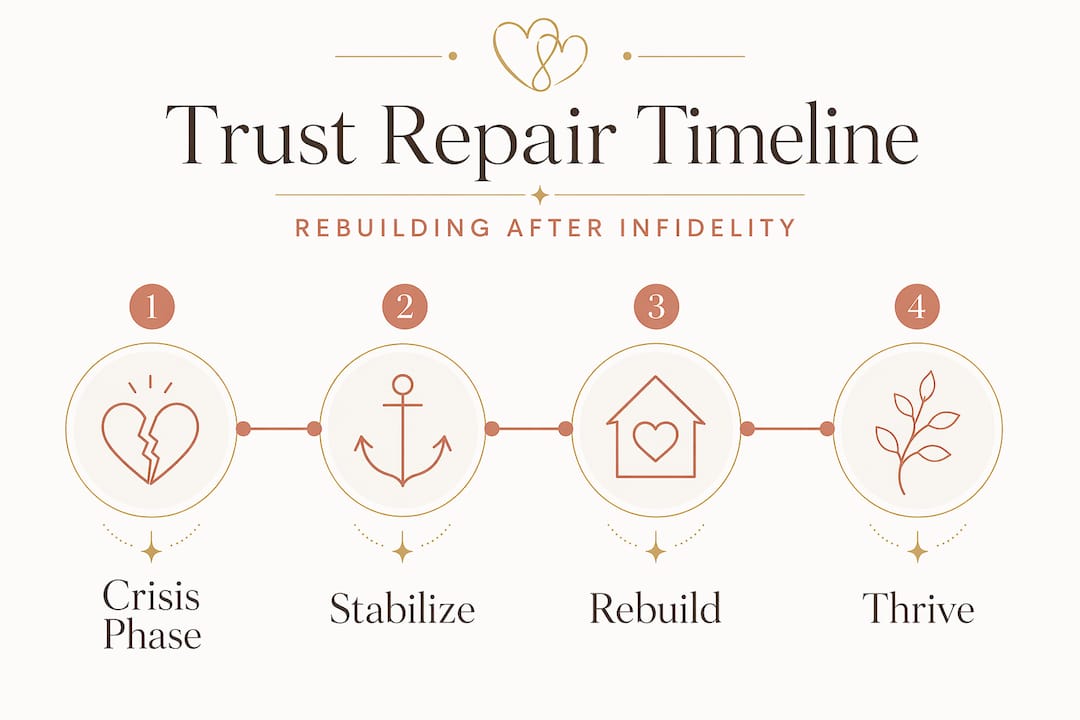
Here is a realistic sense of where most couples find themselves at different points in the process:
| Timeline | Typical experience |
|---|---|
| 0 to 3 months | Crisis phase: high emotional reactivity, establishing basic safety |
| 3 to 6 months | Beginning to talk more structurally, first signs of emotional regulation |
| 6 to 12 months | Attunement work deepens, conflict cycles start to shift |
| 12 to 24 months | Attachment rebuilding, new rituals forming, trust becoming more consistent |
| 2 to 4 years | Integrated recovery, relationship either strongly rebuilt or consciously ended |
The rebuilding trust timeline offers a more detailed breakdown of what to expect at each stage. If you prefer a structured sequence of actions, the betrayal recovery step-by-step guide walks through each phase with specificity.
Pro Tip: Track your progress by writing a brief weekly note about one moment of connection and one moment of difficulty. Reviewing these notes at the three-month mark often reveals forward movement that is invisible day to day.
Verifying progress and sustaining repair long term
One of the quieter challenges in relationship repair is knowing whether things are actually getting better or whether both partners are just getting better at avoiding the hard parts. Real progress has observable markers. And knowing what to look for keeps the work honest.
Effective repair shows in small promises kept and reduced emotional reactivity during conflict over time. There is no finish line. Repair becomes a relational habit rather than a project with an end date. The couples who sustain it long term treat it that way.
Signs of genuine progress include:
- Follow-through on small commitments is consistent and no longer requires reminders
- Conflict de-escalates faster than it used to, with fewer days needed to recover
- Empathy appears more naturally in both partners during disagreements
- Emotional flooding during triggers is less intense and less frequent
- Requests for reassurance from the betrayed partner are met with patience rather than frustration
Repair requires shifting from reacting automatically to pausing and choosing connection over being right. That pause, however brief, is the moment where real repair happens. Training yourself to recognize your triggers before you act on them is one of the highest-value skills either partner can develop.
The relationship healing process outlines what sustained repair looks like in practice. Therapists and counselors looking to support clients through this can also find structured frameworks in the guide clients after infidelity resource.
Pro Tip: When you notice a trigger rising, try naming it out loud to your partner before you react: “I’m being triggered right now and I need five minutes.” This one sentence prevents more conflict than almost any other single repair skill.
Why most relationship repair advice misses the mark after infidelity
Here is what most guides on how to mend relationship problems will not tell you: general relationship repair advice was not designed for what infidelity does to the body. Not just the heart. The body.
Betrayal trauma places the nervous system into a state of high alert that resembles post-traumatic stress. The betrayed partner may experience hypervigilance, intrusive thoughts, and physical panic responses that have nothing to do with poor communication skills. Betrayal trauma impacts nervous system states in ways that require trauma-informed therapy, not just better listening techniques.
When generic advice tells couples to “have an honest conversation,” it assumes both partners can access calm, rational communication. After infidelity, that access is often genuinely impaired. Pushing toward vulnerable dialogue before the nervous system is regulated does not build connection. It frequently retraumatizes the betrayed partner and creates more distance.
The idea that one “big talk” can reset the relationship is particularly damaging. Repair is not a single conversation but a pattern of repeated, regulated reconnection over time. What actually works is small, consistent contact: moments of empathy, accountability, and genuine presence, repeated until the body learns to feel safe again.
Couples counseling helps, but the type of counseling matters. Therapists trained specifically in infidelity recovery or trauma-informed couples work operate very differently from general marriage counselors. Explore the therapy types for infidelity trauma to understand what specialized support actually involves.
The couples who repair most successfully are not those who are most naturally compatible. They are the ones who accept that this level of injury requires a proportional level of intentional, sustained effort, and who stop waiting for a moment when repair feels easy.

Discover structured support for healing after infidelity
If you have read this far, you already understand that repairing a relationship after infidelity is not something to figure out alone on a difficult night. It takes structured guidance built specifically for this kind of wound.
At After the Affair, the resources are designed with exactly that in mind. Start with the infidelity recovery checklist to turn an overwhelming process into clear, manageable steps. When you are ready to look further ahead, the relationship growth after infidelity guide explores what a genuinely rebuilt relationship can look like. Therapists and support professionals will find the guide clients after infidelity resource an invaluable clinical companion. Healing is possible. The right tools make the difference between surviving this and genuinely moving through it.
Frequently asked questions
How long does it typically take to repair a relationship after infidelity?
Active recovery spans two to four years for most couples, involving consistent behavioral change and emotional repair work rather than any single turning point. Expecting faster results without sustained effort usually prolongs the pain rather than shortening it.
What are the first steps to take when trying to repair a relationship after betrayal?
The immediate priorities are establishing emotional safety through clear boundaries and full transparency, with the unfaithful partner cutting all ties with the affair partner right away. Honest accountability and regulated communication follow from that foundation, not the other way around.
Can repair happen without professional help after infidelity?
Some couples navigate early stages independently, but specialized therapy is essential for many to address the complex emotional and physiological impacts of betrayal. The nervous system disruption infidelity creates often exceeds what self-guided repair alone can reach.
Why is forgiveness not the first step in healing after infidelity?
Forgiveness that arrives before trust is rebuilt through consistent behavior can actually retraumatize the betrayed partner by pressuring them to minimize their pain. As forgiveness is the destination, not the starting point, it emerges naturally when emotional safety and accountability are firmly established first.
Recommended
- Relationship Growth After Infidelity – After the Affair Series
- Rebuilding Trust Timeline – After the Affair Series
- Trust Rebuilding Guide: Steps to Heal After Infidelity
- Relationship Healing Process – After the Affair Series