TL;DR:
- Discovering betrayal can destabilize an individual, requiring emotional groundwork before forgiveness. Forgiveness is a gradual internal process that involves accountability, safety, and understanding, not rushing or superficial acceptance. Long-term healing depends on consistent actions, honest communication, and respecting each partner’s emotional timeline, whether choosing reconciliation or separation.
Discovering that someone you trusted has cheated on you is one of the most destabilizing experiences a person can face. The forgiving after cheating steps that matter most aren’t the ones you rush through in a desperate attempt to feel normal again — they’re the ones that actually rebuild emotional safety from the ground up. Forgiveness after betrayal is rarely simple or immediate; it unfolds gradually alongside healing, understanding, and the slow reconstruction of trust. This guide gives you a clear, honest roadmap for that process.
- Key Takeaways
- Understanding forgiveness after infidelity
- Preparing yourself emotionally to forgive
- Step-by-step actions to forgive and rebuild trust
- Common challenges and how to overcome them
- Verifying progress and sustaining healing long term
- The misunderstood truths about forgiveness after cheating
- Frequently asked questions
Key Takeaways
| Point | Details |
|---|---|
| Forgiveness is a process | Forgiveness after cheating unfolds gradually and cannot be rushed or demanded. |
| Accountability is essential | The partner who cheated must take full responsibility and show consistent, trustworthy behavior. |
| Emotional safety is key | Rebuilding safety and trust must come before genuine forgiveness can occur. |
| Differentiate forgiveness vs reconciliation | You can forgive internally without choosing to continue the relationship, and vice versa. |
| Professional support helps | Therapy and structured guidance increase the chances of healing and informed decisions. |
Understanding forgiveness after infidelity
Before anything else, you need to know what forgiveness actually is in this context — and what it is not. Most people confuse forgiveness with acceptance, or worse, with letting someone off the hook. Forgiveness is an internal process. It’s the gradual release of the corrosive anger and grief that poisons your own life when you hold them at full force for too long. It does not mean the behavior was acceptable. It does not mean you owe your partner a second chance.
One of the most important distinctions in understanding forgiveness after affair recovery is separating forgiveness from reconciliation. You can forgive and still leave. You can also stay without having fully forgiven yet. These are two separate tracks, and conflating them puts unfair pressure on the entire healing process.
Here’s what genuine forgiveness in this context requires:
- Accountability from the person who cheated. Forgiveness without accountability is just suppression wearing a different name.
- Your hurt must be witnessed. Not explained away, not minimized — actually seen and acknowledged.
- Your emotional timeline must be respected. No one gets to decide how long your grief takes.
- Safety must come before softening. You cannot move toward forgiveness while you still feel emotionally unsafe.
As the research on betrayal consequences shows, betrayal operates at an identity level, not just a relational one. It shakes your fundamental sense of reality. Rushing forgiveness can violate emotional sovereignty and becomes a second injury on top of the first.
Preparing yourself emotionally to forgive
Before you can work through the forgiving after cheating steps with your partner, you have to do significant work inside yourself. This is not optional groundwork. It’s the foundation everything else rests on.
- Allow every emotion without editing it. Anger, grief, disgust, shame, even love — all of it is valid. Suppressing these emotions can delay healing and forgiveness. You don’t have to act on every feeling, but you do have to let yourself feel it.
- Seek understanding of the affair’s context. This is not about excusing what happened. It’s about moving from blind shock to a clearer picture, which reduces the power the unknown has over you. Understanding the “why” helps you make informed decisions about your future.
- Reconnect with your own needs and limits. Betrayal often collapses your sense of self. What do you need to feel safe? What are you no longer willing to accept? These aren’t rhetorical questions. Write them down.
- Consider professional support. A counselor trained in trauma understanding and healing gives you a space where you don’t have to manage anyone else’s emotions while processing your own. This matters more than people realize.
- Build a personal emotional safety plan. Before you sit down with your partner to discuss the affair, know in advance what you’ll do if the conversation becomes overwhelming. Have an exit strategy for moments that flood you.
This preparation work also feeds directly into processing emotional trauma after infidelity, which sits beneath every other piece of recovery. You can also explore coping after infidelity naturally for day-to-day stabilization strategies alongside this deeper work.
Pro Tip: Keep a private journal during this phase. Not to process publicly, but to track what you’re actually feeling week to week. People in early trauma often can’t see their own gradual progress. Written records make the growth visible.
Step-by-step actions to forgive and rebuild trust
Once your emotional foundation is partially in place, the forgiving partner after affair process becomes something you and your partner can engage in together — with structure.
- Full disclosure. Your partner must answer your questions honestly, fully, and without deflection. Partial truths discovered later cause more damage than the initial affair.
- Complete responsibility. No “but you” statements. No context that shifts blame. The person who cheated owns what they did, cleanly and without conditions.
- Active validation of your pain. Your partner must demonstrate they understand the specific impact of their actions — not just that you’re upset, but why and how deeply.
- Consistent transparency going forward. Open access to phones and accounts, honest accounting of time, proactive communication — not because you’ll check forever, but because rebuilding safety requires it during the critical window.
- Boundary setting and agreement. Both partners define what the relationship requires now. What contact with the affair partner is acceptable? What communication standards apply? These must be explicit.
- Trust accumulates through repeated action. Consistent reliable behaviors over time restore trust, not single grand gestures. One perfect weekend means very little. Six months of steady honesty means a great deal.
The rebuilding trust timeline varies for every couple, but research consistently shows that real recovery takes longer than most people expect. A trust rebuilding guide can help you navigate which phase you’re actually in versus where you wish you were.
Here’s how to distinguish forgiveness from reconciliation in practical terms:
| Forgiveness | Reconciliation |
|---|---|
| Internal emotional process | A joint decision about the relationship |
| Can happen without the partner’s involvement | Requires both partners’ active participation |
| Releases resentment for your own peace | Rebuilds the shared bond between two people |
| Can be reached without staying together | Only meaningful if trust is being restored |
| Timescale driven by your emotional readiness | Timescale driven by mutual progress |
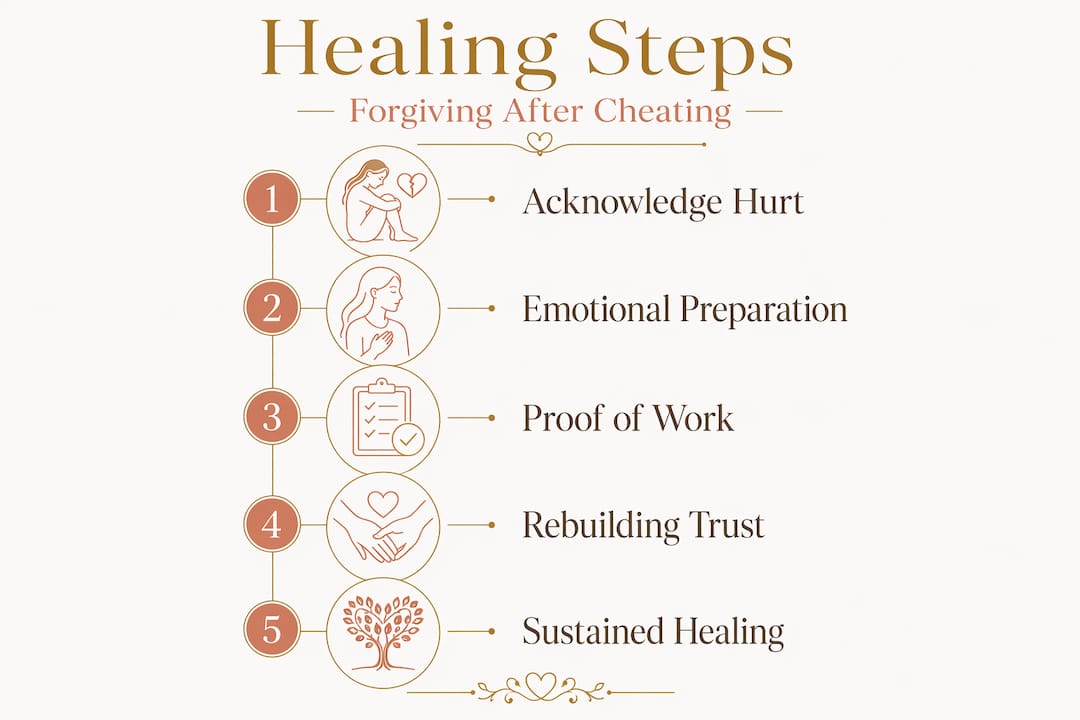
Pro Tip: Think of trust-rebuilding as a “proof-of-work” system. Each consistent, honest action is a deposit. There are no shortcuts, and there are no single actions large enough to replace sustained effort. Recognize when you’re seeing real deposits and when you’re being offered performance.
Common challenges and how to overcome them
Even when both partners genuinely want to heal, the path gets difficult. Knowing the obstacles ahead makes them less derailing when they arrive.
- Imposed timelines. “Aren’t you over this yet?” is one of the most damaging things a cheating partner can say. Healing cannot be scheduled. Pressure to forgive faster is not support — it’s a request for the betrayed partner to manage the cheating partner’s discomfort.
- Emotional flashbacks and triggers. A song, a location, a phrase can resurface the full intensity of the original pain. These aren’t signs you’re not healing. They’re normal trauma responses. Name them when they happen instead of reacting blindly.
- The Time Machine Error. This is the impulse to try to skip back to who you were before the affair and resume the relationship from there. It doesn’t work. You are changed. The relationship is changed. Healing forward looks different from healing back.
- Resentment loops. When the conversation keeps cycling back to the same arguments without resolution, it usually means something hasn’t been fully acknowledged. A third-party counselor can interrupt this loop more effectively than trying harder at the same conversations.
- Mistaking silence for peace. Sometimes couples stop fighting and call it progress. Real progress is marked by connection and openness, not just the absence of conflict.
“Treating forgiveness as a ‘next checklist item’ without rebuilding safety or answering key questions leads to stalled recovery and resentment cycles.”
The relationship healing process addresses many of these cycles directly. Recognizing which trap you’re in is usually the first step to getting out of it.
Pro Tip: When you feel triggered, use a simple grounding script: “I am feeling [emotion] because [trigger]. This is a memory response, not a current threat.” It doesn’t erase the feeling, but it adds a layer of awareness between the stimulus and your reaction.
Verifying progress and sustaining healing long term
How do you actually know you’re healing? And how do you keep that momentum going when the initial urgency fades? These are questions most articles skip over entirely.
Signs of genuine progress include:
- Communication has changed in structure, not just tone. You’re not just fighting less — you’re talking differently, with more honesty and less defensiveness on both sides.
- Transparency happens voluntarily. Your partner shares information without being asked. This is fundamentally different from answering questions when prompted.
- You have moments of actual connection again. Not forced. Not performed. Real ones, even if brief.
- You’re making choices from clarity rather than fear. Whether that’s choosing to stay or choosing to leave, the decision comes from insight rather than panic.
- Your sense of self is returning. You have interests, plans, and an identity outside this crisis.
The data on long-term recovery is sobering but also genuinely encouraging. Full recovery usually takes years of consistent work — and yet relationship satisfaction can actually surpass pre-affair levels when both partners genuinely commit. That’s not a given, but it is possible.
| Stage | What healthy progress looks like | Red flag signs |
|---|---|---|
| Early (0-3 months) | Emotions acknowledged, basic safety rules in place | Minimizing, blame-shifting, stonewalling |
| Mid (3-12 months) | Trust-building actions consistent, counseling active | Pressure to “move on,” repeated broken promises |
| Long-term (1+ years) | Genuine reconnection, individual growth visible | Resentment cycles, unresolved triggers, avoidance |
Investing in relationship growth after infidelity at this stage means looking beyond survival and asking what kind of relationship you actually want to build going forward.
Pro Tip: Do a quarterly check-in with yourself. Ask: “Am I healing, or am I just tolerating?” The answer shapes what you do next.
The misunderstood truths about forgiveness after cheating
Here’s what most articles won’t tell you: forgiveness is not a decision you make once and then carry out. That framing sets people up to feel like failures when the anger comes back a month after they declared themselves “over it.”
Forgiveness is better understood as something that happens to you — an experience that emerges when emotional safety has been genuinely restored and accountability has been genuinely given. You cannot will it into existence. You can only create the conditions for it.
The cultural narrative around infidelity forgiveness tends to center on the question of whether you’re a “big enough person” to forgive. That framing puts all the moral weight on the betrayed partner and quietly relieves the cheating partner of sustained responsibility. It’s worth noticing who benefits from that story.
What actually works is separating your internal healing from your external decision about the relationship. Your healing guide on forgiveness is yours. It belongs to you, not to the relationship. When you claim it that way, you stop waiting for your partner’s behavior to give you permission to feel better — which, ironically, often accelerates the healing itself.
Real change in a cheating partner shows up in consistent proof-of-work over months and years. It shows up in who they are on ordinary Tuesday afternoons, not in dramatic gestures during crisis. Your nervous system already knows the difference. Trust it.

Supporting your healing: resources and next steps
If this article has resonated with you, you don’t have to navigate the next phase alone or figure it out as you go.
At After the Affair, we’ve developed structured, evidence-informed resources built specifically for where you are right now. Whether you’re just beginning to process what happened or you’re further into recovery and need a clearer framework, our infidelity recovery checklist gives you a practical starting point grounded in real recovery principles. For couples working toward something better, our resources on relationship growth after infidelity map out what that actually looks like in practice. And if you’re a professional supporting someone through this, our guide for clients after infidelity offers clinical grounding for that work. Taking the next step now means less time in the dark.
Frequently asked questions
How long does it typically take to forgive a partner after cheating?
Forgiveness after infidelity usually takes months to years, with identity wounds healing on a timeline shaped by real repair work rather than time passing alone — there is no standard schedule.
Can you forgive a cheating partner but still decide not to stay in the relationship?
Yes. Forgiveness is freedom you give yourself, not a commitment to the relationship — you can fully forgive someone and still choose not to rebuild with them.
What is “proof of work” in the context of rebuilding trust after infidelity?
Proof of work means the consistent, observable actions a cheating partner takes over time, because repeated reliable behaviors are what the nervous system actually recognizes as real change, not words or one-time apologies.
Why is it harmful to rush forgiveness after infidelity?
Rushing forgiveness can violate emotional sovereignty — the most vulnerable part of you deserves to be witnessed and given time, not pushed past before it has been properly acknowledged.
How can professional therapy help after cheating?
Therapy provides a structured space to process trauma and improve communication, and it helps couples decide honestly and thoughtfully whether to rebuild or separate without either partner carrying that weight alone.
Recommended
- Understanding forgiveness after an affair: healing guide – After the Affair Series
- How to Guide Clients After Infidelity for Healing – After the Affair Series
- Trust Rebuilding Guide: Steps to Heal After Infidelity
- Rebuilding Trust Timeline – After the Affair Series