For many survivors of infidelity, the affair itself is not the whole story. There is a layer underneath it that runs deeper and takes longer to recover from.
TL;DR:
Many survivors of infidelity were not simply deceived about the affair. They were actively managed — told that their instincts were wrong, their concerns unfounded, their perception of reality unreliable — by the same person who was simultaneously conducting the deception. This is gaslighting, and it is a distinct and additional layer of trauma on top of the infidelity itself. This article explains what gaslighting looks like in the specific context of an ongoing affair, why it intensifies and complicates betrayal trauma, and what recovery from this particular layer requires.
- Key Takeaways
- What Gaslighting Means in the Context of Infidelity
- Why Gaslighting Happens Alongside Affairs
- How to Recognise It in Your Own History
- What the Gaslighting Layer Does to Betrayal Trauma
- The Specific Symptoms the Gaslighting Layer Produces
- Why This Layer Needs Separate Attention in Recovery
- FAQ
Key Takeaways
| Point | What this means for you |
|---|---|
| Gaslighting during an affair is common, not exceptional | Sustained deception almost always requires active management of the betrayed partner’s perception. |
| It is a distinct trauma layer, not just part of the affair | The gaslighting often produces different symptoms and requires different recovery work than the infidelity itself. |
| Your instincts were not wrong | They were managed. There is a meaningful difference. |
| Recovery from gaslighting requires naming it explicitly | Treating it as simply “part of the affair” allows it to continue doing damage underneath the surface. |
| The damage to reality-testing is real but reversible | With the right support, the capacity to trust your own perception can be rebuilt. |
What Gaslighting Means in the Context of Infidelity
Gaslighting as a term has entered common usage to the point where it has become imprecise. In the context of infidelity specifically, it is worth defining exactly what it means, because precision matters for recovery.
Gaslighting in an affair context refers to the systematic invalidation of the betrayed partner’s perception — their instincts, observations, concerns, and questions — by the partner conducting the affair, in order to maintain the deception.
It does not require conscious malice, though it sometimes involves it. It does not require dramatic scenes of confrontation and denial, though those occur. In its most common form, it is quieter and more plausible than the dramatic version, which is partly what makes it so effective.
It looks like:
A question about why someone’s name appeared in the phone being answered with mild irritation and the observation that “you are always suspicious.” A concern about changed behaviour being reframed as a relationship problem: “you have never really trusted me.” An attempt to raise a specific observation being met with enough counter-logic that the survivor ends the conversation doubting their own starting point. A pattern of affection and normalcy that seems to disprove the concern — which was, in some cases, strategically offered for exactly that purpose.
The net effect is not that the survivor is convinced everything is fine. It is that they are convinced their concern is the problem, not the behaviour that prompted it.
Why Gaslighting Happens Alongside Affairs
An affair that continues over time requires active concealment. And active concealment, when the person being concealed from is living alongside you and paying attention, requires more than simply not mentioning the other relationship. It requires managing the information environment — which inevitably includes managing the inquiries that come from a partner who senses, however imprecisely, that something is wrong.
This is not presented here as an excuse. It is a description of a mechanism. The gaslighting that accompanies most sustained affairs is not, in most cases, a separate campaign of psychological abuse running alongside the affair. It is the natural consequence of someone attempting to maintain a deception while living in close proximity to the person they are deceiving.
Which does not make it less harmful. The effect on the survivor’s perception, self-trust, and relationship with reality is real and significant regardless of the intent behind it.
What it does mean is that gaslighting in this context is extremely common. It is not the exceptional experience of survivors who happened to be with particularly manipulative partners. It is the near-universal experience of anyone who was betrayed by a partner who attempted to deny or deflect their instincts during the affair. Which is most of them.
How to Recognise It in Your Own History
The following questions are not a diagnostic tool, but they are the ones that tend to surface the gaslighting layer when survivors begin looking for it:
During the period before discovery, did you raise concerns about your partner’s behaviour, and were those concerns dismissed, minimised, or turned back on you?
Did you find yourself apologising for having concerns that, after discovery, turned out to have been entirely justified?
Were you told, in any form, that your perception of the relationship or your partner’s behaviour was distorted by jealousy, insecurity, anxiety, past trauma, or some other personal failing?
Did you reduce or stop voicing concerns because doing so had consistently produced conflict, dismissal, or a deterioration in the relationship?
Did you experience periods of being flooded with reassurance and affection that seemed to follow, with suspicious precision, episodes where you had raised concerns?
If several of these apply, the gaslighting layer is likely part of your history. And it is worth treating as its own dimension of what happened to you, not just as part of the general context of being deceived.

What the Gaslighting Layer Does to Betrayal Trauma
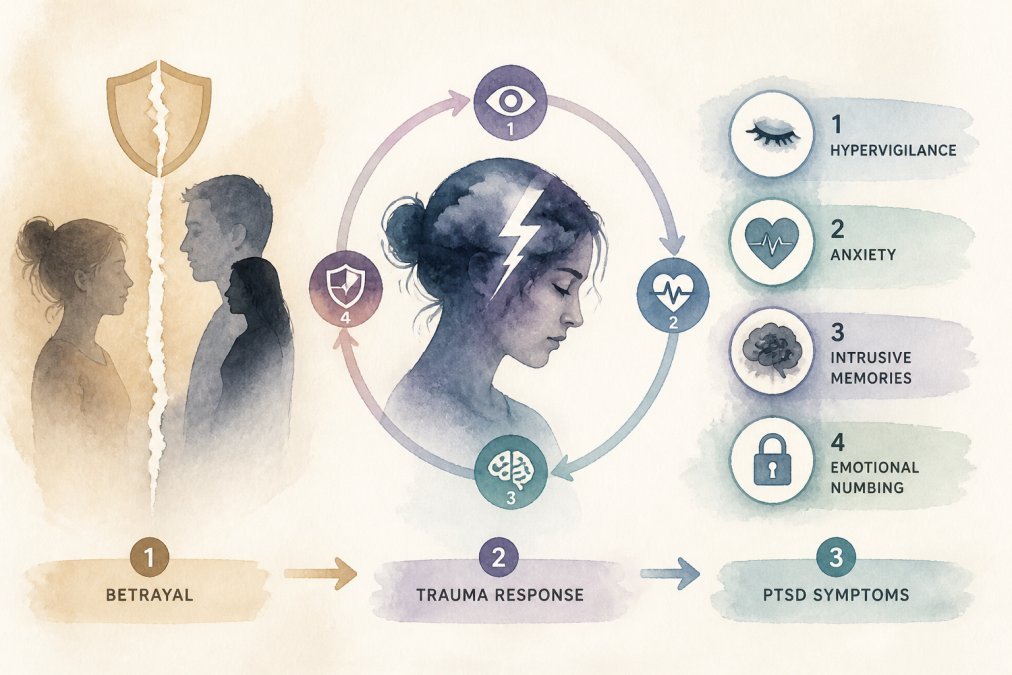
Betrayal trauma on its own is a serious nervous system injury. The gaslighting layer adds several dimensions that compound it.
It makes the reality rupture more complete. The standard reality rupture of infidelity discovery involves learning that an assumption about the relationship was false. The gaslighting layer means the reality rupture extends further: not only was the relationship not what I thought, but the reality I was inhabiting — the one I was being actively guided to inhabit — was a construction. That is a more thorough dismantling of the survivor’s orientation to reality.
It targets the survivor’s relationship with their own mind. Standard betrayal trauma involves losing trust in another person. The gaslighting layer involves losing trust in your own perception. These are different wounds. The second one is in some ways more destabilising, because it removes the internal anchor that you need in order to navigate the recovery from the first.
It creates a specific form of shame. On top of the shame that many betrayal trauma survivors carry — “I was not enough,” “I should have seen it” — the gaslighting layer adds a particular variant: “I was pathologised for knowing.” The concern that was real was treated as evidence of a personal problem. And that pathologising often left a residue: a belief that the survivor’s way of processing reality is itself the issue.
It complicates the anger. In straightforward betrayal trauma, the anger has a clear direction. In cases with a significant gaslighting layer, the anger is often more tangled — directed partly at the affair, partly at the sustained denial, partly at the specific memory of being made to feel unstable for being right.
The Specific Symptoms the Gaslighting Layer Produces
Beyond the standard betrayal trauma symptom cluster, the gaslighting layer tends to produce or intensify the following:
Hyperreactive concern about whether you are “being crazy.” An anxious monitoring of your own responses for evidence that they are excessive, unreasonable, or paranoid. This was the direct product of the gaslighting: the survivor learned to interrogate their own reactions before voicing them, and that habit does not switch off when the relationship context changes.
Difficulty believing confirmed information. Some survivors find, paradoxically, that even when they have clear evidence of what happened, the gaslighting history makes it hard to fully trust that evidence. The habit of doubting the signal is so deeply ingrained that it applies even to verified fact.
Profound confusion about the past. Not just grief about what was lost, but genuine disorientation about what was real during the affair period. Which moments were authentic? Which interactions were performance? This confusion is harder to resolve than grief, because it does not have a clear object.
A specific difficulty with anger. Many survivors with a significant gaslighting layer find their anger muted or delayed, because they were taught — during the affair — that expressing concern or anger produced bad outcomes. The anger that would ordinarily arise from betrayal is suppressed by a learned association between expressing it and being pathologised for it.
Chronic self-monitoring in subsequent relationships. The habit of checking one’s own perception against an imagined external judgment — “is this reasonable, or am I being paranoid?” — tends to persist into subsequent relationships or into the reconciliation process, where it produces a particular kind of hypervigilance focused inward rather than outward.
Why This Layer Needs Separate Attention in Recovery
General betrayal trauma therapy addresses the impact of the infidelity. It covers the nervous system dysregulation, the intrusive thoughts, the hypervigilance, the emotional flashbacks. This is essential and important work.
But it does not, by default, address the specific damage that gaslighting does to the survivor’s relationship with their own perception. And if that dimension is not addressed directly, it tends to persist as a quiet undertow beneath an otherwise progressing recovery.
The survivor may reach a point where the betrayal trauma symptoms have significantly reduced — the intrusive thoughts are less frequent, the hypervigilance has settled — and still find themselves in a persistent state of self-doubt. Still second-guessing their instincts. Still monitoring their own responses for evidence of unreasonableness. Still flinching from the expression of concern in relationships.
That is the gaslighting layer, still running. And it needs to be named and worked with explicitly to change.
Therapeutic approaches that are particularly relevant to this layer include those that work directly with reality-testing — helping survivors rebuild confidence in their own perception through a combination of cognitive work, somatic awareness, and the gradual, evidence-based restoration of self-trust. The supporting article on self-trust collapse on this site covers the recovery process in this area in more depth.
My Perspective
The gaslighting layer is the one that tends to surprise people most in recovery — not because the experience itself is a surprise, but because they had not understood it as a distinct dimension of what happened to them.
They had filed it under “part of the affair.” Another aspect of the deception. And in one sense it is. But in another sense, the gaslighting has a different quality and a different impact than the infidelity itself, and treating it as simply one aspect of a larger betrayal can mean it does not get the specific attention it needs.
What I want to say to survivors who recognise this layer in their own history is: you were not imagining things. You never were. The signal your body and mind were sending was accurate. What went wrong was not your perception. What went wrong was what was done to your perception — and there is a meaningful difference between those two things that changes the entire recovery question.
You do not need to rebuild a perception that was broken. You need to recover one that was suppressed. And that is a different task, with a different set of tools, and a considerably more hopeful outcome.
— S.J.Howe
FAQ
Is gaslighting always intentional? Not always. In the context of affairs, the gaslighting is often a by-product of the concealment rather than a deliberate psychological strategy. This does not reduce its impact on the survivor, but it does mean that attributing conscious malice to every instance is not always accurate. What matters for recovery is the effect, not the intent.
How do I know if what happened to me was gaslighting or just normal relationship disagreement? The key distinction is the systematic nature and the direction of the impact. Normal relationship disagreement involves two people with different perceptions of a shared reality, neither of whom is attempting to make the other doubt their own mind. Gaslighting, in the infidelity context, involves one partner consistently managing the other’s perception in order to maintain a deception. If your concerns were consistently pathologised, if you found yourself apologising for accurate instincts, if you reduced your expression of concern because it reliably produced bad outcomes — that pattern is worth examining directly.
My partner says they were not gaslighting me, just trying to protect me from something painful. Is that possible? It is a common framing after discovery, and it deserves honest assessment. There is a meaningful difference between one act of denial in a moment of panic and a sustained pattern of invalidating the partner’s perception over weeks or months. The former may be more charitably explained. The latter, regardless of the stated motivation, had specific effects that need to be worked through in recovery.
Why do I feel angrier about the gaslighting than about the affair itself? This is reported by many survivors and it makes sense. The affair is a betrayal of the relationship. The gaslighting is a betrayal of the survivor’s relationship with their own mind — something more intimate and more disorienting. Anger about the gaslighting is often anger about having been made to doubt something that was real, which carries a particular quality of violation.
Will I always be more suspicious in relationships because of this? Heightened vigilance after being gaslighted is a normal and understandable adaptation. It tends to reduce over time, with consistent evidence of trustworthiness from the people around you and with therapeutic work that specifically addresses the self-trust dimension. The goal is not returning to a pre-gaslighting openness that may have made you vulnerable. The goal is a more grounded, discerning attentiveness to your own instincts — one that serves you, rather than one that exhausts you.