TL;DR:
- Passive suffering is ineffective when your spouse continues to work with their affair partner; proactive boundaries and transparency are essential for recovery. Structural separation, verified accountability, and professional support help rebuild trust and manage betrayal trauma effectively. Consistent honesty and deliberate emotional self-care are critical in navigating workplace infidelity challenges and healing over time.
- How to cope when your spouse works with the person they cheated with
- What specific boundaries rebuild trust in this situation?
- How do you manage the emotional triggers of workplace proximity?
- When and how does therapy accelerate healing here?
- What must the unfaithful spouse actually do to rebuild trust?
- What do you do when boundaries are crossed or emotions overwhelm you?
- Key takeaways
- What I’ve learned about healing when the affair partner doesn’t disappear
- FAQ
Coping when your spouse works with the person they cheated with is defined by one non-negotiable truth: passive suffering is not a strategy. Betrayal trauma, the clinical term for the psychological injury caused by a partner’s infidelity, does not resolve on its own when the affair partner remains in your spouse’s daily environment. Workplace affairs account for 31 to 44% of all infidelity cases, making this one of the most common and most painful situations in infidelity recovery. The path forward requires proactive boundaries, radical transparency from your spouse, and deliberate emotional self-care. None of those things happen by accident. Understanding that your spouse works with their affair partner adds another layer of complexity to the healing process.

How to cope when your spouse works with the person they cheated with
The first thing to understand is that “professional-only contact” is not a boundary. It is a starting point, and a fragile one. Strictly professional communication still acts as a trauma trigger for the betrayed partner, because the nervous system does not distinguish between a work email and a flirtatious text. Your brain has been wired by betrayal to treat any contact as a threat. That response is neurologically normal, not a sign of weakness.
Coping in this situation requires three parallel tracks running simultaneously. Your spouse must adopt concrete, verifiable behaviors. You must build an emotional support structure that does not depend entirely on your spouse. And both of you must engage with professional help, whether through couples therapy, individual counseling, or structured self-help resources like those offered by Aftertheaffair. Without all three tracks, progress stalls.
What “coping” actually means here
Coping does not mean tolerating the situation indefinitely without change. It means actively managing your emotional responses while holding your spouse accountable for creating safety. The goal is not to white-knuckle your way through each workday. The goal is to build a structure where trust can realistically grow again, or where you gain enough clarity to make a decision about the relationship’s future.
What specific boundaries rebuild trust in this situation?
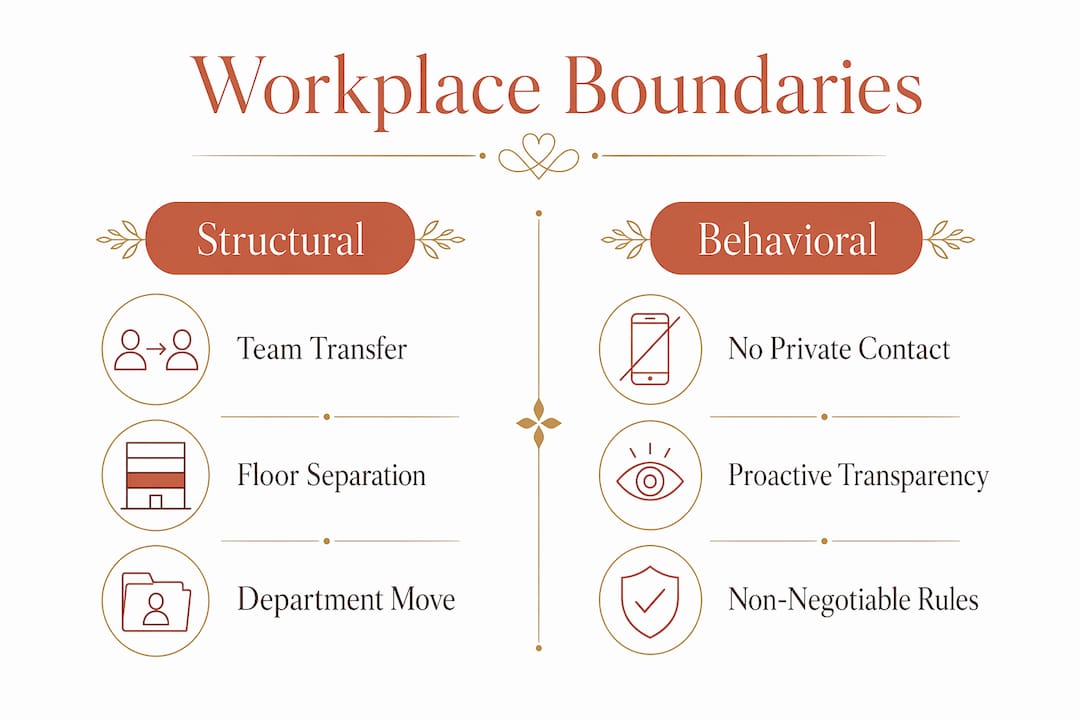
Boundaries in workplace infidelity recovery fall into two categories: structural and behavioral. Structural boundaries change the physical reality of the situation. Behavioral boundaries govern how your spouse conducts themselves within that reality. Both matter, and neither works without the other.
The ideal structural boundary is a team or department transfer. When one spouse can move to a different floor, a different project, or a different office location, the daily exposure drops dramatically. This is worth requesting formally, and a good therapist can help you frame that conversation. Structural separation is often necessary for genuine safety when the affair partner remains a coworker, not just a preference.
Behavioral boundaries must be specific and non-negotiable. Vague agreements like “I’ll keep it professional” give your spouse too much interpretive room and give you no way to verify compliance.
| Boundary type | Specific requirement | Impact on trust |
|---|---|---|
| No private communication | Work channels only, no personal texts or calls | Removes secrecy, high impact |
| No social contact | No shared lunches, after-work drinks, or off-site events | Eliminates ambiguity, high impact |
| Proactive reporting | Spouse reports all contact before being asked | Builds active trust, very high impact |
| Daily check-ins | Brief update each evening about workplace interactions | Reduces hypervigilance, high impact |
| Device transparency | Open access to phone and email during recovery | Dismantles secret world, very high impact |
Proactive transparency means your spouse reports contact before you ask, not after. That distinction is the difference between information and reassurance. When you have to ask, you are still doing the emotional labor of monitoring. When your spouse volunteers the information, they are carrying that weight themselves.
Pro Tip: Watch for boundary slippage in small increments. A shared coffee that becomes a shared lunch, or a work update that becomes a personal conversation, rarely announces itself as a violation. Ask your spouse to apply a simple test: “Would I tell my partner about this immediately?” If the answer is no, the interaction has crossed a line.
How do you manage the emotional triggers of workplace proximity?
Betrayal trauma produces hypervigilance. Your brain scans constantly for signs of danger because it learned, through your spouse’s affair, that the environment it trusted was unsafe. Daily brief updates from your spouse about workplace contact provide a replacement structure for that hypervigilance. Instead of your nervous system running threat-detection all day, it learns to wait for the check-in.
Managing emotions when your spouse works with their affair partner also means building your own support structure independent of your spouse. Relying solely on your spouse for reassurance creates an unhealthy dynamic where your emotional regulation depends on their consistency, which will inevitably be imperfect. Recovery depends on a safe therapeutic relationship, external emotional support, and physical self-care, not on the unfaithful partner alone.
Practical emotional management techniques that work in this specific context include:
- Journaling with a prompt. Write one sentence about what triggered you today and one sentence about what you did to manage it. This builds self-awareness without rumination.
- Scheduled worry time. Set a 20-minute window each day to process anxiety about the workplace situation. Outside that window, redirect intrusive thoughts to a grounding technique like box breathing.
- Physical movement. Exercise reduces cortisol, the stress hormone elevated by chronic hypervigilance. A 30-minute walk is clinically meaningful, not just anecdotally helpful.
- Social support outside the marriage. A trusted friend, a support group, or an online community of people dealing with infidelity at work provides perspective your spouse cannot.
- Limiting device-checking. Compulsive phone-checking is a symptom of unmet need for reassurance. Address the need directly through agreed transparency rather than surveillance.
Radical empathy from the unfaithful spouse reduces the betrayed partner’s pain more effectively than any single boundary. When your spouse consistently prioritizes your emotional safety over their own convenience, your nervous system begins to recalibrate. That recalibration takes time, but it is measurable.
Pro Tip: If you are experiencing intrusive thoughts, panic attacks, difficulty sleeping, or an inability to function at work, seek individual therapy immediately. These are symptoms of acute betrayal trauma, not ordinary stress. A therapist with experience in trauma-informed care, specifically one familiar with infidelity recovery, will move faster than a general counselor.
When and how does therapy accelerate healing here?
Therapy is the single most effective tool for couples surviving workplace infidelity, and the format matters. Therapy helps couples enforce boundaries and rebuild empathy especially when the affair partner remains a daily presence. A skilled therapist does three things a couple cannot do alone: mediates emotionally charged conversations, holds both partners accountable to agreed boundaries, and provides a structured framework for rebuilding trust.
Intensive therapy can produce breakthroughs in days rather than months, which matters enormously when the affair partner is still in your spouse’s workplace. Weekly sessions across six months may not be fast enough to prevent the relationship from deteriorating under ongoing stress. Intensive formats, where couples meet for multiple hours over several consecutive days, compress that timeline significantly.
| Therapy format | Session structure | Best suited for | Approximate timeline |
|---|---|---|---|
| Weekly couples therapy | 50 minutes, once per week | Stable couples in early recovery | 6 to 18 months |
| Intensive couples therapy | 3 to 6 hours per day, 2 to 5 days | Crisis situations, ongoing workplace contact | 1 to 2 weeks for initial breakthrough |
| Individual trauma therapy | 50 minutes, once or twice per week | Betrayed partner with acute trauma symptoms | 3 to 12 months |
| Combined individual and couples | Parallel tracks | Complex cases with workplace proximity | 6 to 24 months |
The rebuilding trust timeline varies by individual, but therapy consistently shortens it. The therapist also serves as an external accountability holder. When your spouse knows they will be asked about boundary adherence in the next session, compliance improves.
Pro Tip: When selecting a therapist, ask directly: “Do you have experience with infidelity recovery, specifically cases where the affair partner is still in the picture?” A therapist without that specific experience may inadvertently apply frameworks that do not fit betrayal trauma. The Gottman Method and Emotionally Focused Therapy (EFT) both have strong evidence bases for infidelity recovery.
What must the unfaithful spouse actually do to rebuild trust?
Accountability is not a feeling. It is a set of behaviors that your spouse either performs consistently or does not. Surviving workplace infidelity situations requires the unfaithful partner to move from remorse, which is internal and invisible, to accountability, which is external and verifiable.
Granting 24/7 access to all personal communication channels is standard practice in infidelity recovery, not an invasion of privacy. This access remains in place until the betrayed partner’s urge to check fades organically. That fading signals that the secret world has been dismantled and trust is rebuilding. Removing access prematurely, or negotiating limits on it, sends the opposite signal.
All non-essential contact with the affair partner must end completely and immediately the moment the couple decides to attempt recovery. “Winding down” contact gradually is not a real option. Every day of continued non-essential contact is a day the betrayed partner’s nervous system cannot begin to calm.
The unfaithful spouse’s accountability checklist:
- Report all workplace interactions with the affair partner proactively, before being asked, every single day
- Avoid defensiveness when your partner asks questions, even repetitive ones
- Pursue structural separation at work, including requesting a transfer if possible
- Share location data voluntarily during the recovery period
- Attend therapy consistently and engage honestly, not performatively
- Prioritize your partner’s safety over your own comfort in every decision that affects both
The most common failure point is the unfaithful spouse treating accountability as a temporary phase rather than a sustained commitment. Trust rebuilds over months and years, not weeks.
What do you do when boundaries are crossed or emotions overwhelm you?
Setbacks are not failures. They are data. When your spouse crosses a boundary, whether by failing to report contact, sharing a meal with the affair partner, or becoming defensive when questioned, the response matters more than the violation itself.
The first step is to name the violation clearly and calmly. “You didn’t tell me you spoke with her today. That was our agreement.” This is not an accusation. It is a statement of fact that invites accountability. Silence, or an explosive reaction, both make the next conversation harder.
Red flags that require immediate escalation to your therapist or counselor:
- Your spouse minimizes or denies a clear boundary violation
- Contact with the affair partner increases rather than decreases over time
- Your spouse becomes secretive about their phone or schedule again
- You find yourself unable to function due to anxiety or intrusive thoughts
- Either partner begins avoiding therapy sessions
Pro Tip: The “silent treatment” is one of the most destructive responses to a boundary violation. It communicates anger without providing information your spouse can act on. Instead, use a structured format: state what happened, how it made you feel, and what you need now. The Partner Accountability Conversation Guide from Aftertheaffair provides scripted frameworks for exactly these conversations.
When emotions become overwhelming, the goal is not to suppress them. The goal is to express them in a way that moves the relationship forward rather than entrenching both partners in defensive positions. That skill is learnable, and therapy is where most people learn it.
Key takeaways
Coping when your spouse works with their affair partner requires proactive boundaries, verified transparency, and professional support working together, not separately.
| Point | Details |
|---|---|
| Structural separation is the goal | Request a team or department transfer to reduce daily exposure to the affair partner. |
| Proactive reporting is non-negotiable | Your spouse must volunteer information about workplace contact before you ask, every day. |
| Therapy accelerates recovery | Intensive couples therapy can produce breakthroughs in days, not months, when workplace contact continues. |
| 24/7 access rebuilds trust | Full access to your spouse’s devices remains in place until the urge to check fades naturally. |
| Setbacks require direct response | Name boundary violations calmly and specifically rather than using silence or explosive reactions. |

What I’ve learned about healing when the affair partner doesn’t disappear
The hardest cases I encounter are not the ones where the affair was discovered and the affair partner vanished. The hardest cases are exactly this one: where the betrayed partner has to live with the knowledge that their spouse will see that person again tomorrow morning.
What I have found, working through these situations, is that the couples who survive this specific challenge share one trait. The unfaithful spouse treats transparency as a gift rather than a punishment. They understand that every proactive disclosure, every check-in, every open phone screen is an act of repair. The couples who struggle are the ones where the unfaithful partner treats accountability as a temporary sentence to serve.
I also want to say something that most articles skip: you do not have to decide right now whether to stay or leave. Coping effectively in the short term, building the structure of boundaries and transparency, gives you the clarity to make that decision from a grounded place rather than from acute pain. The stages of healing are real, and you are not expected to be at the end of them yet.
Give yourself permission to take this one day at a time. The goal today is not to have rebuilt trust. The goal today is to have one honest conversation, to take one step toward your own emotional support, and to hold one boundary. That is enough.
— S.J.Howe
Start your recovery with the right support
Knowing what to do and actually doing it are two different things, especially when you are managing betrayal trauma while your spouse walks into the same building as their affair partner every morning. Aftertheaffair has built a structured, evidence-informed resource library specifically for this stage of recovery.
The 7 Steps Infidelity Recovery Checklist is the clearest starting point: a practical, step-by-step framework that cuts through the noise and tells you exactly what to prioritize first. For couples ready to go deeper, the relationship growth guide addresses trust rebuilding with the same specificity this situation demands. If you are working with a therapist or considering it, the therapist guidance resource helps you get more from every session. You do not have to figure this out alone.
FAQ
What is betrayal trauma and how does it apply here?
Betrayal trauma is the psychological injury caused when someone you depend on for safety violates that trust. When your spouse works with their affair partner, the trauma is compounded by ongoing exposure, making professional support and structured boundaries especially critical.
Can a marriage survive when the affair partner is a coworker?
Yes, but it requires the unfaithful spouse to pursue structural separation at work, adopt full transparency, and commit to consistent accountability. Couples who engage in therapy and follow concrete boundary agreements have a significantly higher chance of rebuilding trust.
How long does it take to trust again after a workplace affair?
The realistic timeline for rebuilding trust ranges from one to several years, depending on the consistency of the unfaithful spouse’s accountability and the quality of professional support. Intensive therapy can compress the early breakthrough phase to days rather than months.
Should I ask my spouse to change jobs?
Requesting a team or department transfer is the preferred first step. A full job change may be necessary if structural separation within the same organization is impossible. The decision should be made with a therapist who can help both partners assess the situation without reactive pressure.
Is checking my spouse’s phone a healthy coping strategy?
Compulsive checking is a symptom of unmet need for reassurance, not a coping strategy. The healthier structure is agreed 24/7 access combined with proactive daily reporting from your spouse, which addresses the underlying need without the anxiety cycle that surveillance creates.
Recommended
- How to Co-Parent After an Affair – After the Affair Series
- Will a Married Partner Leave Their Spouse? A Realistic Guide – After the Affair Series
- Is Your Spouse in Affair Fog? The 25-Point Reality Check – After the Affair Series