TL;DR:
- Documenting interactions with a narcissist is essential for legal protection and psychological reassurance in co-parenting. Using structured logs, secure platforms, and the BIFF communication method helps create factual, court-admissible records that reflect patterns over time. Consistent, strategic documentation supports your mental health and legal standing while minimizing direct conflict.
- How to document everything when co-parenting with a narcissist
- What types of incidents should you document?
- Which tools are best for secure co-parenting records?
- How to communicate in ways that protect you
- How to use your records for legal and psychological protection
- Key takeaways
- What I’ve learned about documentation that most guides won’t tell you
- FAQ
Documenting every interaction is the single most effective legal and psychological protection available when co-parenting with a narcissist. Without a written record, you are left defending yourself against a partner who rewrites history, denies agreements, and uses your children as leverage. This guide covers exactly what to record, which tools to use, how to communicate in ways that create clean evidence, and how to use your records in court or therapy. Platforms like OurFamilyWizard and TalkingParents, frameworks like BIFF, and structured incident logs are the foundation of every effective documentation strategy.
How to document everything when co-parenting with a narcissist
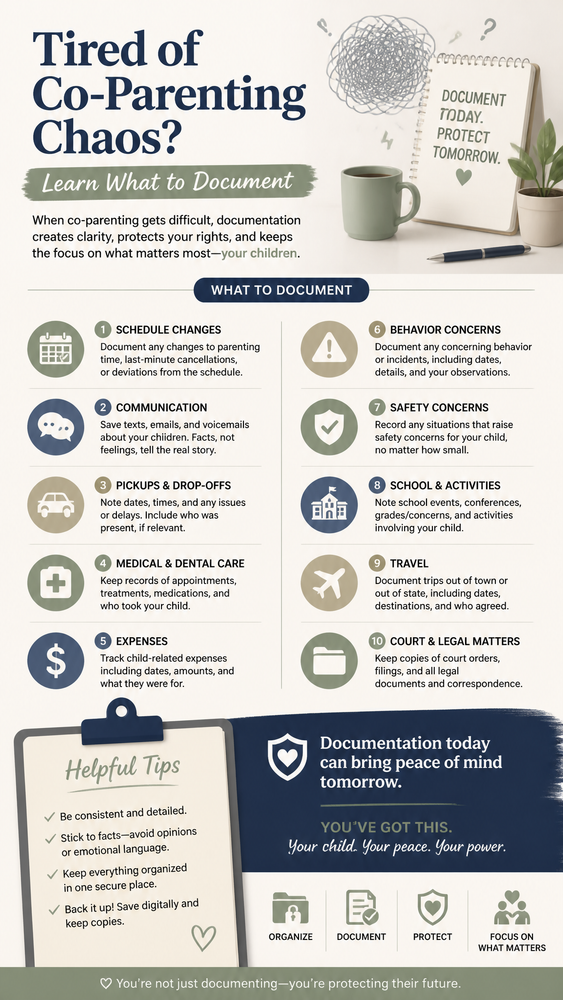
The first step is understanding what “documentation” actually means in this context. Legally and therapeutically, it refers to a systematic record of interactions, incidents, and communications that reveals patterns of behavior over time. A single incident rarely moves a court. A pattern of 14 missed exchanges, 9 withheld medical updates, and 6 hostile messages over six months absolutely does.
Courts prioritize consistent patterns over individual incidents in custody cases involving high-conflict co-parenting. That means your records need to be organized, dated, and factual from day one, not assembled in a panic before a hearing.
The standard industry term for this practice is co-parenting incident documentation, and it sits at the intersection of family law and trauma-informed therapy. Both fields agree: the parent with clear, unemotional records is the parent who gets taken seriously.
What types of incidents should you document?
Not everything deserves a log entry. Over-documenting minor provocations can actually backfire by making you appear conflict-driven to a judge. Your goal is a selective, credible record, not a diary of every frustration.
Focus your documentation on four categories:
- Parenting plan violations. Missed or late custody exchanges, denied visitation, and schedule changes made without notice all belong in your log. Record the exact time, location, and any witnesses present.
- Communication that is hostile, manipulative, or threatening. Screenshot every message immediately. Do not wait. Phones get lost, apps get updated, and messages can disappear.
- Incidents affecting your children’s welfare. This includes arriving at exchanges in inappropriate clothing, reports of unsafe situations, or signs of emotional distress after visits.
- Child disclosures. When your child shares something concerning, use open-ended, neutral prompts to avoid leading questions. Write down the exact words your child used, the date, the setting, and what prompted the conversation.
For each entry, use a four-part incident log structure: date and time, a one-line summary, a factual neutral description, and any supporting evidence attached. This format prevents emotional language from creeping in and produces court-admissible records.
Pro Tip: Write your incident logs in the third person. Instead of “He made me feel threatened,” write “Co-parent arrived 45 minutes late and raised his voice in the driveway.” Third-person language reads as objective and holds up better under cross-examination.
Which tools are best for secure co-parenting records?
The right tools make documentation automatic rather than effortful. The table below compares the three most recommended platforms.
| Platform | Key feature | Court admissibility |
|---|---|---|
| OurFamilyWizard | Tone meter, shared calendar, expense tracking | Widely accepted; used in court orders |
| TalkingParents | Uneditable message archive, call recording | Accepted in most U.S. jurisdictions |
| AppClose | Free tier, basic messaging and scheduling | Less common in formal proceedings |
Co-parenting apps like OurFamilyWizard and TalkingParents provide permanent, timestamped, uneditable records now often required by courts in high-conflict cases. The fact that neither party can delete or alter messages is the critical advantage over standard texting or email.
Beyond the app, maintain a private incident journal. This is your master log, stored offline or in a secure digital location your co-parent cannot access. Paper and digital logs must be stored privately and inaccessibly to prevent tampering or deletion. A password-protected document on a device your co-parent has never used, or a physical notebook kept at a trusted friend’s home, both work.
You can learn more about selecting the right platform in Aftertheaffair’s guide to co-parenting communication tools.
Pro Tip: Set a weekly 15-minute calendar reminder to review and update your incident log. Memories fade fast. Consistent entries written close to the event are far more credible than reconstructed timelines.
How to communicate in ways that protect you
Every message you send is a potential exhibit. That reality should shape how you write, not paralyze you, but focus you.
The BIFF framework, developed by family law mediator Bill Eddy, is the gold standard for communicating with a high-conflict co-parent. BIFF stands for Brief, Informative, Friendly, and Firm, and it keeps messages concise and focused on logistics. Limiting your message to 2–5 sentences removes the space a narcissist needs to find something to argue about.
Practical rules for every message you send:
- Write only about the children. Health, education, safety, and schedules are the only topics.
- Never explain your emotions or justify your decisions at length. One sentence is enough.
- Respond on your own timeline. A 48-hour response window is standard in many parenting plans and signals that you are not reactive.
- Confirm any verbal agreement in writing within 24 hours. Send a follow-up message that says: “Confirming our conversation today: pickup will be at 5 p.m. on Saturday.”
- Never use sarcasm, accusations, or emotional language. Courts read tone.
The goal of effective communication with a narcissist is not to be heard or understood. It is to create a clean, factual record that shows you as the calm, child-focused parent. Every message you send either supports or undermines that picture.
How to use your records for legal and psychological protection
A well-kept log does two things simultaneously. It builds your legal case, and it protects your mental health.
On the legal side, share your documentation selectively. Your attorney decides what is relevant and when to present it. Flooding a court with every minor irritation weakens your credibility. Work with your attorney to establish a threshold: what rises to the level of a formal complaint versus what you simply log and monitor.
On the psychological side, documentation validates your experiences and counters gaslighting by externalizing narcissistic behavior patterns. When you read back through your log and see the same behavior repeated 20 times, you stop questioning your own memory. That is not a small thing. Gaslighting works by making you doubt yourself. A written record makes that doubt impossible.
Systematic logs prevent self-doubt and provide undeniable behavioral patterns over time. They are not just legal tools. They are psychological anchors.
The parallel parenting model pairs naturally with documentation because it minimizes direct contact, which reduces conflict opportunities and makes your records cleaner and more focused. Aftertheaffair covers this approach in depth for parents managing high-conflict separations.
Recognizing the patterns of narcissistic behavior in your logs also helps you stop being surprised by them. When you can see the cycle clearly, you respond strategically instead of emotionally.
Key takeaways
Effective co-parenting documentation requires a structured incident log, secure dedicated tools, BIFF-based communication, and a clear legal threshold for what to act on versus what to monitor.
| Point | Details |
|---|---|
| Use a four-part log structure | Record date, summary, neutral description, and evidence for every incident. |
| Choose court-ready platforms | OurFamilyWizard and TalkingParents create uneditable, timestamped records. |
| Apply the BIFF framework | Keep messages to 2–5 sentences focused only on child logistics. |
| Document patterns, not every irritation | Courts respond to repeated patterns; over-logging undermines your credibility. |
| Store records securely | Keep your master log offline or in a location your co-parent cannot access. |
What I’ve learned about documentation that most guides won’t tell you
By Silviya
Most advice on this topic focuses on the mechanics: which app to use, how to format a log entry. That matters. But what nobody tells you is how emotionally exhausting it is to document your own life with clinical detachment when you are in the middle of real pain.
I have worked with parents who kept meticulous records and still felt like they were losing their minds. The documentation was perfect. The emotional toll was enormous. What helped was reframing the log itself as an act of self-respect. Every time you write a neutral, factual entry instead of an angry one, you are choosing your children’s future over your co-parent’s chaos.
The other thing I want you to hear: you do not have to document everything perfectly from day one. Start now, with whatever you have. A note in your phone with a date and a sentence is better than nothing. Credibility is built over time, not in a single entry.
Choose your battles carefully. Not every provocation deserves a response or a log entry. The parents who fare best in high-conflict custody situations are the ones who are consistent, calm, and strategic. That is not weakness. That is the long game.
If you are also working through the trauma of betrayal that preceded this co-parenting situation, understanding what gaslighting does to your sense of reality is a critical first step. Your instincts are not broken. They just need evidence to back them up.
— S.J.Howe

How Aftertheaffair can support you through this
High-conflict co-parenting rarely exists in isolation. For many parents, it follows betrayal, and the psychological weight of both is real. Aftertheaffair offers structured, evidence-informed resources designed specifically for people navigating trauma, separation, and the long road back to stability.
If you are rebuilding after betrayal while also managing a difficult co-parenting situation, the infidelity recovery checklist is a practical starting point. It walks you through seven concrete steps toward healing, including how to protect your mental health during ongoing conflict. Aftertheaffair also offers guidance on supporting your kids across two homes, which directly addresses the emotional complexity your children face when co-parenting is contentious.
FAQ
What is the best app for co-parenting with a narcissist?
OurFamilyWizard and TalkingParents are the most court-recognized options because neither platform allows message deletion or editing, creating a permanent, tamper-proof record.
How often should I update my co-parenting incident log?
Write each entry as close to the incident as possible, ideally within 24 hours. A weekly review session helps you catch anything you missed and keeps your records current.
Should I document every single thing my co-parent does?
No. Establish a threshold with your attorney for what rises to the level of formal documentation. Over-logging minor provocations can make you appear conflict-driven to a court.
Can my co-parenting documentation be used in court?
Yes, provided it is factual, dated, and neutral in tone. Records from court-recognized apps like OurFamilyWizard carry particular weight because they are timestamped and uneditable.
What is parallel parenting and how does it relate to documentation?
Parallel parenting minimizes direct contact between co-parents, which reduces conflict and makes your documentation cleaner and more focused on child-welfare incidents rather than interpersonal disputes.
Recommended
- Parallel Parenting With a Narcissist – After the Affair Series
- Gray Rock: Co-Parenting With a Narcissist or Toxic Ex-PR3 – After the Affair Series
- How to Respond When Your Ex Uses Kids as Pawns
- What Not To Do When Co-Parenting – After the Affair Series