
Children living between two households after infidelity don’t automatically struggle more than other kids. What actually shapes their outcomes is how their parents handle the transition. 79.8% good mental health was found in children with cooperative co-parents after divorce, compared to 67.9% in sole custody arrangements. That gap isn’t about the number of bedrooms your child sleeps in. It’s about structure, predictability, and how well you and your co-parent can set aside the hurt to put your kids first.
Table of Contents
- The emotional impact of living in two homes
- Why cooperative co-parenting matters most
- Building predictable routines and smooth transitions
- Communication strategies for stability and reassurance
- Managing high-conflict or complicated situations
- Adapting for unique family needs and edge cases
- Practical resources for co-parents healing after infidelity
- Frequently asked questions
Key Takeaways
| Point | Details |
|---|---|
| Consistency is key | Predictable routines and duplicated essentials help children adjust to two homes. |
| Cooperation matters | Children thrive when parents communicate well and minimize conflict. |
| Parallel parenting for conflict | When cooperation is not possible, using parallel parenting protects kids from stress. |
| Child-focused communication | Keep all discussions and planning centered on your child’s needs, using neutral language and apps. |
| Adapt to unique needs | Be flexible; if safety or special concerns arise, seek professional help for the best arrangement. |
The emotional impact of living in two homes
When infidelity breaks up a family, children don’t just lose the version of home they knew. They lose their sense of safety. Moving between two households forces kids to constantly re-orient, and for many, that feels like standing on shifting ground. The disruption isn’t just logistical. It’s emotional.
Children in this situation commonly experience:
- Loyalty conflicts: feeling like loving one parent means betraying the other
- Anxiety about transitions: dreading drop-offs and pick-ups, especially early on
- Grief and confusion: mourning the family they had without fully understanding why it changed
- Behavioral changes: regression, withdrawal, or acting out as ways of expressing what they can’t say
Here’s the critical insight that most parents miss: conflict between parents, not divorce or infidelity alone, is what predicts poor outcomes for children after separation. The affair itself matters far less to your child’s adjustment than what happens in the hallway during hand-offs.
“Children are remarkably resilient when they feel safe, seen, and free from the burden of adult conflict. Your job isn’t to be perfect. It’s to be consistent.”
Validating your child’s feelings without over-explaining adult details is one of the most powerful things you can do. Start emotionally preparing kids early, and keep that preparation ongoing as circumstances evolve.
Why cooperative co-parenting matters most
The evidence is clear and it’s worth sitting with for a moment. Children don’t need two parents who love each other. They need two parents who can work together. That distinction changes everything about how you approach shared custody.
A recent meta-analysis found that joint custody arrangements produced good mental health outcomes in 79.8% of children, compared to 67.9% in sole custody. That’s nearly a 12-point difference, and it holds even when the divorce followed infidelity.
| Custody arrangement | Good mental health outcomes |
|---|---|
| Joint custody with cooperation | 79.8% |
| Sole custody | 67.9% |
| High-conflict joint custody | Significantly lower |
What drives that gap? Low conflict, consistent routines, and children feeling free to love both parents without guilt. The details of the affair, as painful as they are for you, are largely irrelevant to your child’s adjustment. What matters is the emotional climate you create going forward.
Pro Tip: Treat co-parenting like a business partnership. Keep communications focused on logistics and your child’s needs. Save the emotional processing for your therapist, your journal, or a trusted friend. Explore healthy co-parenting strategies and rebuilding resilience in your children as parallel tracks of your recovery. For additional practical guidance, co-parenting tips from HelpGuide offer a solid starting framework.
Building predictable routines and smooth transitions
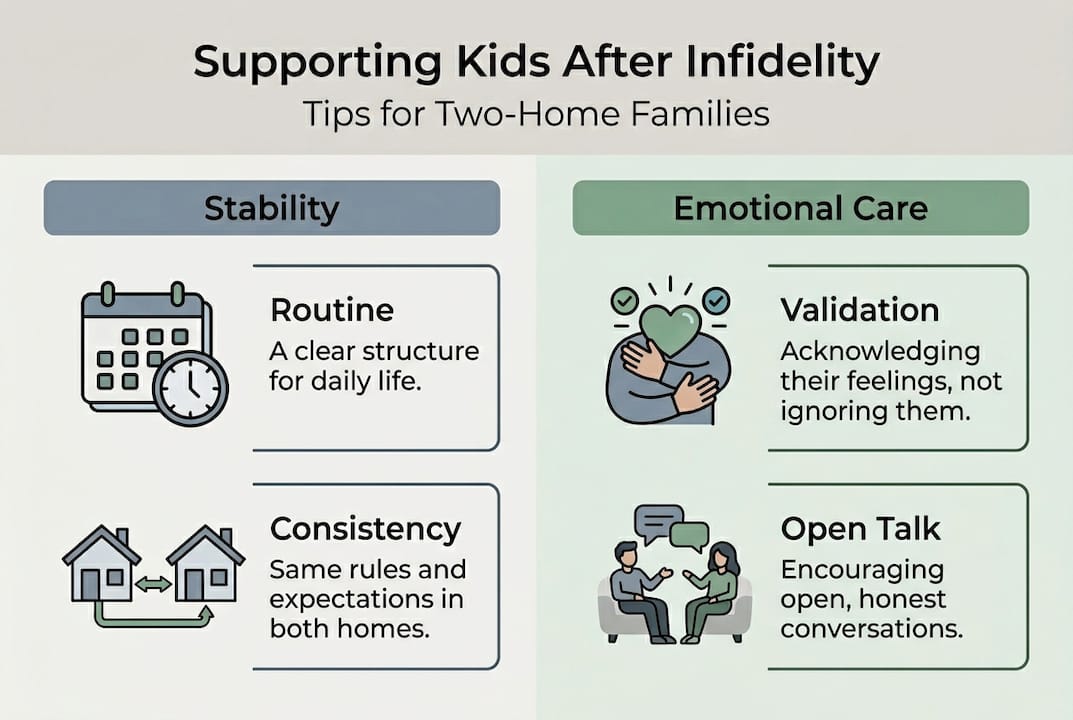
Routine is not boring. For a child moving between two homes, routine is the closest thing to solid ground. When kids know what to expect, their nervous systems can relax. When they don’t, every transition becomes a potential source of anxiety.
Research confirms that predictable, repeated routines reduce stress during custody exchanges, and that drop-off is consistently less distressing for children than pick-up. That one shift in logistics can make a real difference.
Here’s a practical framework to build stability across both homes:
- Duplicate comfort items: Keep a set of essentials at each home, pajamas, a favorite stuffed animal, toiletries. Packing bags every time signals instability.
- Create a leaving ritual: A specific hug, a phrase, or a small gesture that marks the transition. Predictability in the goodbye reduces anxiety about it.
- Use a transition checklist: A simple visual list your child checks off before leaving each home gives them a sense of control.
- Coordinate drop-offs, not pick-ups: Whenever possible, the parent leaving does the drop-off. It’s less emotionally loaded for the child.
- Sync the basics: Bedtimes, homework expectations, and screen time rules don’t have to be identical, but the closer they are, the easier the adjustment.
- Debrief after transitions: Give your child 15 to 20 minutes to settle before asking questions. Let them come to you.
Pro Tip: Use a shared digital calendar visible to your child (age-appropriate) so they always know where they’ll be and when. Uncertainty is the enemy of calm. For more on transitions between homes, HelpGuide offers additional tools worth bookmarking. And if you’re struggling with your own emotional load during hand-offs, the guide on co-parenting after an affair speaks directly to that experience.
Communication strategies for stability and reassurance
Even the most carefully designed routine will crack under the pressure of poor communication between parents. Children are extraordinarily sensitive to tension. They pick up on clipped tones, loaded silences, and the things adults think they’re hiding.
Effective co-parent communication protects your child from becoming a messenger, a mediator, or an emotional sponge. Here’s what that looks like in practice:
- Keep children out of adult business: Never share details of the affair, legal disputes, or financial stress with your kids. They don’t need that weight.
- Use neutral language: Refer to your co-parent by their parental role, not by their mistakes. “Your dad” not “your dad who…” Your child loves them.
- Communicate directly with your co-parent: Never use your child to relay messages. It puts them in an impossible position.
- Use structured tools: Apps like OurFamilyWizard or 2Houses keep communication documented, organized, and emotionally buffered. Scheduled check-ins and neutral language through these platforms reduce conflict significantly.
- Reassure consistently: Tell your child regularly that both homes are safe, that both parents love them, and that none of this is their fault.
Pro Tip: If direct communication with your co-parent triggers strong emotions, switch to written-only contact through a co-parenting app for a period. It creates space to respond thoughtfully rather than react. Check out co-parenting tools and review communication mistakes to avoid so you can sidestep the most common pitfalls.
Managing high-conflict or complicated situations
Not every co-parenting situation allows for calm, cooperative exchanges. When the hurt from infidelity is still raw, or when one parent is unwilling to disengage from conflict, standard co-parenting advice can feel completely out of reach. That’s where parallel parenting comes in.
Parallel parenting is a structured approach that minimizes direct contact between parents while still allowing both to be actively involved in their child’s life. Parallel parenting with detailed plans reduces child exposure to conflict, which research consistently identifies as the primary driver of poor outcomes after separation.
| Approach | Best for | Key feature |
|---|---|---|
| Cooperative co-parenting | Low to moderate conflict | Shared decisions, open communication |
| Parallel parenting | High conflict | Minimal contact, detailed written plans |
Key elements of a parallel parenting setup include:
- A detailed written parenting plan: Covers schedules, holidays, school events, and medical decisions in advance so there’s less need for real-time negotiation
- Communication only in writing: Reduces emotional escalation and creates a record
- Neutral hand-off locations: Schools, community centers, or other public spaces reduce tension at transitions
- No real-time decision-making: Major decisions are handled through the plan or a mediator, not in the moment
For families in this situation, the parallel parenting approach offers a structured path forward. You can also explore the parallel parenting method in more detail, or download a parallel parenting plan template to get started. The Child Mind Institute also offers guidance on protecting kids in conflict that’s worth reading alongside these resources.
Adapting for unique family needs and edge cases
Most families benefit from some version of joint custody, but not all. When safety is a concern, standard frameworks don’t apply and forcing them can cause real harm. Knowing when to adapt is just as important as knowing the general rules.
Situations that may require a specialized approach include:
- Domestic violence or abuse: Joint custody is not appropriate when one parent poses a physical or emotional safety risk to the child or the other parent
- Untreated mental illness or addiction: Instability in one home requires careful assessment of what level of contact is safe
- Special needs children: Some kids require highly consistent environments that may not translate easily across two households
- Parental alienation: When one parent actively undermines the child’s relationship with the other, professional intervention is essential
Joint custody benefits most families, but not when safety concerns are present. In those cases, professional input from a family counselor, mediator, or child psychologist isn’t optional. It’s necessary. If you’re navigating one of these more complex situations, the resource on navigating unique cases addresses the emotional and practical layers that standard advice doesn’t cover.
Don’t let the pressure to appear cooperative override your instinct to protect your child. Asking for help is not weakness. It’s the most child-focused thing you can do.
Practical resources for co-parents healing after infidelity
Putting these strategies into practice is hard enough on a good day. After infidelity, it can feel almost impossible. The emotional weight you’re carrying while trying to show up for your kids is real, and you deserve support that meets you where you are.

At AfterTheAffair.uk, we’ve built resources specifically for parents in your position. The infidelity recovery checklist gives you a clear, step-by-step framework for your own healing, because you can’t pour from an empty cup. If you’re ready to look further ahead, the guide on relationship growth after infidelity addresses how to rebuild trust in yourself and your future. And if you want to explore everything available to you, the full resource library covers every stage of recovery, from survival to transformation.
Frequently asked questions
How do I help my child adjust to living in two homes after infidelity?
Stick to consistent routines, keep comfort items in both homes, and validate your child’s feelings without sharing adult details. Predictable routines and co-regulation are among the most effective tools for easing adjustment.
What if co-parenting is too high-conflict after infidelity?
Switch to parallel parenting with a detailed written plan that minimizes direct contact. Parallel parenting reduces harm in high-conflict situations by shielding children from parental tension.
Is joint custody always better for children?
Most children benefit from joint custody, but joint custody is not best when safety concerns like abuse or untreated mental illness are present. Always seek professional guidance in those cases.
How can we keep communication healthy for our child’s sake?
Use neutral, child-focused language and consider a co-parenting app to keep exchanges structured. Scheduled check-ins and co-parenting apps significantly reduce emotional spillover into your child’s world.
What are some transition rituals that help?
Simple, repeated rituals like a specific goodbye phrase, a short walk, or a pizza night on arrival make hand-offs feel safe and familiar. Rituals and consistent hand-off routines ease the emotional load of transitions for children of all ages.