TL;DR:
- A job change by a cheating spouse can remove daily triggers that hinder emotional safety and recovery.
- It is most necessary when the affair involved a coworker and ongoing workplace contact makes healing impossible.
A job change by a cheating spouse is one of the most direct structural steps available to couples asking whether their relationship can heal after infidelity. When the affair involved a coworker, the question of whether your cheating spouse should get a new job for your relationship to heal is not hypothetical. It is a practical decision with real consequences for trust, safety, and recovery. Rebuilding emotional safety after betrayal takes 18–24 months or more of dedicated effort. A job change does not replace that work, but it can remove a daily obstacle that makes healing nearly impossible.
Should my cheating spouse get a new job for our relationship to heal?
The clearest answer is yes, in specific circumstances. Therapeutic guidance recommends a job change when the affair involved a colleague and daily contact continues. The conditions that make a job change necessary are not vague. They are concrete and identifiable.
Proximity is the central issue. When your spouse shares an office, a project team, or even a lunch break with the person they had an affair with, your nervous system reads that as an ongoing threat. Workplace proximity acts as a micro-trigger, keeping your body in a state of low-grade alarm that prevents the emotional safety required for healing. No amount of conversation or couples therapy fully compensates for that daily retraumatization.
The following factors signal that a job change is not optional but necessary:
- The affair partner is a direct colleague, manager, or direct report
- Your spouse and the affair partner share regular one-on-one meetings or travel
- Workplace gossip about the affair has spread and cannot be contained
- The company culture enabled or normalized the behavior
- You experience physical anxiety symptoms when your spouse leaves for work
- No-contact is structurally impossible without a job change
Pro Tip: The job change carries far more weight when your spouse initiates it without being asked. A voluntary resignation or transfer signals genuine commitment. An ultimatum-driven change signals compliance, and the difference matters to your recovery.
How should couples approach the decision to change jobs together?
The decision to change jobs works best as a shared project between partners, not a demand issued by one and resented by the other. Treating it as a mutual decision protects both of you from the resentment that builds when one partner feels they sacrificed everything while the other simply waited.
Open discussion must cover four areas: values, finances, career goals, and fears. Your spouse may worry about losing professional identity or income. You may worry that any hesitation signals they are protecting the relationship with the affair partner. Both concerns are real. Neither cancels the other out.
A structured approach to the decision helps couples move forward without circular arguments:
- Name the problem clearly. State why the current job creates a barrier to healing, using specific examples rather than general accusations.
- Research alternatives together. Look at internal transfers, remote arrangements, or roles at other organizations before deciding on a full resignation.
- Set a timeline. Agree on a date by which a decision will be made and a change will begin. Open-ended timelines breed anxiety.
- Discuss financial impact honestly. Calculate the income gap, savings runway, and any benefits changes before committing.
- Revisit the decision in therapy. A counselor can help both partners process fears and confirm the decision reflects genuine commitment rather than panic or control.
Pro Tip: If your spouse is driving the job search proactively, sending you updates, and including you in the process, that behavior itself is part of rebuilding trust after cheating. Transparency during the transition matters as much as the outcome.
What role does a job change play in rebuilding trust and emotional safety?
A job change is a facilitating tool, not a cure. The Five Behaviors model identifies truth, transparency, empathy, consistency, and commitment as the core drivers of trust repair. A job change creates the conditions for those behaviors to take hold. Without the behaviors, the job change is a gesture that fades quickly.
Think of it this way. Removing the affair partner from your spouse’s daily environment stops the bleeding. But the wound still needs treatment. Therapy, honest communication, and daily acts of accountability are the treatment. Healing after infidelity means building a new kind of relationship built on honesty and transparency, not restoring the old one.
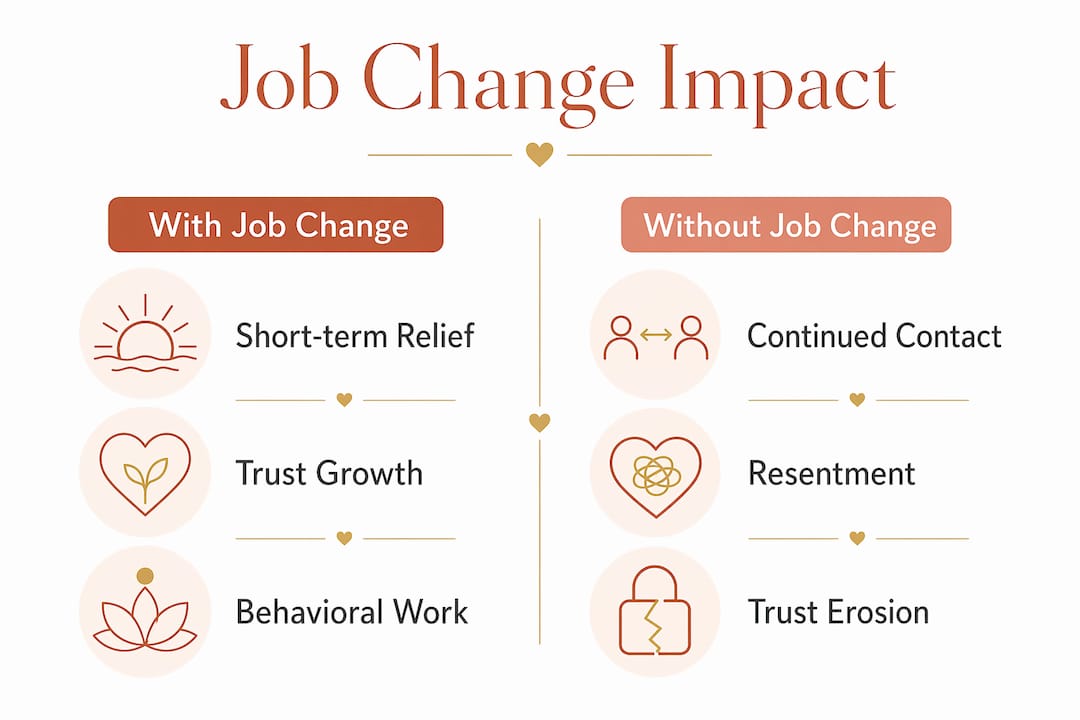
The table below shows how outcomes differ depending on whether a job change is paired with active trust-building behaviors.
| Scenario | Likely outcome |
|---|---|
| Job change with no behavioral change | Short-term relief, long-term resentment and relapse of distrust |
| No job change, strong behavioral work | Partial healing, ongoing triggers limit full emotional safety |
| Job change paired with Five Behaviors | Best conditions for sustained trust repair and emotional reconnection |
| No job change, no behavioral work | Healing is unlikely; separation becomes the probable outcome |
The data is clear. Structural changes like a job shift facilitate but do not replace the behavioral work. Couples who pair the job change with consistent daily proof of the Five Behaviors give themselves the strongest foundation for recovery. You can explore what that relationship growth looks like in practice through Aftertheaffair’s dedicated recovery resources.
What are the emotional and practical challenges of changing jobs during recovery?
A job change during affair recovery carries real costs that couples must name honestly. Ignoring them does not make them smaller. It makes them more likely to surface as resentment later.
The most common challenges include:
- Career disruption. Your spouse may lose seniority, specialized projects, or a professional network built over years. That loss is real, even if the change is necessary.
- Financial strain. A gap between jobs, a lower starting salary, or lost benefits can add economic stress to an already fragile household.
- Identity threat. Many people define themselves through their work. Leaving a role under these circumstances can trigger grief, shame, or a loss of confidence.
- Resentment risk. If the change feels forced or unacknowledged, your spouse may build quiet resentment that surfaces months later in arguments or emotional withdrawal.
- Misconceptions about proof. Some unfaithful partners believe staying in the same job and “proving” they can resist temptation demonstrates strength. This misunderstands betrayal trauma. The betrayed partner does not need proof of willpower. They need the trigger removed.
Managing these challenges requires two things: therapy and honest communication. A couples counselor can help both partners cope with the emotional weight of the transition without letting it become another source of conflict. Individual therapy for the unfaithful spouse supports the identity work that a career change often requires. The cost of a job change is almost always less than the ongoing emotional cost of daily proximity to the affair partner.
Key Takeaways
A job change by a cheating spouse is most effective when it is voluntary, paired with the Five Behaviors of trust repair, and treated as a shared decision rather than a unilateral sacrifice.
| Point | Details |
|---|---|
| Job change is sometimes necessary | Daily workplace contact with an affair partner prevents emotional safety and blocks healing. |
| Voluntary action matters most | A spouse who initiates the change without being asked signals genuine commitment, not compliance. |
| Behavioral change must accompany it | Truth, transparency, empathy, consistency, and commitment are required alongside any structural change. |
| Collaborative decision-making protects both partners | Discussing finances, fears, and career goals together reduces resentment and builds mutual investment. |
| Recovery takes sustained effort | Deep trust rebuilding requires 18–24 months or more; a job change is one step in a longer process. |

The uncomfortable truth about job changes and healing
By S.J.Howe
After working with couples navigating betrayal, I have noticed a consistent pattern. The couples who recover most fully are not the ones who made the biggest gestures. They are the ones who made the right gestures at the right time, and owned them completely.
A job change is one of those gestures. But I have seen it go wrong in two specific ways. The first is when the unfaithful partner changes jobs under pressure and then treats it as a debt the betrayed partner now owes them. “I gave up my career for you” becomes a weapon in arguments two years later. That is not healing. That is a transaction dressed up as sacrifice.
The second failure is when the betrayed partner demands the job change but refuses to engage in the emotional work of recovery. The job change becomes a condition for staying, not a step toward rebuilding. The relationship limps forward without real repair.
What actually works is when the unfaithful spouse decides, without being asked, that the job is incompatible with the relationship they want to build. That decision, made freely and communicated clearly, is one of the most powerful signals of genuine commitment I have ever seen in recovery work. It says: “I am choosing us over my comfort.” That is the foundation of what Aftertheaffair calls Relationship 2.0, a new version of the partnership built on honesty rather than the assumptions of the old one.
If you are weighing this decision, get professional support before you act. The role of a therapist in this process is not to tell you what to decide. It is to help you make the decision in a way that serves your recovery rather than your fear.
— S.J.Howe
Structured support for the decisions ahead
Deciding whether a job change is right for your recovery is one of many complex choices you will face in the months ahead. Aftertheaffair provides structured, evidence-informed resources built specifically for this stage of healing.
The 7 Steps Infidelity Recovery Checklist walks you through the full recovery process, including how to approach major decisions like career changes, no-contact boundaries, and trust-building milestones. It gives you a clear framework when everything feels uncertain. Aftertheaffair also offers guidance on making recovery decisions collaboratively, so both partners can move forward without one carrying the full weight of change. These resources do not replace therapy. They work alongside it, giving you structure between sessions.
FAQ
Does a cheating spouse always need to change jobs to heal the relationship?
No, not always. A job change is most necessary when the affair involved a coworker and daily contact continues, making no-contact structurally impossible without leaving the role.
How long does relationship healing after infidelity typically take?
Deep trust rebuilding takes 18–24 months or more of consistent effort. A job change can remove a significant obstacle, but it does not shorten that timeline on its own.
What if my spouse refuses to change jobs after a workplace affair?
Refusal to change jobs when daily contact with the affair partner continues is a strong signal that no-contact is not a priority. That pattern makes sustained healing very difficult and warrants direct discussion in couples therapy.
Can a job change alone rebuild trust after cheating?
No. A job change alone cannot rebuild trust without the Five Behaviors: truth, transparency, empathy, consistency, and commitment practiced daily over time.
Should the betrayed partner demand the job change or wait for their spouse to offer it?
The most effective outcome occurs when the unfaithful spouse initiates the change voluntarily. Ultimatums can produce compliance but often generate resentment that undermines the healing process.
Recommended
- How to Cope When Your Spouse Works With Their Affair Partner
- How to Guide Clients After Infidelity for Healing – After the Affair Series
- Top marriage healing strategies to rebuild trust after infidelity
- Why Do Cheaters Stay? The Truth About What Your Spouse Really Wants – After the Affair Series