Last Updated: July 17, 2026
- Understanding When and Why Custody Schedules Change
- Co-Parenting Communication Strategies for Schedule Changes
- Handling Temporary Custody Schedule Changes
- The Legal Process for Custody Modification
- Documenting Custody Changes and Co-Parenting Interactions
- Supporting Your Child Through Custody Schedule Changes
- Common Mistakes to Avoid When Handling Custody Schedule Changes
- Conclusion
Navigating custody schedule changes is one of the most challenging aspects of co-parenting after separation or divorce. Whether your circumstances have shifted due to relocation, employment changes, or your child‘s evolving needs, understanding how to handle custody schedule changes requires both emotional intelligence and practical knowledge. This guide provides actionable strategies to help you navigate schedule modifications while protecting your child’s wellbeing and maintaining stability.
Understanding When and Why Custody Schedules Change
Custody schedules aren’t fixed forever. Life circumstances shift, children grow, and what worked during infancy may no longer serve a teenager’s needs.
Common Reasons for Modifying a Custody Schedule
A substantial change in circumstances often triggers the need for custody schedule modifications. According to American Bar Association guidance on family law, courts recognize several legitimate reasons for modifying existing custody arrangements.
Relocation is one of the most common drivers. A parent who relocates 300 miles away cannot maintain a weekly exchange schedule. Work schedule changes create genuine conflicts when a parent shifts to overnight work or frequent travel. Child’s developmental needs evolve over time; a schedule that works for a six-year-old may not suit a fourteen-year-old with school activities and sports commitments. Health issues or special needs sometimes require adjustments to accommodate medical appointments or therapies. Co-parent’s changed circumstances, such as job loss or illness, may affect their parenting capacity.
The key distinction: a legitimate reason for modification differs from a desire to punish your co-parent or reduce their time with your child. Courts examine motivations carefully.
Types of Custody Schedules and Their Flexibility
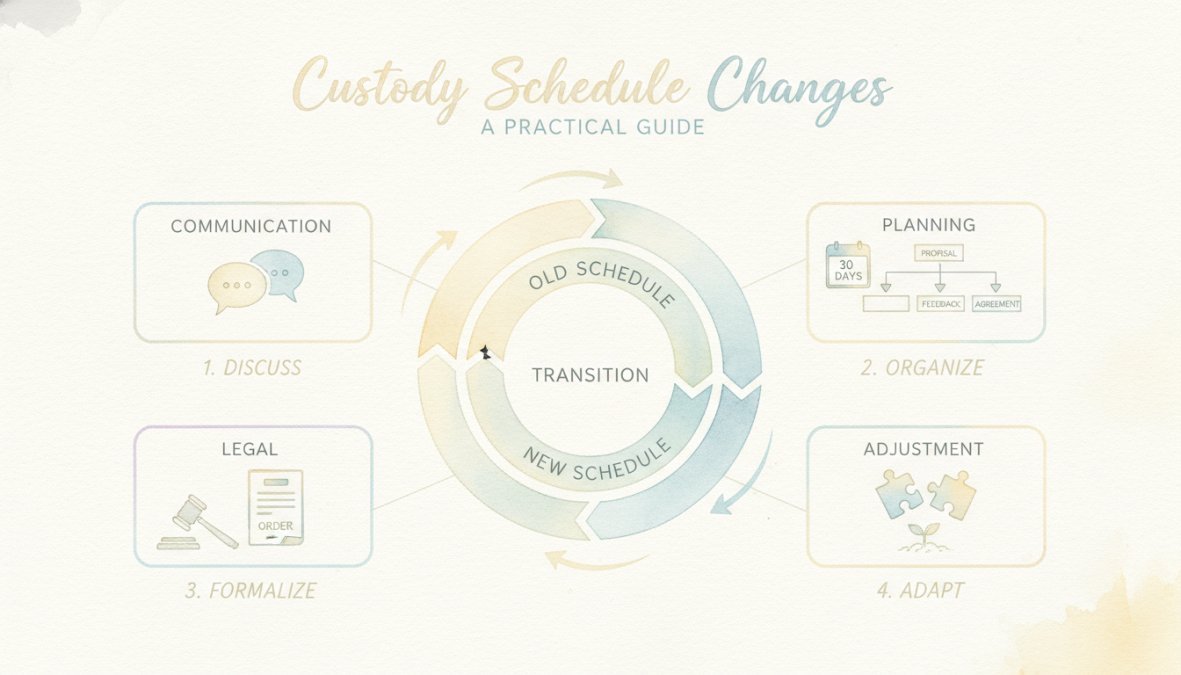
50/50 schedules divide parenting time equally through alternating weeks or 2-2-3 arrangements and work well when parents live close together. 60/40 schedules give primary custody to one parent while the other has substantial parenting time. 70/30 schedules provide one parent with primary custody while the other has regular but limited parenting time, typically one or two weekends per month. Flexible schedules build in room for adjustments based on specific activities or seasonal needs.
The flexibility of your current schedule matters when considering modifications. A rigid 50/50 schedule may require formal legal modification if circumstances change significantly. A schedule that already includes flexibility language may accommodate adjustments through agreement alone.
Review your current custody order carefully. Look for language about “substantial and material changes” and any provisions allowing temporary modifications by mutual agreement.
Co-Parenting Communication Strategies for Schedule Changes
How you communicate about custody schedule changes often determines whether the process goes smoothly or escalates into conflict.
Initiating the Conversation with Your Co-Parent
Prepare your case first. Clarify your reasoning and write down the specific circumstances requiring change, how the new schedule benefits your child, and what you’re proposing.
Choose the right setting. Never initiate this conversation during a child exchange, in front of your child, or during an already-tense interaction. Request a separate conversation in person, by phone, or video.
Lead with your child’s interests. Frame the conversation around what’s best for your child. “I’ve noticed our son struggles with the current schedule because his soccer practice is on Thursday nights, and he’s missing games. I’d like to discuss moving his Wednesday evening with you to Thursday so he can attend practices” works better than convenience-based arguments.
Be specific and solution-focused. Propose a concrete alternative: “I’m suggesting we move to a 2-2-3 schedule starting in September. You’d have him Monday and Tuesday, I’d have him Wednesday and Thursday, and we’d alternate weekends.”
Acknowledge your co-parent’s perspective. Show you understand their position even if you disagree. “I know you value your midweek time with the kids, and this schedule actually preserves that while making things work better for their school commitments.”
Listen more than you talk. After presenting your proposal, ask for their thoughts and listen without interrupting.
The goal of the initial conversation is to establish that a genuine need exists and that you’re willing to discuss solutions respectfully, not to reach immediate agreement.
Managing Difficult Conversations and Resistance
When your co-parent says no immediately, ask specific questions: “What concerns you most about this schedule?” / “What would need to be different for this to work for you?”
Many initial rejections stem from feeling ambushed. Giving your co-parent space to process often softens their position.
If they cite legitimate concerns, address them directly. If they worry about logistics, problem-solve together. If they fear losing time with your child, explore whether the schedule actually reduces their time or simply shifts it.
When resistance seems rooted in control or spite, you may need to pursue formal legal modification. This is where documentation becomes critical.
Avoid these communication traps:
- Don’t threaten legal action as a negotiating tactic.
- Don’t involve your child in the negotiation or ask them to advocate for the schedule change.
- Don’t use the child as a messenger.
- Don’t make the conversation about your co-parent’s failures.
If direct conversation repeatedly fails, consider using a co-parenting app or mediator to facilitate communication.
Handling Temporary Custody Schedule Changes
Not all schedule changes require formal legal modification. Temporary adjustments for specific circumstances can often be handled informally, provided you document everything.
Informal vs. Formal Temporary Adjustments
Informal temporary changes work when both parents agree and the adjustment is short-term. Get agreement in writing, even if it’s just a text confirmation: “Just confirming that I’ll have the kids Monday-Wednesday next week instead of the usual schedule, and you’ll pick them up Thursday as normal.”
Formal temporary modifications are court-ordered or mediated adjustments for situations lasting weeks or months. A parent needs to relocate temporarily for work, or a child requires extended medical treatment in another city.
Many parents use temporary agreements to test whether a proposed permanent schedule change actually works before pursuing formal modification.
Emergency Changes and Crisis Management
Medical emergencies take priority over custody schedules. If your child is hospitalized, you notify the other parent immediately and coordinate care.
Safety concerns justify immediate deviation from the schedule. If your child feels unsafe at the other parent’s home, you can deviate from the schedule and notify your co-parent afterward.
Natural disasters, severe weather, or other crises may make scheduled exchanges impossible. Communicate with your co-parent as soon as possible.
Document the emergency and your response: “On March 15, I received a call that our daughter had appendicitis and was being rushed to surgery. I immediately notified you and kept the children through March 18 until she was discharged.”
Never use “emergency” or “crisis” as an excuse to unilaterally change the schedule for non-emergency reasons. Courts take a dim view of parents who claim emergencies that don’t actually exist.

The Legal Process for Custody Modification
When informal agreement isn’t possible, understanding the legal process for custody modification helps you navigate it effectively.
Substantial and Material Change in Circumstances
Courts don’t modify custody orders lightly. To succeed in a modification petition, you must demonstrate a substantial and material change in circumstances since the original order was entered.
Changes affecting the child’s needs: A child’s diagnosis with a chronic illness requiring specialized care, significant changes in educational needs, or mental health issues requiring therapeutic support.
Changes in parental capacity: A parent’s job loss, relocation, or health issues affecting their ability to parent. Conversely, a parent’s improved circumstances, completing addiction treatment, or securing stable employment can support modification requests.
Changes in the child’s preferences: Older children (typically age 12 and up) can request schedule changes based on their own preferences.
Changes in logistics or distance: A parent’s relocation making the current schedule impractical qualifies as substantial change.
Courts examine whether the change is temporary or permanent. A parent’s three-month work project doesn’t typically justify modification. A permanent job relocation does.
Research from National Council of Juvenile and Family Court Judges emphasizes that courts prioritize the child’s best interests and stability.
Filing a Petition and Court Procedures
If informal agreement fails and you have legitimate grounds for modification, filing a petition with the family court begins the formal process.
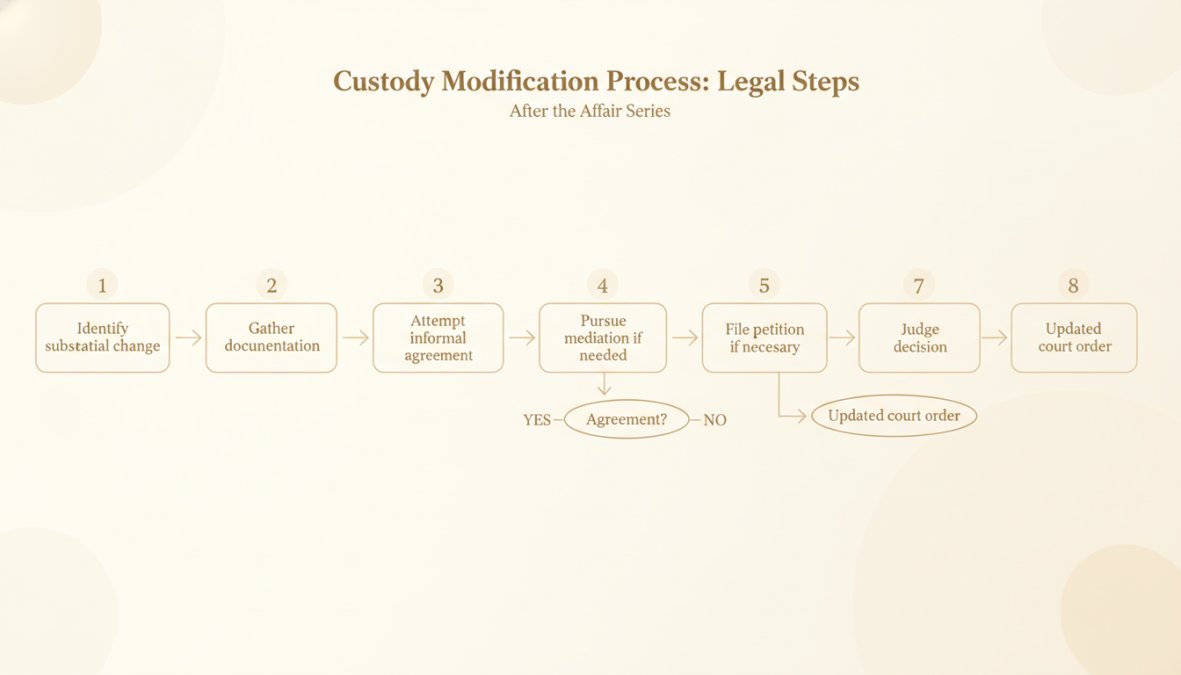
Step 1: Consult a family law attorney. Family law varies significantly by jurisdiction, and an attorney ensures your petition is filed correctly and includes all required documentation.
Step 2: Gather documentation. Collect evidence supporting your claim of substantial change: job offer letters, medical records, school records, and evidence of how the current schedule affects your child.
Step 3: File the petition. Your attorney files the modification petition with the court, including your sworn statement detailing the changes in circumstances and how the proposed new schedule serves the child’s best interests.
Step 4: Serve the other parent. The other parent must be formally notified of your petition through certified mail or personal service.
Step 5: Attempt mediation. Many jurisdictions require mediation before trial. A neutral mediator helps both parents negotiate a settlement.
Step 6: Trial (if mediation fails). If you can’t reach agreement, the case goes to trial. Both parents present evidence, and the judge issues a new custody order.
The entire process typically takes 3-6 months. Throughout, maintain detailed records of all interactions with your co-parent and how the current schedule affects your child.
Many judges look favorably on parents who attempt to resolve custody modifications cooperatively. If you can reach agreement with your co-parent and present a joint modification request, the court typically approves it quickly without trial.
Documenting Custody Changes and Co-Parenting Interactions
Documentation is your protection. If custody modifications ever go to court, judges examine written records of what actually happened.
What Records to Keep and Why They Matter
Communication records: Save all text messages, emails, and written communication with your co-parent about the custody schedule.
Schedule documentation: Keep a detailed calendar showing when the child was actually with each parent. Note any deviations from the court-ordered schedule and whether they were agreed to or unilateral.
Child-related records: Maintain copies of school report cards, medical appointments, therapy sessions, and extracurricular activities.
Incident records: If significant events occur, document them contemporaneously. Write down what happened, when, what your child said, and how you responded.
Financial records: Keep records of child support payments and expenses for the child’s care.
The principle: courts favor parents who keep meticulous records.
Never falsify or exaggerate records. Courts can detect dishonesty, and fabricating documentation destroys your credibility entirely.
Using Co-Parenting Apps and Tools
Technology can reduce conflict and create automatic documentation of custody schedule changes.
OurFamilyWizard is a dedicated co-parenting platform that includes a shared calendar, expense tracking, and message logs. All communication is time-stamped and archived. The platform’s tone-monitoring feature alerts you if a message sounds hostile.
Custody X Change allows you to create detailed custody schedules, set reminders for exchanges, and track parenting time.
Google Calendar with shared access allows both parents to see the custody schedule and any changes in real time.
The advantage of dedicated co-parenting apps: they normalize communication, reduce emotional escalation, and create automatic documentation.
Supporting Your Child Through Custody Schedule Changes
Schedule changes affect children emotionally and developmentally. How you handle the transition significantly impacts your child’s adjustment.
Minimizing Disruption to Routines and Stability
Prepare your child in advance. Explain the new schedule in age-appropriate language. Young children benefit from visual schedules. Older children need detailed explanation about why the change is happening.
“Starting next month, you’ll spend Monday and Tuesday nights with Dad instead of Wednesday and Thursday. This way, you can go to soccer practice on Thursday with Mom. You’ll still spend weekends with Dad, that’s not changing.”
Maintain consistent routines across both homes. Bedtime routines, meal times, homework expectations, and screen time rules should be similar in both homes.
Allow a transition period. Children often need 4-6 weeks to adjust to a new routine. Expect some regression and respond with patience.
Watch for signs of distress. Changes in sleep, appetite, school performance, behavior, or mood warrant attention.
Mental Health Resources and Coping Strategies
Normalize the feelings. Let your child know that feeling sad about schedule changes is normal. “It’s okay to miss Dad when you’re with me, and it’s okay to miss me when you’re with Dad. That means you love us both.”
Maintain connection during parenting time gaps. Phone calls, video chats, or text messages help children feel connected to the other parent.
Create transition rituals. A special goodbye routine before exchanges or a weekly video call on a specific day provides structure around transitions.
Consider counseling. A child therapist can help your child process the schedule change and develop coping strategies.
Take care of your own mental health. Children are remarkably perceptive. If you’re anxious or angry about the schedule change, your child absorbs that stress.
American Academy of Pediatrics guidance on children and divorce emphasizes that parental conflict and parental mental health significantly affect children’s adjustment.
Common Mistakes to Avoid When Handling Custody Schedule Changes
Mistake 1: Making unilateral changes without agreement or court order. Deviating from the custody order without permission exposes you to accusations of parental kidnapping or contempt of court.
Mistake 2: Using schedule changes as punishment. Reducing the other parent’s time because they missed a support payment or angered you violates the custody order and damages your credibility with courts.
Mistake 3: Involving your child in custody negotiations. Never ask your child which parent they prefer or whether they want a schedule change.
Mistake 4: Failing to document changes. If you informally agree to schedule modifications, document them in writing.
Mistake 5: Not considering the other parent’s legitimate concerns. Listen to their actual concerns rather than dismissing them as spite.
Mistake 6: Making the schedule change about adult convenience rather than the child’s needs. Courts examine whether modifications genuinely serve the child’s best interests.
Mistake 7: Neglecting to update documentation. If you informally modify a schedule long-term, eventually formalize it.
Mistake 8: Ignoring your child’s adjustment. Monitor your child’s wellbeing throughout the transition.
Mistake 9: Pursuing legal modification when informal agreement is possible. Court modification is expensive, time-consuming, and adversarial. Exhaust informal options first.
Conclusion
Handling custody schedule changes requires balancing legal requirements, co-parenting communication, and your child’s emotional needs. The most successful custody modifications happen when both parents prioritize the child’s wellbeing over their own preferences, communicate respectfully even when they disagree, and remain flexible as circumstances evolve.
When informal agreement isn’t possible, understanding the legal process and documenting everything carefully protects your interests and your child’s stability. If you’re navigating high-conflict co-parenting or struggling to communicate about schedule changes, After the Affair Series provides structured frameworks and communication tools designed for exactly these situations.
| Schedule Change Type | Best For | Timeline | Documentation Needed |
|---|---|---|---|
| Informal temporary change | Short-term adjustments (1-4 weeks) | Immediate with agreement | Text confirmation or email |
| Informal ongoing change | Long-term agreed modifications | Ongoing | Written agreement; calendar tracking |
| Formal temporary modification | Changes lasting weeks-months | 2-4 weeks | Court order or mediated agreement |
| Formal permanent modification | Substantial circumstance changes | 3-6 months | Court petition; support |