Last Updated: July 23, 2026
- Quick Comparison Table
- Best Co-Parenting Apps for Documented, Court-Approved Communication
- Co-Parenting Communication Examples: Apps vs Manual Scripts in Action
- High-Conflict Co-Parenting Communication: Why Apps and Scripts Both Matter
- Court-Approved Co-Parenting Apps: Legal Admissibility and Documentation
- Apps vs Manual Scripts: Pros, Cons, and Pricing Breakdown
- How to Choose Between Co-Parenting Communication Apps and Manual Scripts
- Integrating Co-Parenting Apps with Scripts and Other Tools
- The Bottom Line: Apps vs Manual Scripts
- Frequently Asked Questions
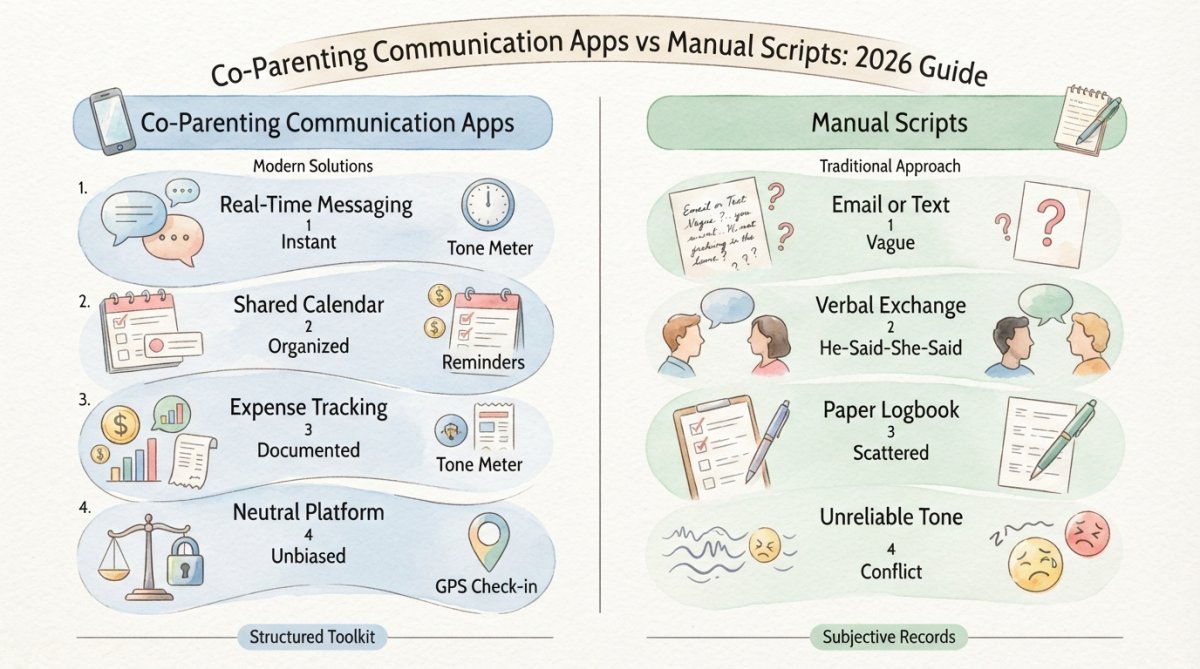
When co-parents face high-conflict situations, every word matters. The difference between a message that de-escalates and one that triggers a legal dispute often comes down to how you communicate. After the Affair Series has spent years helping separated and divorced parents navigate these exact conversations, and the data is clear: the right communication method can reduce conflict by up to 40% while protecting your children’s emotional wellbeing.
Quick Comparison Table
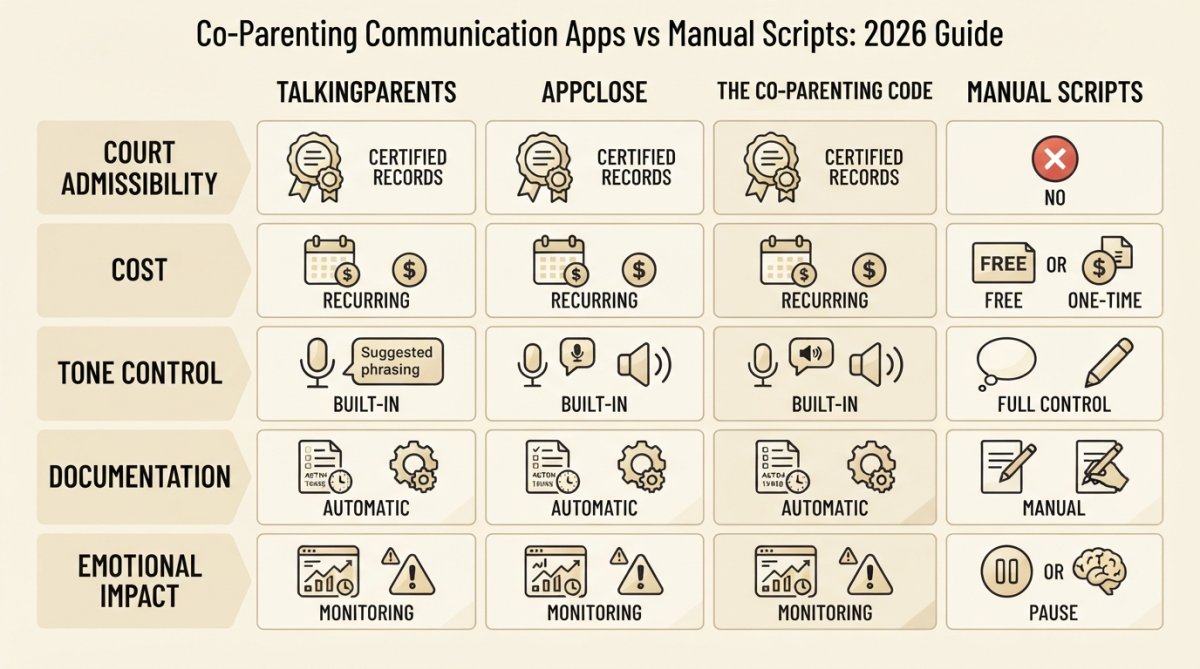
| Method | Best For | Court-Admissible | Cost | Learning Curve | Tone Control |
|---|---|---|---|---|---|
| TalkingParents | High-conflict situations needing documentation | Yes (certified records) | $7+/month per parent | Low | Built-in sentiment scanner |
| AppClose | All-inclusive features at one price | Yes (certified records) | $8.99/month per parent | Low | Co-Parents Assist feature |
| Manual Scripts (The Co-Parenting Code) | Managing emotional triggers and tone | No (but evidence of thoughtfulness) | One-time purchase | Medium | Highest control, you write it |
| Unstructured text/email | Quick, informal updates | Weak in court | Free | None | High risk of escalation |
Best Co-Parenting Apps for Documented, Court-Approved Communication
TalkingParents: Certified Records and Accountable Calling
TalkingParents treats every message like a potential legal document, creating unalterable, timestamped records that courts recognize as evidence. Accountable Calling allows you to record phone calls with both parties’ consent, eliminating ambiguity about what was said. The Sentiment Scanner and Writing Assist tool flag language that might escalate tension before you send. Pricing starts at $7 per month per parent for the Essentials plan, with fee waivers available for financial hardship or domestic violence situations.
AppClose: All-Inclusive Features at a Single Price
AppClose offers unlimited messaging, calls, call recording, shared custody calendar, expense tracking, and certified electronic business records for $8.99 per month through app stores or $7.99 on the web. The Co-Parents Assist feature helps with message tone, similar to TalkingParents’ sentiment scanner. Like TalkingParents, AppClose provides Certified Electronic Business Records and Business Records Affidavits, making your communication court-ready from day one. Fee waivers are available for financial hardship and domestic violence survivors.
The Co-Parenting Code: Manual Scripts for Strategic Communication
The Co-Parenting Code offers over 280 ready-to-use communication scripts organized by topic and emotional trigger. You copy the script, paste it into your preferred communication method, and send. This approach gives you the highest level of control over tone and messaging. The scripts are designed by experts who understand manipulation tactics, boundary-setting, and de-escalation. The downside: The Co-Parenting Code lacks automatic documentation, shared calendars, or expense tracking. Scripts alone won’t carry the same legal weight in court as certified app records, though they demonstrate thoughtfulness and consistency in your communication pattern.
Co-Parenting Communication Examples: Apps vs Manual Scripts in Action
When Apps Shine: Scheduling and Accountability
Scenario: Your ex agreed to pick up your child at 3 PM on Wednesday but shows up 45 minutes late for the third time this month.
With an app (TalkingParents/AppClose):
You send a timestamped message: “You arrived 45 minutes late on Wednesday, June 12. This is the third late pickup this month. The parenting plan specifies 3 PM. Please confirm you can meet this time going forward.”
This message sits in an unalterable log. If custody becomes disputed, your attorney can pull the entire thread showing a pattern of lateness, your calm responses, and exact dates/times.
With manual scripts:
You use a script from The Co-Parenting Code: “I noticed you arrived 45 minutes late on Wednesday. On-time pickups are important for [child’s name]’s schedule and my ability to plan. Can we discuss what’s making 3 PM difficult?”
This is thoughtful and non-accusatory, but it lives in your text message history without certified legal status.
Winner for accountability: Apps, because documentation is automatic, unalterable, and court-recognized.
When Manual Scripts Work Better: Tone Control and Emotional Triggers
Scenario: Your ex told your child they’re “taking them away” from you, and your child is terrified. You’re furious.
With an app (TalkingParents/AppClose):
You open the app and see the message. You want to fire back something harsh. The sentiment scanner flags your angry draft. You can send it anyway, but now you’re creating evidence of your anger that could be used against you in court.
With manual scripts (The Co-Parenting Code):
Before responding, you pull up a script designed for parental alienation: “I’m concerned about what [child’s name] heard. Children need to feel safe with both parents. Let’s discuss how we can reassure them that both of us love them and want them in our lives.”
This script gives you a moment to cool down and reframe the conversation from accusation to child’s wellbeing.
Winner for tone control: Manual scripts, because they force you to pause, think, and choose language that protects your emotional wellbeing and your child’s safety.
High-Conflict Co-Parenting Communication: Why Apps and Scripts Both Matter
In genuinely high-conflict situations, neither apps nor scripts alone are sufficient. You need both.
Research shows that the medium you choose affects how messages are received and how conflict escalates. Text messages lack tone and body language, making neutral statements sound harsh. Co-parenting apps with built-in tone-checking features reduce this risk by flagging language that might be misread. Manual scripts address emotional reactivity directly by interrupting the automatic response cycle. Instead of reacting from anger or hurt, you pause, select a script that aligns with your values, and send a message that de-escalates.
The most effective high-conflict co-parents use both: they write from scripts (to manage emotional reactivity and choose de-escalating language), then send through an app (to create certified, unalterable records). This combination protects both your peace and your legal position.
Structured scripts interrupt the emotional reactivity cycle. When triggered, your brain floods with cortisol and adrenaline. Scripts give your rational brain something to do while your emotional brain is activated. After the Affair Series has found that parents who use structured scripts report feeling 30-40% more in control of their reactions within the first month. Their children notice the difference, and households become less tense.
Court-Approved Co-Parenting Apps: Legal Admissibility and Documentation
If your communication might end up in court, admissibility matters.
Courts recognize three types of communication records:
Certified electronic business records (what TalkingParents and AppClose provide): Timestamped, unalterable, and created by a third-party platform. Judges accept them without question because the platform’s design prevents tampering.
Text message/email threads (what you create manually): Admissible, but with caveats. A text message is evidence of what was sent, but not necessarily proof of what was meant. Screenshots are admissible but can be doctored.
Affidavits or sworn statements: Admissible only if you can verify the other party received the message. Without a certified platform, this is difficult to prove.
The legal advantage of apps like TalkingParents and AppClose is that they eliminate ambiguity. The court sees: message sent [timestamp], message delivered [timestamp], message read [timestamp], response sent [timestamp].
If you’re using text messages or email for co-parenting communication in a high-conflict situation, screenshot everything and save copies in a cloud backup. A certified app record is far stronger legally because the platform itself is the authenticator.
Manual scripts don’t create certified records. However, they have legal value in demonstrating consistency, thoughtfulness, and an effort to de-escalate. Many parents use scripts within certified apps: you write from a script, then send the message through TalkingParents or AppClose. This gives you the best of both worlds: the emotional discipline of scripts plus the legal protection of certified records.
Apps vs Manual Scripts: Pros, Cons, and Pricing Breakdown
Advantages of Co-Parenting Apps
Automatic documentation. Every message is timestamped and logged without manual effort.
Court admissibility. Certified records carry legal weight that text messages don’t.
Accountability features. Shared calendars, expense tracking, and read receipts reduce disputes about what was agreed to.
Tone monitoring. Built-in sentiment scanners catch escalating language before you send.
Centralized communication. Everything related to co-parenting is in one place.
Reduced direct contact. In abusive or hostile situations, apps create a buffer between parents.
Advantages of Manual Scripts
Complete tone control. You write every word and can adjust phrasing to match your values.
Emotional pause. Using a script forces you to slow down and interrupt emotional reactivity.
No subscription required. Scripts are a one-time purchase; apps charge per parent, per month.
Flexibility in delivery. You can use scripts via text, email, app, or in-person conversation.
Psychological empowerment. Many parents feel more confident and in control when using scripts.
Pricing Comparison
| Method | Cost Structure | Annual Cost (Single Parent) | Annual Cost (Two Parents) | One-Time vs Recurring |
|---|---|---|---|---|
| TalkingParents | $7/month (Essentials) | $84 | $168 | Recurring |
| AppClose | $8.99/month (app) or $7.99/month (web) | $96-108 | $192-216 | Recurring |
| The Co-Parenting Code | One-time purchase | Contact for pricing | Same | One-time |
| Manual scripts (free resources) | Free | $0 | $0 | One-time |
| Unstructured text/email | Free | $0 | $0 | N/A |
Apps cost money every month indefinitely. Manual scripts cost once and are yours forever. However, the legal protection and accountability features of apps may save you thousands in legal fees if your custody dispute goes to court.
How to Choose Between Co-Parenting Communication Apps and Manual Scripts
Your choice depends on your specific situation, your ex’s behavior, and your priorities.
Use Apps If You Need Court Documentation
If you’re in a custody dispute, anticipating one, or co-parenting with someone genuinely hostile or unpredictable, an app is essential. The certified records protect your legal position. Start with TalkingParents if you need recorded phone calls and maximum legal protection. Choose AppClose if you want all features (messaging, calls, calendar, expense tracking) in one all-inclusive plan.
Apps are mandatory if you’re protecting yourself legally. The $7-9 per month is insurance against a custody dispute where your communication becomes evidence.
Use Manual Scripts If You’re Managing Emotional Triggers
If your primary challenge is staying calm and not escalating conflict, scripts are your tool. They interrupt emotional reactivity in a way that apps don’t. The Co-Parenting Code’s 280+ scripts are organized by trigger: “My ex is being manipulative,” “My child is upset after visits,” “My ex is late,” “My ex is threatening,” etc.
The Hybrid Approach: When to Use Both
The most effective strategy for high-conflict co-parenting is hybrid: use scripts to write thoughtfully, then send through an app for documentation.
Here’s how it works:
- Your ex sends a hostile or manipulative message.
- You feel triggered. Instead of responding immediately, you pause.
- You open The Co-Parenting Code and find a script that addresses the situation.
- You read it, adjust it if needed.
- You copy it.
- You open TalkingParents or AppClose and paste it.
- You send it through the app, creating a certified record.
You get the emotional discipline of scripts plus the legal protection of certified records. This hybrid approach is what After the Affair Series recommends for parents navigating both emotional healing and legal protection.
Integrating Co-Parenting Apps with Scripts and Other Tools
The most sophisticated co-parents create a system using multiple layers.
Layer 1: Scripts for emotional management. Use The Co-Parenting Code or similar resources to build your communication muscle. Over time, you internalize the principles and can write thoughtfully even without a script.
Layer 2: Apps for documentation. Use TalkingParents or AppClose for all official co-parenting communication. This creates the legal record and handles scheduling and expense tracking.
Layer 3: Therapy or coaching for deeper work. Scripts and apps manage communication itself, but they don’t address underlying trauma of betrayal or separation. Many parents benefit from working with a therapist or coach who understands family dynamics.
According to research on high-conflict co-parenting outcomes, parents who use structured communication tools report 35-40% reduction in conflict within 6 months. When combined with therapy or coaching, improvement is even more significant.

The Bottom Line: Apps vs Manual Scripts
The choice between co-parenting communication apps and manual scripts isn’t either/or. It’s about understanding what each does and when you need it.
Apps (TalkingParents, AppClose) are essential if you need legal protection, accountability features, and certified records. They’re the right choice for high-conflict situations, custody disputes, or when co-parenting with someone hostile or unpredictable.
Scripts (The Co-Parenting Code) are essential if you struggle with emotional reactivity or want to learn the principles of de-escalating communication. They’re the right choice if your primary challenge is staying calm and responding thoughtfully.
The hybrid approach, writing from scripts then sending through an app, gives you the best of both worlds: emotional discipline and legal protection.
For parents navigating the complexity of separation or betrayal, having both tools available is transformative. Scripts help you heal emotionally and communicate more effectively. Apps help you protect your legal position and document accountability. Together, they create a foundation for genuinely effective co-parenting.
If you’re struggling with high-conflict co-parenting communication and finding it hard to stay calm or know what to say, After the Affair Series offers structured frameworks and 50+ age-appropriate scripts designed specifically for parents in your situation. The free 23-point assessment provides scored results showing exactly where your communication challenges lie. Start there to understand your triggers, then build a communication strategy that protects both your peace and your children’s wellbeing.
Frequently Asked Questions
What are the best co-parenting apps for high-conflict situations?
TalkingParents and AppClose are top choices for high-conflict co-parenting. Both provide court-approved communication records, shared calendars, and expense tracking. TalkingParents offers Accountable Calling for recorded phone conversations, while AppClose provides an all-inclusive subscription. For parents who struggle with emotional triggers, The Co-Parenting Code offers 280+ pre-written scripts designed to de-escalate conflict and maintain boundaries without the need for an app platform.
Are co-parenting communication apps admissible in court?
Yes, court-approved co-parenting apps like TalkingParents and AppClose provide certified electronic business records and affidavits that are admissible in family law proceedings. These platforms create unalterable, timestamped logs of all communication. Manual scripts alone are not court-admissible unless used within a documented app or saved with timestamps. If legal documentation is critical to your situation, app-based communication is the stronger choice.
When should I use manual scripts instead of a co-parenting app?
Manual scripts work best when you’re managing emotional triggers, need to control your tone in real-time, or want to practice responses before sending them. Scripts help you avoid reactive language that could escalate conflict or be used against you in court. They’re particularly valuable in high-conflict situations where your ex may misinterpret or weaponize casual language. However, scripts should be paired with app-based communication for documentation purposes if legal issues are a concern.
How do co-parenting communication apps help reduce conflict?
Co-parenting apps reduce conflict by creating structured, documented communication that discourages hostile exchanges. Features like tone meters (sentiment scanners) help parents recognize when their language is escalating. Shared calendars eliminate scheduling disputes, and expense tracking removes ambiguity about financial responsibilities. The accountability built into these platforms, knowing all messages are recorded, naturally encourages more civil communication. Combined with manual scripts for emotional regulation, this hybrid approach addresses both the structural and psychological barriers to peaceful co-parenting.
What’s the difference between After the Affair Series scripts and generic co-parenting app templates?
After the Affair Series provides 50+ age-appropriate scripts specifically designed for high-conflict situations involving betrayal, infidelity, and separation. These scripts use structured communication tools like the Gray Rock Method to manage hostile interactions and protect your emotional wellbeing. Unlike generic app templates, they address the unique psychological dynamics of post-affair co-parenting. The toolkit includes a free 23-point assessment to help you identify your specific challenges, making the scripts actionable rather than one-size-fits-all.