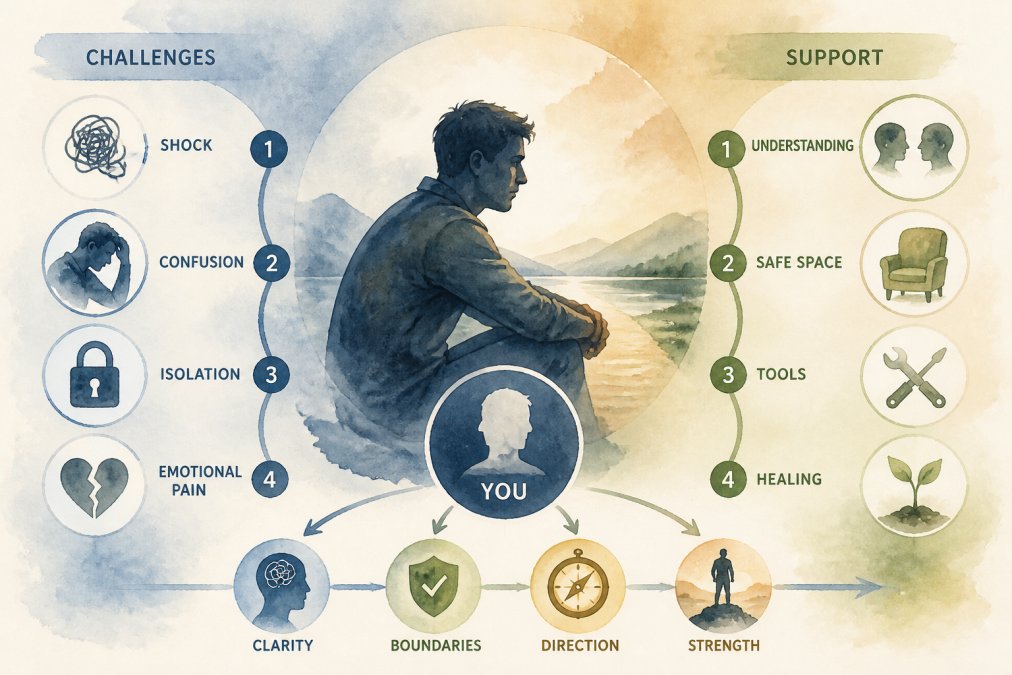
10 Somatic Exercises for Betrayal Trauma Recovery
- What Somatic Exercises Do for Betrayal Trauma
- Nervous System Regulation After Betrayal
- 1. Grounding Through the 5-4-3-2-1 Technique
- 2. Butterfly Hug for Self-Soothing and Emotional Release
- 3. Body Scan and Tracking Physical Sensations
- 4. Pendulation: Moving Between Safety and Sensation
- 5. Voo Sounding and Vocal Release for Anger
- 6. Orienting to Safety in Your Environment
Last Updated: August 29, 2026
What Somatic Exercises Do for Betrayal Trauma
Betrayal trauma rewires your nervous system into constant protection. Talk therapy alone often can’t reach this deeply embedded physiological response. Somatic exercises work directly with your body’s nervous system to undo the protective patterns that keep you trapped in hypervigilance, numbness, or emotional shutdown. These practices help you access and release trapped energy stored in your muscles and tissues, teaching your nervous system that safety is possible again.
Nervous System Regulation After Betrayal
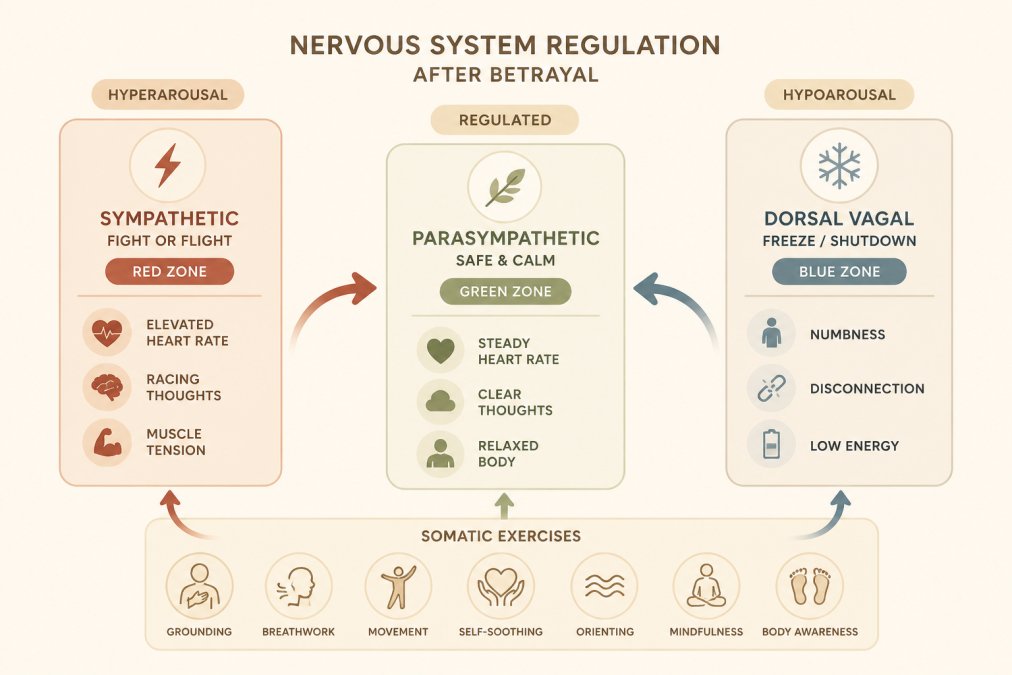
Your nervous system doesn’t distinguish between physical and emotional threats. When betrayal happens, your body responds as if you’ve survived a physical attack, shifting into protection mode and often staying there long after the betrayal is revealed.
In a healthy state, your nervous system moves fluidly between three modes: parasympathetic (calm and regulated), sympathetic (fight-or-flight), and dorsal vagal (freeze). After betrayal, many people get stuck cycling between sympathetic hyperarousal (constant vigilance, racing heart, intrusive thoughts) and dorsal vagal hypoarousal (numbness, disconnection, shutdown).
Somatic exercises interrupt this stuck pattern by giving your nervous system direct feedback that safety is possible. The felt sense, what your body actually experiences in the present moment, becomes the entry point for healing. Somatic experiencing recognizes that betrayal trauma creates a disconnect between what you know intellectually and what your body believes. You might know logically that you’re safe now, but your body remains in protection mode. Somatic exercises close that gap.
The nervous system learns through repetition and safety. Consistency matters more than intensity. Five minutes of daily somatic practice produces more lasting change than occasional longer sessions.
1. Grounding Through the 5-4-3-2-1 Technique
The 5-4-3-2-1 grounding technique is one of the fastest ways to interrupt a betrayal trauma trigger and bring your nervous system back to the present moment.
How to practice the 5-4-3-2-1 technique:
Identify 5 things you can see. Look around and name five specific objects, noticing colors, textures, and shapes.
Name 4 things you can physically feel. Feel your feet on the ground, your back against the chair, fabric of your clothing, or the temperature of the air.
Identify 3 things you can hear. Listen for sounds in your environment, traffic, appliances, birds, or silence.
Name 2 things you can smell. If you can’t detect a smell, deliberately smell something like coffee or lotion.
Identify 1 thing you can taste. Notice the taste in your mouth or eat something small.
This exercise works because it engages all five senses, forcing your brain out of the trauma narrative and into present-moment awareness. Practicing 5-4-3-2-1 several times daily, especially when you first notice a trigger, prevents the nervous system from escalating into full hyperarousal.
Reading this won’t change tomorrow’s message
You Know the Tactic Now. Do You Know What You’ll Actually Do When It Lands?
Understanding grey rock is not the same as doing it at 9pm when your phone buzzes. Most parents can explain the theory perfectly and still bite the bait every single time. The gap between the two is exactly what the free self-check measures.
Get Your Ex Out of Your Head \→5 scenarios \· scored result \· 4 minutes \· free
People experiencing intrusive thoughts or flashbacks triggered by reminders of the betrayal. This technique works in public, at work, or anywhere you need rapid nervous system reset without drawing attention.
2. Butterfly Hug for Self-Soothing and Emotional Release
The butterfly hug is a bilateral stimulation technique that activates both sides of your brain simultaneously, helping process trapped emotions and trauma memories.
How to practice the butterfly hug:
Sit comfortably in a supported position.
Cross your arms over your chest, placing your right hand on your left shoulder and your left hand on your right shoulder.
Close your eyes if that feels safe, or keep them slightly open if closed eyes trigger panic.
Begin alternating taps in a slow, rhythmic pattern, roughly one tap per second.
Continue for 1-2 minutes while allowing any emotions, sensations, or memories to surface.
Bilateral stimulation helps the brain process fragmented trauma memories by engaging both hemispheres, allowing your nervous system to integrate difficult experiences rather than keeping them compartmentalized.
3. Body Scan and Tracking Physical Sensations
A body scan rebuilds your relationship with your physical body by systematically bringing awareness to each part and the sensations present there.
How to practice a body scan:
Lie down or sit comfortably where you won’t be interrupted for 10-15 minutes.
Close your eyes and take three deep breaths: in through your nose for a count of 4, hold for 4, exhale through your mouth for 4.
Start at the top of your head and slowly move your attention down through your body: eyes and face, jaw and throat, shoulders, arms, hands, chest, belly, lower back, hips, thighs, calves, feet. Spend 30-60 seconds with each area.
Notice without changing. The goal is not to relax or fix anything, but to gather information about what your body is experiencing.
Tracking physical sensations is the core skill of somatic work. When you can identify where you hold tension or numbness, you gain the ability to work with these patterns intentionally.
If a body scan triggers intense panic, flashbacks, or dissociation, stop and return to grounding techniques like 5-4-3-2-1. Work with a trauma-informed therapist if you have severe dissociation.
4. Pendulation: Moving Between Safety and Sensation
Pendulation is a somatic technique where you deliberately move your nervous system’s attention between a place of safety and a place of activation or discomfort, teaching your nervous system that it can process difficult sensations without becoming overwhelmed.
How to practice pendulation:
Identify a place of safety in your body, your feet on the ground, your hands in your lap, or any area where you feel calm. Spend 30 seconds focusing on this safe place.
Shift your attention to an area where you hold tension or discomfort. Simply notice it for 30 seconds without pushing into the sensation.
Return to your safe place for another 30 seconds.
Pendulate back and forth between the safe place and the area of activation 5-10 times. Each time you return to safety, your nervous system receives the message that the activation is manageable.
Pendulation mimics how a healthy nervous system naturally moves between activation and calm. By practicing pendulation, you’re retraining your nervous system to oscillate between these states rather than getting locked in one.
Understanding the pattern is not the same as breaking it
You Can Explain Why This Happened. Can You Explain Why You’re Still Stuck In It?
Most people in affair recovery can narrate their entire situation with total clarity, the timeline, the triggers, the whole story, and still find themselves back in the same spiral by evening. Insight was never the missing piece. This free assessment shows you exactly where the gap actually is.
Take the Free Affair Recovery Clarity Check \→A few honest questions \· a scored result \· 4 minutes \· free
5. Voo Sounding and Vocal Release for Anger
Voo sounding is a vocal release technique where you create a low, humming sound from deep in your chest, engaging the vagus nerve and helping release trapped anger and grief.
How to practice voo sounding:
Sit or stand with your spine upright to allow your diaphragm to engage fully.
Take a deep breath in through your nose.
On the exhale, make a low “voo” sound from deep in your chest, like a foghorn, sustained for the entire exhale.
Repeat for 5-10 breaths, allowing the sound to come from your belly rather than your throat.
Voo sounding stimulates the vagus nerve, signaling safety to your nervous system and activating the parasympathetic response. Many people who’ve experienced betrayal have learned to suppress anger as a survival strategy. Voo sounding gives you permission and a container to release this stored anger safely.
Voo sounding is most effective when you combine it with the intention of release. As you make the sound, you might silently say: “I release the anger I’ve been holding” or “I let go of what I cannot control.”
::: psychiatric care for trauma.
6. Orienting to Safety in Your Environment
Orienting is a somatic technique where you deliberately direct your attention to elements of your current environment that signal safety, retraining your nervous system to notice safety cues instead of threats.
How to practice orienting to safety:
-
Look around your environment slowly, moving your eyes deliberately rather than with the rapid scanning of hypervigilance.
-
Identify three things that represent safety to you, a photo of someone you trust, a plant, a favorite object, a window with a view, or anything that creates calm.
-
Focus on each one for 15-20 seconds, noticing the details.
-
Notice what happens in your body as you focus on these safety cues. Many people feel a slight relaxation in their shoulders or a softening in their chest.
-
Practice this daily, especially in the morning and before bed, to train your nervous system to default to noticing safety.
:::bestfor
People stuck in hypervigilance who find themselves constantly braced for the next betrayal or conflict. Orienting retrains the nervous system to notice that safety exists in the present moment.
Integrating Somatic Exercises with Talk Therapy and Communication Tools
Somatic exercises work best as part of a comprehensive healing approach. While these practices regulate your nervous system, they don’t address the cognitive and relational dimensions of betrayal trauma. After practicing somatic exercises, you’re better able to access and process emotions in therapy. When your nervous system is regulated, you’re more capable of using structured communication tools to navigate difficult conversations without becoming dysregulated.
For those managing high-conflict co-parenting, this integration is critical. You might practice pendulation in the morning to resource your nervous system, use orienting techniques before a difficult phone call, and then employ structured communication scripts to manage the interaction itself.
Progress Tracking: Knowing When Somatic Work Is Working
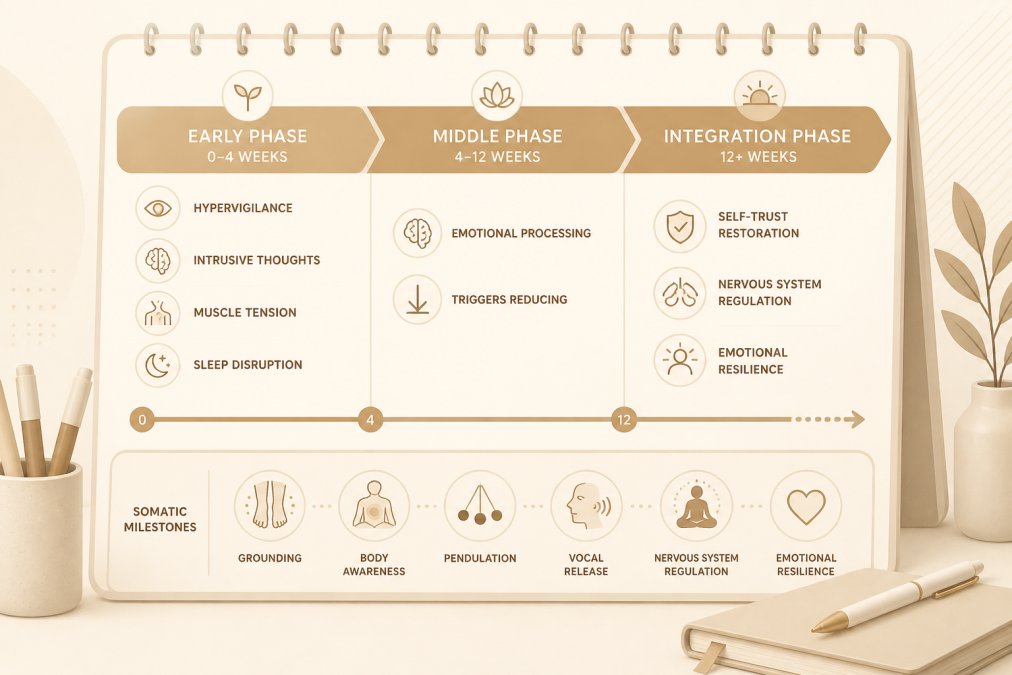
Healing from betrayal trauma isn’t linear. Tracking specific markers helps you recognize that somatic work is creating real change in your nervous system.
What to track:
Trigger response time: How long does it take after a trigger for your nervous system to return to baseline? This often shortens as you practice.
Frequency of intrusive thoughts: Are betrayal-related thoughts appearing less often?
Physical tension patterns: Are you noticing less jaw clenching, shoulder tension, or chest tightness?
Sleep quality: As your nervous system regulates, sleep often improves.
Capacity for difficult conversations: Can you engage in challenging interactions without becoming dysregulated?
Noticing the pattern is not the same as proving it
You Can Feel the Pattern. Can You Prove It to a Judge?
A diary of what happened reads as emotional venting. A structured, timestamped record reads as evidence. Most parents lose that distinction until it costs them. The free checklist shows you exactly what to document today, before the evidence window closes.
Get the Free Red Flag Checklist \→3 categories \· 5 minutes \· free
The goal of somatic exercises is not to eliminate all stress or anger related to betrayal. The goal is to restore your nervous system’s capacity to regulate, to move between activation and calm, to feel emotions without being overwhelmed by them, and to trust your body as a source of information and safety again.
| Somatic Exercise | Primary Purpose | Best For | Time Required | Frequency |
|---|---|---|---|---|
| 5-4-3-2-1 Grounding | Interrupt intrusive thoughts and hypervigilance | Acute triggers and flashbacks | 2-5 minutes | As needed, multiple times daily |
| Butterfly Hug | Release trapped emotions and anger | Processing grief and rage | 1-2 minutes | Daily or 2-3 times weekly |
| Body Scan | Rebuild body awareness and reduce dissociation | Rebuilding interoception and safety | 10-15 minutes | 3-5 times weekly |
| Pendulation | Teach nervous system to move between activation and calm | Processing difficult sensations safely | 5-10 minutes | Daily |
| Voo Sounding | Stimulate vagus nerve and release anger | Vocal expression of suppressed emotion | 3-5 minutes | Daily or as needed |
| Orienting to Safety | Retrain nervous system to notice safety cues | Reducing hypervigilance and anxiety | 5 minutes | Daily, especially morning and evening |
Your Path Forward
Betrayal trauma lives in your nervous system as well as your mind. The somatic exercises in this guide offer direct pathways to nervous system regulation and healing by teaching your body that safety is possible again.
Consistency matters more than perfection. Start with one or two exercises that resonate with you, practice them daily, and notice what shifts. As your nervous system becomes more regulated, you’ll find yourself more capable of processing the emotional and relational dimensions of betrayal and more able to navigate difficult interactions with clarity and boundaries.
If you’re also managing high-conflict co-parenting or struggling with communication after betrayal, the structured frameworks from After the Affair Series complement these somatic practices. Get started with After the Affair Series and access the communication frameworks, co-parenting scripts, and structured decision-making tools designed specifically for individuals navigating betrayal, separation, and high-conflict situations. Your nervous system can heal, and your capacity to show up regulated, for yourself and your children, is within reach.
Additional Resources
For more information on somatic approaches to trauma healing, explore the Somatic Experiencing Practitioner Directory, which connects you with certified professionals trained in this evidence-based approach.
Research from the Sensorimotor Psychotherapy Institute provides free guided somatic practices and educational resources on how the body holds and releases trauma.
The PTSD Coach App from the VA offers free tools for managing trauma symptoms, including relaxation techniques and coping strategies that complement somatic exercises.
Frequently Asked Questions
How can somatic exercises help me heal after being betrayed?
Somatic exercises work directly with your nervous system to process the trauma stored in your body. Betrayal trauma creates a state of hyperarousal or shutdown, where your body remains stuck in fight-or-flight or freeze responses. These exercises teach your nervous system to recognize safety again through grounding, movement, and breath. By releasing the physical tension and repressed emotions held in your muscles, you rebuild the body-mind connection and restore your capacity for self-regulation and emotional processing.
What are the most common triggers for betrayal trauma?
Common betrayal trauma triggers include reminders of the infidelity (places, dates, times of day), contact with the person who betrayed you, intimacy or physical touch, situations requiring trust, and unexpected changes in routine. Your nervous system may react with panic, rage, or numbness even when you’re cognitively aware the trigger is not an immediate threat. Somatic exercises help you develop the capacity to notice these triggers without becoming flooded, creating space between the trigger and your response.
Can somatic exercises replace therapy for betrayal trauma recovery?
Somatic exercises are a powerful complement to therapy, not a replacement. They address the body-level responses that talk therapy alone may not reach. The most effective healing integrates both: talk therapy helps you process the narrative and meaning of the betrayal, while somatic work regulates your nervous system and releases stored trauma. If you’re experiencing severe PTSD symptoms, hypervigilance, or suicidal thoughts, professional mental health support is essential. Somatic exercises work best alongside clinical care.
How long does it take to see results from somatic exercises for betrayal trauma?
Some people notice shifts in their nervous system response within days of consistent practice, calmer sleep, reduced heart racing, or less emotional reactivity. Deeper healing typically unfolds over weeks and months as you build new neural pathways and process stored emotions. Progress is not linear; you may have days of breakthrough followed by setbacks. Consistency matters more than intensity. Most people report meaningful improvement in emotional regulation and self-trust with daily or near-daily practice, especially when combined with therapy.
Are there any contraindications or safety warnings for somatic exercises with betrayal trauma?
Yes. Somatic work can activate intense emotions or traumatic memories, so it’s important to start slowly and titrate (gradually increase intensity). Avoid intensive somatic practices if you’re in active crisis, acutely suicidal, or in an unsafe relationship. Some exercises like voo sounding may feel destabilizing if you have severe dissociation. Always work with a trauma-informed professional if you have a history of severe PTSD, eating disorders, or self-harm. Begin with grounding and orienting exercises before moving to deeper emotional release work.
Understanding the pattern is not the same as breaking it
You Can Explain Why This Happened. Can You Explain Why You’re Still Stuck In It?
Most people in affair recovery can narrate their entire situation with total clarity, the timeline, the triggers, the whole story, and still find themselves back in the same spiral by evening. Insight was never the missing piece. This free assessment shows you exactly where the gap actually is.
Take the Free Affair Recovery Clarity Check \→A few honest questions \· a scored result \· 4 minutes \· free