Last Updated: August 5, 2026
What Emotional Volatility After Betrayal Actually Is
- What Emotional Volatility After Betrayal Actually Is
- Understanding Emotional Flooding After Infidelity
- How to Regulate Your Nervous System After Trauma
- The Stages of Healing From Betrayal
- Managing Triggers and Intrusive Thoughts
- Healthy vs. Unhealthy Expressions of Anger
- When to Seek Professional Therapy and Support
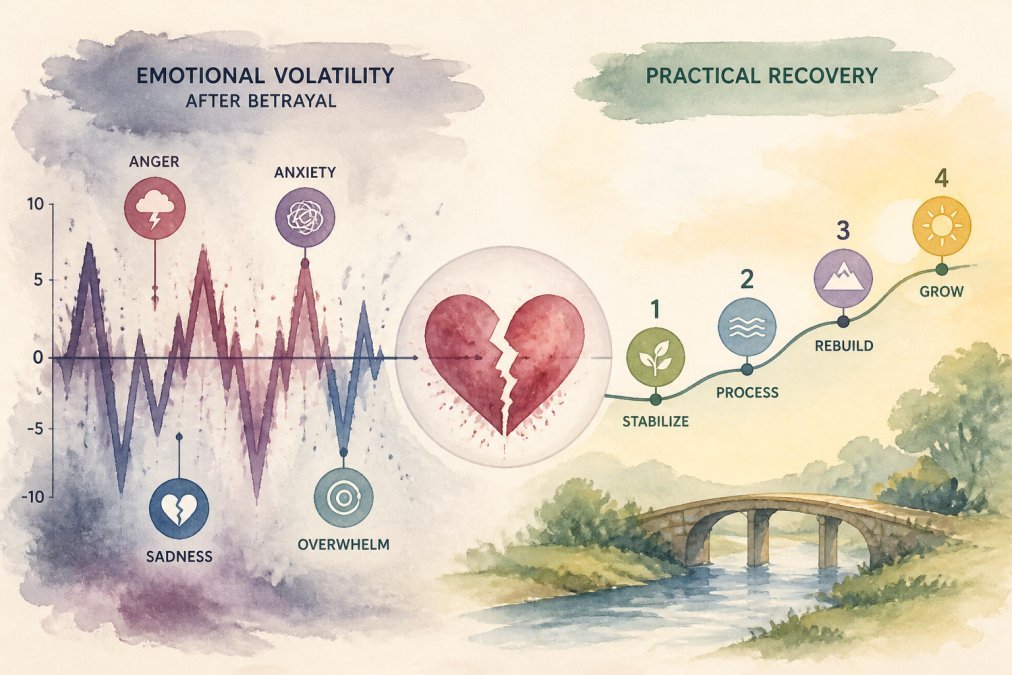
Emotional volatility after betrayal is the unpredictable swings between rage, despair, numbness, and false calm that follow discovery of infidelity or relational betrayal. Your nervous system has shifted into constant threat detection. You’re not overreacting; your brain is responding to genuine injury that activates the same neural pathways as physical trauma.
The discovery of betrayal destabilizes your sense of reality. The person you trusted becomes a stranger. Your body floods with cortisol and adrenaline, keeping you in hyperarousal where you’re simultaneously exhausted and unable to rest. Your nervous system is doing exactly what it’s designed to do when it perceives threat, the problem is this protection mechanism becomes destructive when activated for weeks or months.
The physical and psychological reality
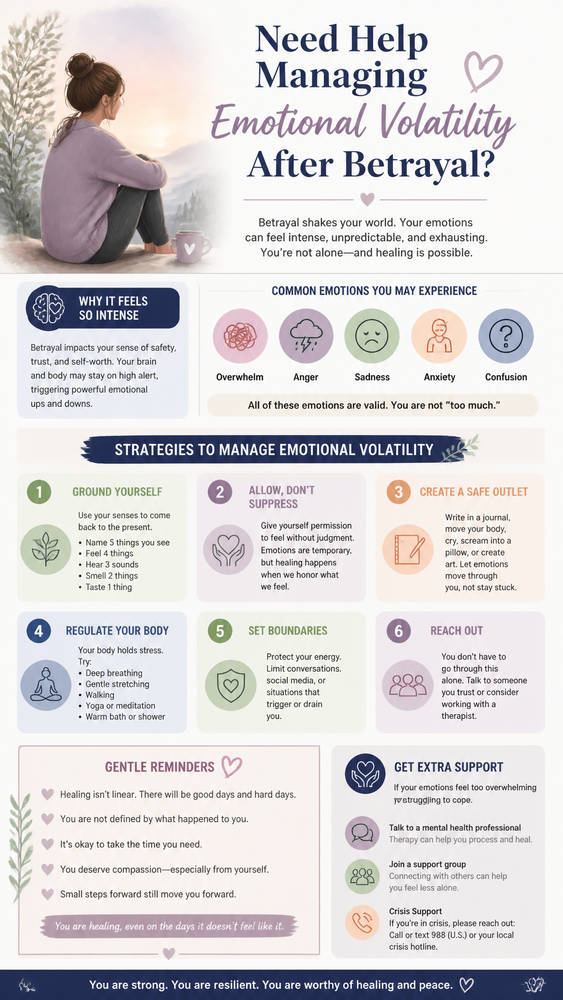
Your body holds the betrayal. Chest tightness, jaw clenching, insomnia, and nausea aren’t signs of weakness; they’re somatic symptoms of post-traumatic stress. Intrusive thoughts replay the betrayal obsessively. Hypervigilance toward your partner’s behavior creates persistent danger even in moments of safety.
The psychological component involves “attachment injury,” a wound to the core belief that your partner would keep you safe. This isn’t just about the infidelity; it’s about the betrayal of trust and the discovery that the person closest to you prioritized their desires over your wellbeing.
Many people in this state make major relationship decisions while their nervous system is in crisis mode. Clarity is nearly impossible when dysregulated. Before making any final decisions about your relationship, stabilize your nervous system first. This doesn’t mean staying or leaving; it means getting to a place where you can think clearly about what you actually want.
Why your nervous system is in overdrive
When you discover betrayal, your brain’s threat-detection system activates instantly. The amygdala perceives the betrayal as a survival threat. To your nervous system, emotional danger is an emergency just like physical danger.
This activation triggers fight-or-flight. Your body floods with stress hormones and your prefrontal cortex, the rational thinking part of your brain, goes offline. You’re left operating from your limbic system, designed to keep you alive in danger. This is why you might yell at your partner one moment and be unable to speak the next. This is why you can’t sleep despite exhaustion.
Hyperarousal keeps your nervous system scanning for threat. You notice every text message, every hesitation in your partner’s voice, every late arrival home. Your brain is trying to predict danger to protect you. This vigilance is exhausting and unsustainable.
Your nervous system doesn’t distinguish between real and perceived threat. Grounding techniques, methods that bring your awareness back to the present moment and your physical safety, interrupt the threat-detection cycle by providing evidence that you’re actually safe right now.
Understanding Emotional Flooding After Infidelity
Emotional flooding after infidelity is the sudden, overwhelming surge of feeling that hits without warning: rage so intense you can’t see straight, despair so deep you can’t imagine recovery, panic so acute you think you’re having a heart attack. These aren’t meltdowns; they’re your nervous system in acute dysregulation.
Flooding typically lasts 20 minutes to an hour, though it feels much longer when you’re in it. During a flood, your rational mind is offline. You cannot problem-solve, communicate clearly, or make good decisions. Your only job is to survive it and help your nervous system downregulate.
The fight-or-flight response and attachment injury
The betrayal activates your fight-or-flight response because it threatens your primary attachment, your sense of safety with the person closest to you. Attachment injury runs deeper than simple hurt. It’s a wound to your fundamental belief that you matter, that your wellbeing was important enough to protect.
When fight-or-flight activates, you experience one of several responses: Fight shows up as rage and aggressive confrontation. Flight shows up as the urge to leave and escape. Freeze shows up as numbness and dissociation. Fawn shows up as people-pleasing and over-apologizing. None of these responses is a character flaw; all are your nervous system attempting to protect you from further harm.
Your partner, who’s supposed to be your safe harbor, is now the source of threat. This creates a painful paradox: you want closeness with the person who hurt you while also wanting to protect yourself from them.
Triggers, intrusive thoughts, and hyperarousal
A trigger is anything, a location, song, time of day, phrase, or smell, that reminds your nervous system of the betrayal and activates the threat-response cycle again. Triggers aren’t rational, and you might be fine until suddenly something catapults you into acute distress.
Intrusive thoughts are obsessive replaying of the betrayal. Your mind cycles through details searching for a pattern that prevents this from happening again. Rumination actually strengthens the neural pathways associated with trauma, making intrusive thoughts more frequent and intense.
Hyperarousal is constant vigilance. Your nervous system stays activated, scanning for threat. You might startle easily, have trouble concentrating, feel irritable, or experience racing thoughts.
Triggers, intrusive thoughts, and hyperarousal create a feedback loop: a trigger activates the threat response, which generates intrusive thoughts, which keeps you in hyperarousal, which makes you more sensitive to triggers. Breaking this loop requires interventions that work at the nervous system level, not just the cognitive level.
How to Regulate Your Nervous System After Trauma
Nervous system regulation is the practice of bringing your body back into a state where your parasympathetic nervous system, your “rest and digest” system, can function again. The goal is not to eliminate emotion but to create enough nervous system stability that you can feel your emotions without being overwhelmed and make decisions from your values rather than panic.
Somatic grounding techniques for acute volatility
Somatic techniques work directly with your body’s nervous system response. They’re not about thinking your way to calm; they’re about using physical sensation to interrupt the threat-detection cycle.
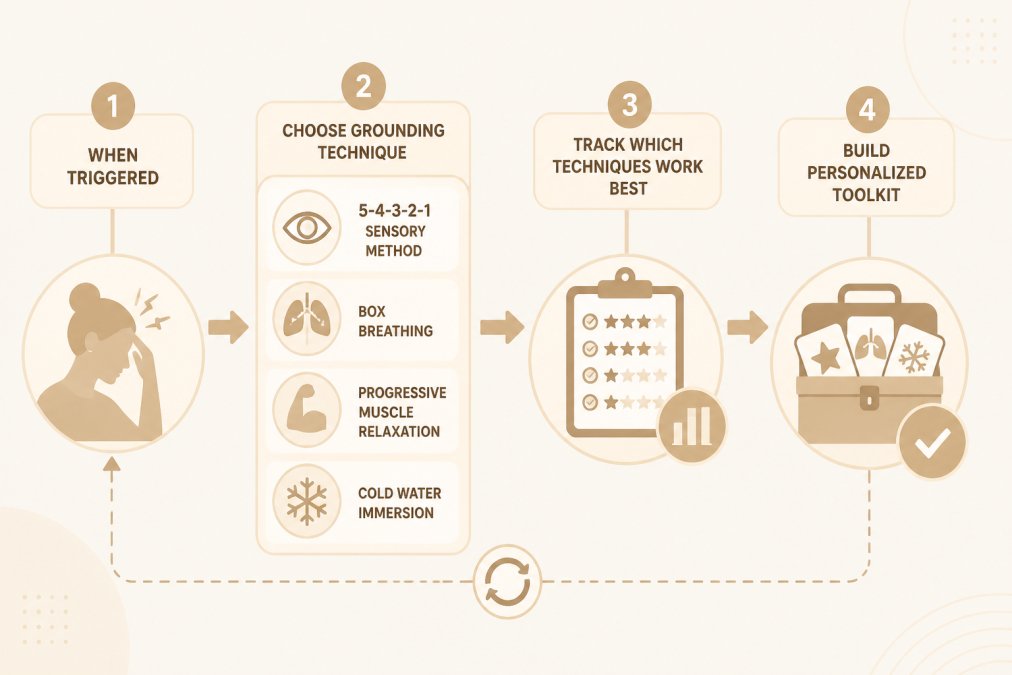
The 5-4-3-2-1 sensory grounding method anchors your awareness to present-moment sensation. Name five things you can see, four things you can touch, three things you can hear, two things you can smell, and one thing you can taste. This interrupts the intrusive thought cycle by redirecting your brain’s attention to sensory data confirming you’re safe right now.
Box breathing is simple but powerful: inhale for a count of four, hold for four, exhale for four, hold for four. Repeat for 5-10 cycles. The extended exhale activates your parasympathetic nervous system. Your body interprets a longer exhale as a signal that the threat has passed.
Progressive muscle relaxation involves tensing and releasing different muscle groups systematically. This gives your mind a concrete task and teaches your body what relaxation feels like after tension.
Cold water immersion, splashing cold water on your face or holding ice, activates the dive response, a parasympathetic reflex that slows your heart rate and shifts you out of fight-or-flight. It works quickly for acute flooding.
Find which techniques work for your nervous system. Build a personal toolkit by experimenting during lower-intensity distress, so you know what works when dysregulated.
Self-soothing and nervous system reset practices
Self-soothing is providing yourself with comfort and safety signals when your nervous system is activated. Warm beverages and wrapping yourself in a blanket activate parasympathetic response. Your body interprets these signals as “the threat has passed, it’s safe to rest.”
Movement is a powerful regulator. Gentle yoga, walking, or dancing helps discharge stress hormones accumulated during dysregulation. Bilateral stimulation, alternating left-right stimulation of your nervous system through walking or tapping, helps process trauma.
Social connection is one of the most powerful nervous system regulators available, but only if the connection feels safe. A phone call with someone who understands or sitting near someone without talking helps your nervous system recognize you’re not alone.
Many people in [betrayal trauma](/physical-symptoms-of-betrayal-trauma/) states withdraw socially due to shame or fear of judgment. This withdrawal intensifies dysregulation. If you can identify even one or two people who provide safe connection without judgment, prioritize that connection. Your nervous system needs to know you’re not isolated.
The Stages of Healing From Betrayal
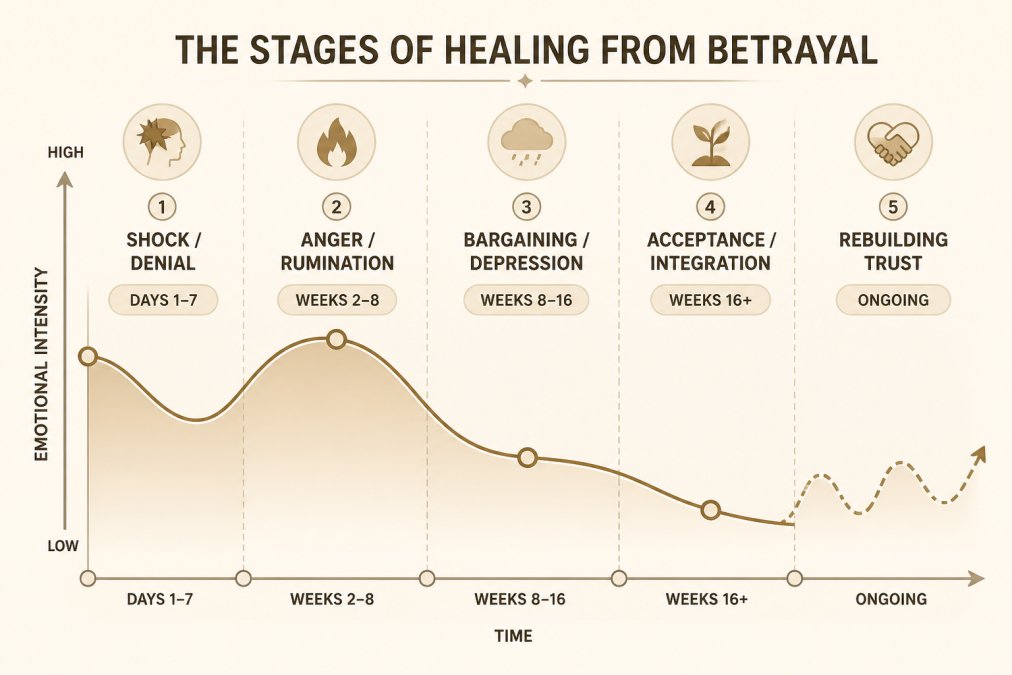
Healing from betrayal is not linear. You cycle through stages, sometimes spending weeks in one, sometimes moving through multiple in a single day. Understanding these stages helps you recognize where you are and what your nervous system needs.
Shock and denial to anger and rumination
The shock stage typically lasts days to a few weeks. Your mind cannot process what happened. Shock is a mercy. It keeps you functional when the full reality would be paralyzing.
As shock wears off, anger emerges. This anger is fierce and necessary. It’s your nervous system recognizing the violation and mobilizing energy to protect yourself. The anger stage is when you might confront your partner or demand answers. It’s also when you’re most likely to make impulsive decisions.
Rumination follows. Your mind cycles obsessively through betrayal details, searching for clues you missed. This rumination feels productive, like solving a puzzle, but it keeps you stuck. The betrayal wasn’t logical. Your partner made a choice that violated your trust. No amount of analysis will change that.
Take the free 23-point assessment →
Rebuilding trust and emotional safety
Rebuilding trust is the longest stage. It’s not about trusting your partner again, though that may eventually happen. It’s about rebuilding trust in yourself, in your ability to recognize and respond to threat, and in your capacity to create safety in your life.
This stage involves setting clear boundaries with your partner about acceptable behaviors and consequences for violations. It involves rebuilding your sense of self outside the relationship and grieving the relationship you thought you had.
Many people need professional support during this stage. A trauma-informed therapist can help you process the attachment injury, regulate your nervous system, and make clear-headed decisions about your relationship. After the Affair Series provides structured frameworks that help you navigate these conversations with clarity and protect your emotional wellbeing.

Managing Triggers and Intrusive Thoughts
Triggers are individual and connected to the specific details of your betrayal, your personal history with abandonment or betrayal, and the neural pathways your brain has formed in response to trauma.
Identifying your personal triggers
A trigger is anything that activates your threat-detection system and pulls you back into acute distress. It might be a location where the infidelity occurred, the day of the week you discovered it, your partner’s phone buzzing, a particular cologne, or a song that was playing when you found out.
Start tracking triggers by noticing when you experience sudden emotional or physical shifts. Write these down. Over time, patterns will emerge. Some triggers are avoidable; if a particular restaurant triggers you, you can avoid it for now. For unavoidable triggers, the work is desensitization: gradually exposing yourself to the trigger in small doses while your nervous system is regulated, so your brain learns the trigger itself is not dangerous.
Stopping rumination and regaining mental clarity
Rumination is obsessive cycling through betrayal details. It feels like problem-solving but is actually a symptom of your brain being stuck in threat-detection mode. Rumination strengthens the neural pathways associated with trauma.
Recognize when you’re ruminating. Is it solving a problem or cycling through the same details? When you notice rumination, interrupt it using a grounding technique. Break the rumination cycle before it gains momentum.
Set boundaries on rumination time. Allow yourself 15 minutes in the morning and 15 minutes in the evening to process thoughts and feelings about the betrayal. Outside those windows, when rumination starts, interrupt it and redirect your attention. This isn’t suppressing thoughts; it’s not feeding them.
Healthy vs. Unhealthy Expressions of Anger
Anger after betrayal is valid and necessary. It’s a sign that you recognize the violation. The question is not whether to feel anger, but how to express it in ways that don’t harm you or your family.
Recognizing emotional dysregulation
Emotional dysregulation is when your emotional response is disproportionate to the current situation, or when you’re unable to shift out of an emotional state even when the trigger is gone. Dysregulation is not a character flaw. It’s a symptom of your nervous system being in overdrive.
Recognizing dysregulation in yourself is the first step toward managing it. Notice the physical signs: chest tightening, jaw clenching, voice getting louder, thoughts becoming scattered. These are signs your nervous system is activated and your rational mind is going offline.
Channels for processing anger constructively
Anger needs somewhere to go. If you suppress it, it festers. If you direct it at your partner, it escalates conflict. If you direct it at yourself, it becomes depression or self-harm. Find channels that allow you to process and discharge anger without harming yourself or others.
Physical movement is one of the most effective channels. Intense exercise, running, boxing, or dancing allows your body to discharge stress hormones associated with anger. Creative expression works for many people. Writing, painting, or music allows you to externalize anger and give it form.
Talking about anger with someone who can hold space without judgment helps. A therapist, trusted friend, or support group can provide this space.
Expressing anger directly at your partner during dysregulation typically escalates conflict and can damage your case if custody or legal issues are involved. If you have children, expressing rage in front of them teaches them this is how adults handle conflict. Find outlets for raw anger before attempting to communicate with your partner about what happened.
When to Seek Professional Therapy and Support
There’s no shame in needing professional help. Working with a trauma-informed therapist accelerates healing significantly.
Recognizing post-traumatic stress symptoms
Post-traumatic stress after betrayal includes intrusive thoughts you can’t control, nightmares about the betrayal, avoidance of places or people associated with it, emotional numbness or hyperarousal, difficulty concentrating, and persistent feelings of danger or shame.
If these symptoms persist beyond the first few weeks, or if they’re interfering with your ability to function at work or care for your children, professional support is warranted. Early intervention prevents symptoms from becoming entrenched. Trauma therapies like EMDR or Somatic Experiencing work directly with the nervous system to help it process and integrate trauma.
Navigating social isolation during recovery
Many people experiencing betrayal trauma withdraw from their support system due to shame, fear of judgment, or emotional exhaustion. This isolation intensifies the trauma.
You need connection during this time, even if it feels impossible. Start small. A text conversation with one person who understands. A phone call with a friend who doesn’t require explanation. Support groups for people navigating infidelity or betrayal can be invaluable. Hearing other people’s stories and realizing you’re not alone is powerful.
If you have children, maintaining your parental role and connection with them is crucial, even when struggling. Children need to see you’re managing, getting help, and that their emotional needs matter. Having concrete tools makes it easier to reach out for support and communicate your needs. After the Affair Series provides specific frameworks and scripts for navigating these conversations and managing high-conflict situations with clarity.
Dealing with emotional volatility after betrayal is one of the hardest things you’ll face. Your nervous system has been wounded. Your trust has been violated. But healing is possible. Thousands of people have moved through this devastation and rebuilt their lives and relationships.
The path forward starts with stabilizing your nervous system so you can think clearly. It continues with understanding what you’re experiencing and recognizing that your responses are normal reactions to abnormal circumstances. It includes getting professional support when you need it and building a support system around you. And it involves making intentional choices about your relationship and your life from a place of clarity rather than crisis.
After the Affair Series is designed specifically for people in this situation. It provides the frameworks, scripts, and structured guidance that help you navigate the most difficult moments with clarity and protect your emotional wellbeing while you’re deciding what comes next. Take the free 23-point assessment to get clarity on where you are in your healing journey and what support you need.