TL;DR:
- Emotional responses to infidelity are normal and include shock, anger, grief, and anxiety.
- Clarifying personal needs and setting boundaries helps create stability for decision-making.
- Support from therapy and taking time before making permanent choices are crucial for healing.
Discovering an affair turns your world upside down in ways that are genuinely hard to describe. The shock, the grief, the anger, and the desperate need to know what to do next can all hit at once, leaving you paralyzed. You might feel pressure to make life-changing decisions before you even know what you want. This guide walks you through a structured, research-informed approach to post-affair decision-making, so you can move forward with more clarity and less regret, whether that means staying, leaving, or simply surviving the next few days.
Table of Contents
- Understanding your emotional landscape
- Clarifying your priorities and boundaries
- Choosing a path: Stay, leave, or rebuild?
- Getting help: Therapy and outside support
- Making decisions with children or complex circumstances
- Our perspective: What matters most after infidelity
- Next steps: Resources and support for your healing journey
- Frequently asked questions
Key Takeaways
| Point | Details |
|---|---|
| Normalize your emotions | Strong feelings after an affair are natural and require careful attention, not shame. |
| Clarify your boundaries | Defining non-negotiables, needs, and limits helps guide effective decision-making. |
| Consider your options carefully | Each path after infidelity has unique challenges, so evaluate them using both facts and feelings. |
| Professional help matters | Therapy and expert resources can make a significant difference, especially in complex situations. |
| Children change the picture | Having children increases reconciliation chances but also complexity, requiring extra care. |
Understanding your emotional landscape
Before you can make any meaningful decision, you need to understand what is happening inside you. The emotional aftermath of an affair is not a sign of weakness. It is a normal, predictable response to a profound betrayal.
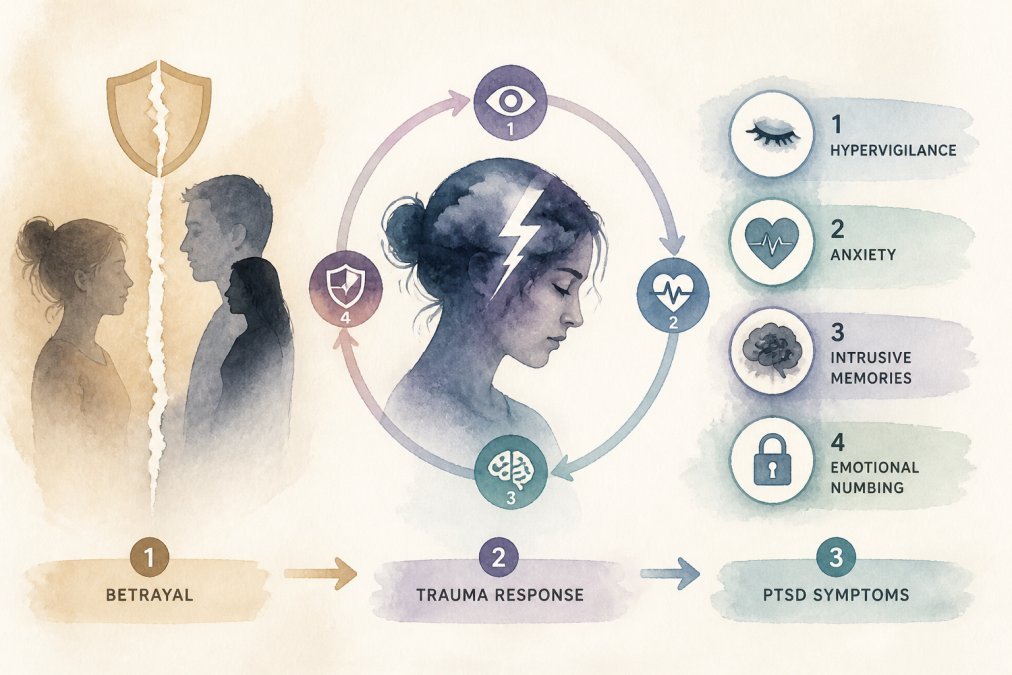
Most people cycle through a cluster of intense feelings in the early weeks. These include:
- Shock and disbelief: The mind’s first protective response, often making the situation feel unreal
- Anger and rage: Directed at the unfaithful partner, the affair partner, or even yourself
- Grief: Mourning the relationship you thought you had, and sometimes the future you imagined
- Anxiety: Constant hypervigilance, intrusive thoughts, and difficulty sleeping
- Guilt: Particularly common among betrayed partners who wonder if they somehow caused it
These emotions do not arrive in a neat order. They overlap, contradict each other, and resurface without warning. That is completely normal when processing emotional trauma after infidelity.
The type of affair also shapes the emotional experience. Research shows that emotional affairs often produce a harder and sometimes shorter recovery than physical ones, largely because the sense of emotional abandonment cuts deeper. The same data shows that repeated infidelity lowers reconciliation rates significantly, while the presence of children increases the odds of couples staying together by 37%. Full disclosure, meaning the unfaithful partner sharing the truth completely, boosts recovery success by 55%.
| Factor | Impact on recovery |
|---|---|
| Emotional affair vs. physical | Harder emotional recovery |
| Repeated infidelity | Reconciliation fails in ~71% |
| Children present | +37% chance of staying together |
| Full disclosure | +55% recovery success rate |
Understanding where you fall on this spectrum helps you approach emotional vs physical affair healing with realistic expectations rather than false hope or unnecessary despair.
Pro Tip: Keep a simple daily journal during the first weeks. Even five sentences about what you felt that day helps you track patterns, spot triggers, and communicate more clearly with a therapist or partner later.
Clarifying your priorities and boundaries
Once you have mapped your emotional terrain, the next task is to find clarity about what truly matters to you. This is not about deciding the future of your relationship yet. It is about knowing what you need right now to feel safe enough to think clearly.
Start with three core questions:
- What do I need to feel physically and emotionally safe? This might mean separate sleeping arrangements, no contact with the affair partner, or simply having a trusted friend available.
- What behaviors are absolute deal-breakers for me? Knowing your non-negotiables before conversations start prevents you from agreeing to things you will later resent.
- What would genuine remorse and accountability look like from my partner? Vague apologies are not the same as sustained, transparent accountability.
Setting early boundaries is not about punishment. It is about creating enough stability to think. You are not obligated to make permanent decisions while in crisis.
Research consistently supports this approach. Full disclosure increases recovery success rates by 55%, which means that how your partner responds to your need for transparency is one of the most reliable early indicators of whether healing is even possible.
| Boundary type | Purpose | Example |
|---|---|---|
| Informational | Reduce uncertainty | Full timeline of the affair |
| Contact | Protect safety | No communication with affair partner |
| Emotional | Reduce re-traumatization | No minimizing or blame-shifting |
| Practical | Maintain stability | Agreement on finances, living arrangements |
Addressing betrayal trauma directly, rather than avoiding it, is what allows you to eventually make decisions from a grounded place rather than a reactive one.
Pro Tip: Write your boundaries down before any difficult conversation. Spoken boundaries under emotional pressure are easy to walk back. Written ones are harder to forget or minimize.
Building trust after betrayal takes time, and that process cannot begin until both partners agree on what honesty and accountability actually look like in practice.
Choosing a path: Stay, leave, or rebuild?
After you have defined your priorities, it is time to weigh your options. Most people face three broad paths: separation, reconciliation, or staying undecided while continuing to gather information and heal.
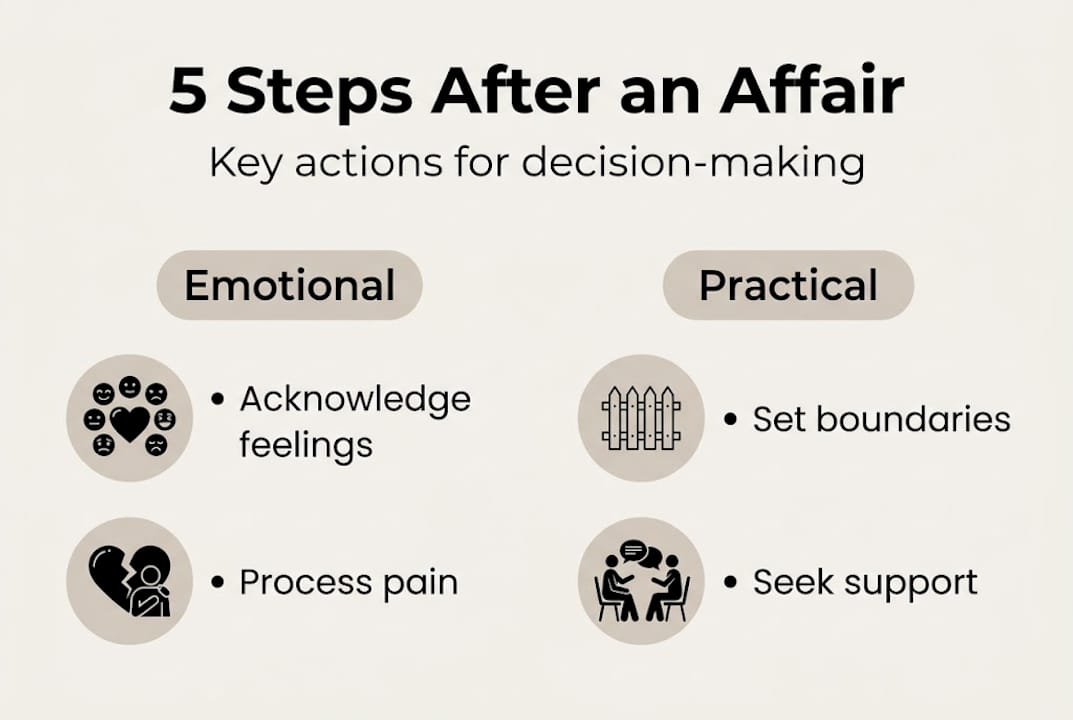
None of these is inherently right or wrong. The right path depends on your specific situation, your values, and what you can genuinely live with long-term.
Key factors to weigh:
- Whether this was a first offense or a pattern of repeated infidelity
- Whether the affair was primarily emotional, physical, or both
- Whether your partner has shown genuine remorse and willingness to change
- Whether children are involved and how they are being affected
- Whether you can envision rebuilding trust given your history together
The statistics here are worth knowing. Therapy can support posttraumatic growth after infidelity, but only 15 to 25% of couples experience what researchers consider full recovery. Many people who stay in the relationship struggle long-term, and the risk of further betrayal remains real.
“Staying is not the same as healing. Leaving is not the same as failing. The only meaningful measure is whether you are moving toward a life that reflects your values and allows you to feel safe.”
For many people, the most honest answer in the early months is: I do not know yet. That is not weakness. That is wisdom. Navigating infidelity in the first months is its own distinct challenge, and rushing a permanent decision during that window often leads to choices people later regret in both directions.
Give yourself permission to stay in the question while still taking action on your own healing.
Getting help: Therapy and outside support
With the main options outlined, many find that support and expertise are crucial for healing. Trying to navigate this alone is possible, but it is significantly harder and slower.
Therapy offers several things that self-help resources cannot fully replicate: a trained outside perspective, a structured space for emotional regulation, and accountability for both partners if you are working on reconciliation.
Steps to finding the right support:
- Start with individual therapy first. You need a space that is entirely yours before entering couples work.
- Look for trauma-informed practitioners. Not all therapists are trained in infidelity recovery specifically. Ask directly.
- Consider couples therapy only when both partners are willing. Forced participation rarely produces meaningful change.
- Explore online options if access or cost is a barrier. Quality support does not require in-person sessions.
- Look into group support. Peer support groups for betrayed partners can reduce isolation significantly.
Research confirms that therapy can help couples achieve genuine posttraumatic growth and improved communication after infidelity, even when the relationship ultimately ends. Growth is not only possible within a reconciled marriage. It can happen through separation too.
Understanding the role of therapists in recovery helps you ask better questions and set realistic expectations from the start. If in-person therapy feels inaccessible, online affair recovery for couples has become a credible and effective alternative.
Pro Tip: Before your first therapy session, write a brief summary of what happened and what you most need help with. Therapists work more efficiently when you can orient them quickly rather than spending the first session just catching up.
For those supporting others through this, the role of counseling in betrayal recovery and guidance on how to guide clients after infidelity offer valuable frameworks.
Making decisions with children or complex circumstances
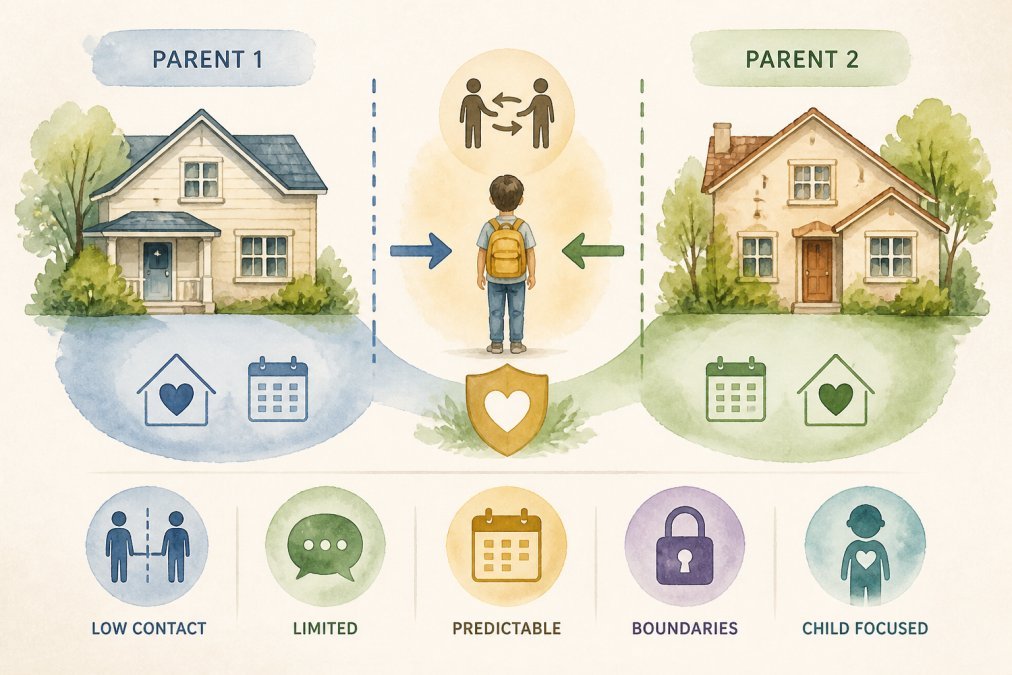
Complex circumstances like children often change the decision and the recovery process in significant ways. When children are part of the picture, the stakes feel higher, the decisions feel more permanent, and the emotional weight multiplies.
Research shows that children’s presence increases the odds of couples attempting reconciliation by 37%. But staying together for the children is only a sound strategy if both partners are genuinely committed to healing. A household filled with unresolved resentment and tension is not a neutral environment for children.
Key considerations when children are involved:
- Protect children from adult details. They do not need to know the specifics of what happened.
- Maintain routines wherever possible. Predictability is calming for children in unstable situations.
- Be honest at an age-appropriate level. Children notice tension and fill information gaps with their own fears, often blaming themselves.
- Avoid using children as messengers or emotional support. That is an unfair burden.
- Seek family therapy if children are showing signs of distress, such as behavioral changes or withdrawal.
Blended families and co-parenting situations add further complexity. If the affair involved a co-parent from a previous relationship, the boundaries between personal healing and practical co-parenting logistics become especially tangled.
Pro Tip: If you are not sure what to say to your children, a child therapist can coach you through age-specific conversations. You do not have to figure out the right words alone.
For those navigating the specific situation where an affair produced a child, the emotional and legal complexity is significant. Resources on preparing kids for parenting changes can also help you approach those conversations with more confidence.

Our perspective: What matters most after infidelity
Here is something we have seen consistently: the people who struggle most are not the ones who made the wrong decision. They are the ones who made a decision too fast, under pressure, before they had the information or stability to make it well.
Cultural messages about infidelity are often deeply unhelpful. They push people toward instant forgiveness as a sign of strength, or toward immediate separation as a sign of self-respect. Both framings miss the point entirely. Real healing is not linear, and it rarely looks the way people expect.
The shame of not moving on fast enough is one of the most damaging things we see. Authentic recovery takes as long as it takes. Navigating the first months well means resisting the pressure to perform recovery before you have actually experienced it.
Slow down. Get support. Let the decisions come from a grounded place. That is not passivity. That is the most strategic thing you can do.
Next steps: Resources and support for your healing journey
Healing after infidelity is genuinely possible, but it rarely happens in isolation. Having the right tools at the right stage makes a real difference to how far and how fast you progress.
At After the Affair, we have built structured resources specifically for each stage of this journey. Whether you are in survival mode or starting to think about what comes next, our infidelity recovery checklist gives you a clear, step-by-step framework to follow. When you are ready to look further ahead, our guide on relationship growth after infidelity helps you rebuild on more honest ground. And if you are still in those early, overwhelming weeks, navigating infidelity in the first months was written exactly for where you are right now.
Frequently asked questions
What are the first steps to take after discovering an affair?
Pause major decisions, seek support from a trusted person or therapist, and allow yourself time to process emotionally before taking action. Research confirms that immediate decisions are rarely best when emotional chaos is at its peak.
Is it possible to rebuild trust after repeated infidelity?
It is possible but statistically unlikely without significant professional support and full transparency. Repeated infidelity ends reconciliation attempts in approximately 71% of cases, making expert guidance especially important.
How long does recovery take after an affair?
Recovery is highly individual and can take months to years depending on the type of affair, the support available, and both partners’ commitment. Studies suggest true full recovery occurs in only about 15 to 25% of cases, though meaningful healing is possible for many more.
What should I tell my children if infidelity has affected our family?
Keep communication age-appropriate, honest without sharing adult details, and focused on reassurance that both parents still love them. Research shows children increase reconciliation odds but also require sensitive, careful communication to avoid lasting emotional harm.
Recommended
- Heal when an affair produced a child: 5 key steps – After the Affair Series
- Navigate stages of infidelity recovery: structured guide – After the Affair Series
- How to Guide Clients After Infidelity for Healing – After the Affair Series
- How to heal when the affair partner won’t leave: 5 steps – After the Affair Series