TL;DR:
- Communicating non-negotiables after betrayal involves setting observable boundaries that protect emotional safety and support trust rebuilding.
- Timing, specific language, and framing as safety measures are crucial, with discussions happening only when regulated.
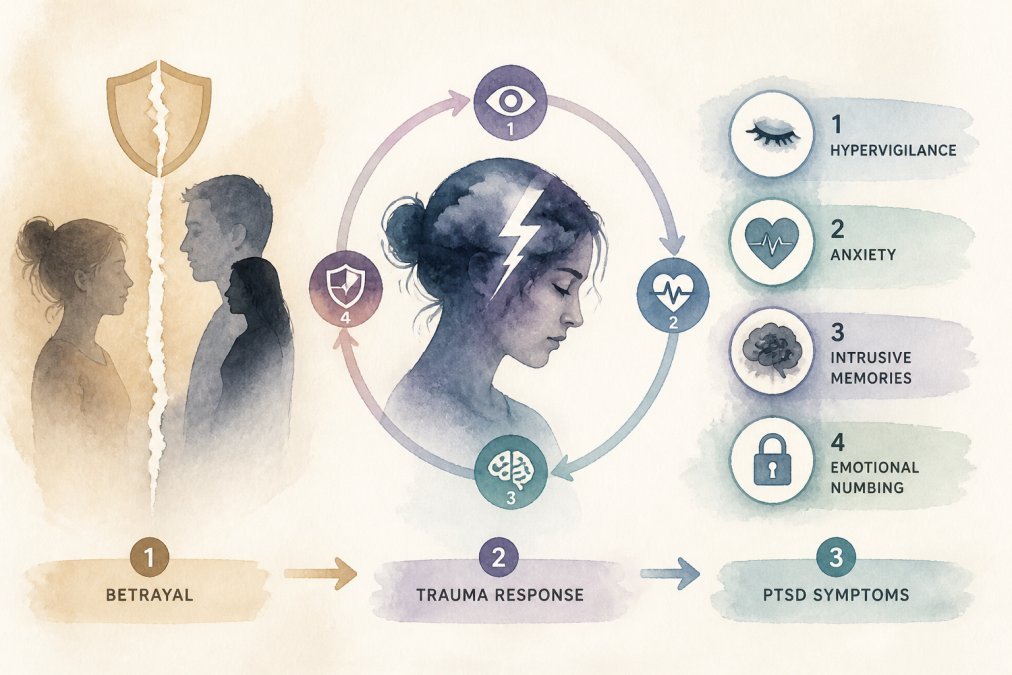
Communicating your non-negotiables after discovering an affair means defining specific, observable boundaries that protect your emotional safety and create the conditions for trust to rebuild. In betrayal-informed therapy, these boundaries are called protective safety structures, and they serve a precise function: stabilizing your nervous system enough to make genuine healing possible. This is not about punishing your partner. It is about reclaiming your sense of safety and agency in a relationship that has been fundamentally destabilized. Getting this communication right, in terms of timing, language, and framing, determines whether your boundaries become a foundation for recovery or a source of ongoing conflict.
- How to communicate your non-negotiables after discovering an affair
- What are healthy non-negotiables to establish after an affair?
- Common mistakes when expressing non-negotiables after infidelity
- Tools and frameworks for communicating non-negotiables in affair recovery
- How non-negotiables evolve during the healing process
- Key takeaways
- Why I think most people get this backwards
- FAQ
How to communicate your non-negotiables after discovering an affair
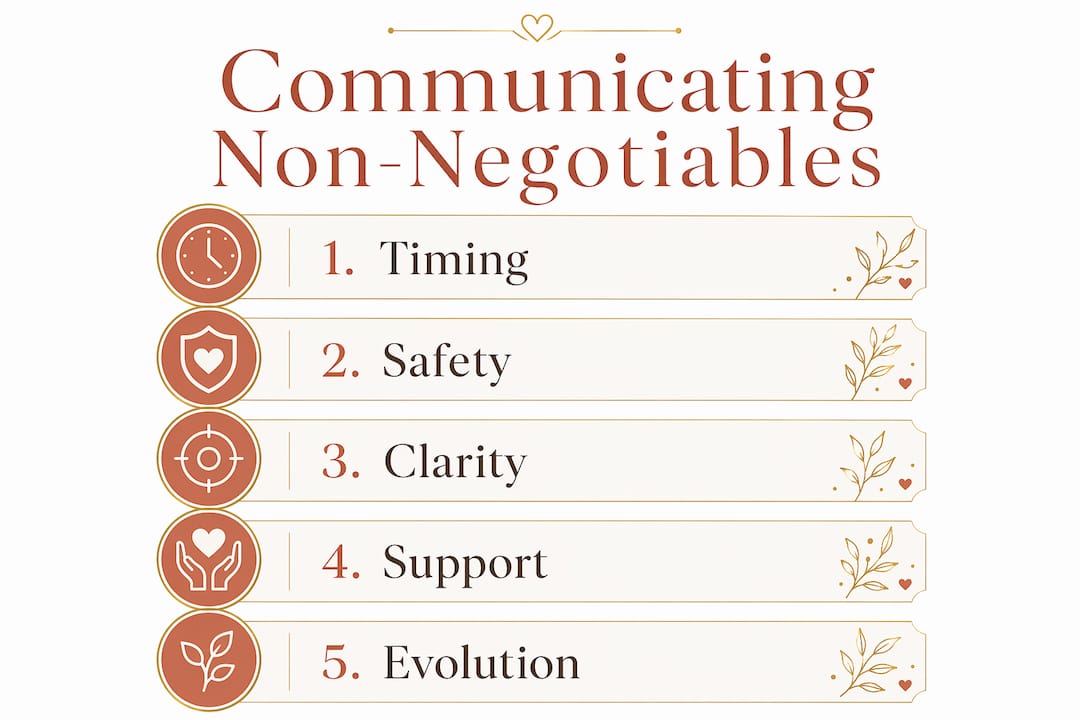
The first principle of expressing non-negotiables after betrayal is timing. Betrayal registers as a threat to the nervous system, which means your brain is in survival mode in the days immediately after discovery. Attempting to set boundaries while flooded with shock, rage, or grief often produces demands that are either too vague to enforce or too extreme to sustain. Therapists who specialize in betrayal trauma consistently recommend letting your nervous system settle before engaging in any structured repair conversation.
Once you have some degree of regulation, use specific and observable language. “I need you to be honest” is not a non-negotiable. It is a wish. “I need you to answer every question I ask within 24 hours, without deflecting or minimizing” is a non-negotiable. The difference matters because specific, observable boundaries are enforceable. Vague ones create room for interpretation, which creates room for more hurt.
Follow these steps when you are ready to communicate your boundaries:
- Write your non-negotiables down before the conversation. This prevents emotional flooding from erasing your clarity mid-discussion.
- Choose a neutral time and setting. Not immediately after a triggering moment, and not in a location associated with conflict.
- State each boundary as a specific behavior, not a feeling. “I need access to your phone for the next three months” rather than “I need to feel secure.”
- Define the consequence calmly. Not as a threat, but as a clear statement of what you will do if the boundary is not honored. “If you have any further contact with her, I will need to separate.”
- Invite questions. Open willingness from the betrayer to engage with your boundaries, rather than resist them, is one of the strongest early signals of genuine accountability.
Pro Tip: Frame each non-negotiable as a safety measure, not a punishment. Say “This helps me feel safe enough to stay in the conversation” rather than “This is what you owe me.” The first invites partnership. The second invites defensiveness.
What are healthy non-negotiables to establish after an affair?
Healthy non-negotiables fall into five categories, and the most effective ones share three qualities: they are specific, they are time-bound or reviewable, and they are focused on your safety rather than your partner’s punishment.
- Communication boundaries: Your partner answers questions honestly and completely. No stonewalling, minimizing, or subject-changing during disclosure conversations.
- Contact boundaries: Complete cessation of contact with the affair partner, including social media, work communication where avoidable, and mutual friends who facilitated the affair.
- Transparency boundaries: Shared location access, open phone and email policies, and honest accounting of time. These are early-stage tools, not permanent arrangements.
- Emotional boundaries: Your partner does not minimize your pain, does not ask you to “move on” before you are ready, and does not use your emotional reactions as evidence that reconciliation is impossible.
- Physical and social boundaries: Agreements about social situations, alcohol use, travel, or other contexts that feel unsafe given the specific circumstances of the affair.
The Orlando Therapy Project notes that non-negotiables that reduce uncertainty directly improve the betrayed partner’s sense of safety. This is why specificity matters so much. Predictability is what your nervous system is desperately seeking after betrayal, and concrete boundaries create predictability.
One critical distinction: boundaries that protect your emotional safety are healthy. Boundaries designed to monitor, control, or punish your partner are not. The line between transparency and surveillance is real, and crossing it consistently will shift your relationship into a parent-child dynamic that makes genuine repair nearly impossible.
Common mistakes when expressing non-negotiables after infidelity
Even with the best intentions, betrayed partners often fall into patterns that undermine the very boundaries they are trying to establish. Recognizing these patterns early saves significant pain.
- Rushing to mutual repair before stabilization. Many couples attempt to “work on the relationship” before the betrayed partner has any emotional safety. Repair conversations require a regulated nervous system on both sides. Skipping stabilization does not speed up healing. It restarts the trauma cycle.
- Setting vague or all-or-nothing boundaries. “You need to be completely transparent forever” is not enforceable. It also does not account for the natural evolution of trust over time. Boundaries need to be specific and revisable.
- Punitive framing. Punitive boundaries provoke resentment and defensiveness rather than accountability. If your partner feels controlled rather than held accountable, they will resist rather than comply.
- Confusing transparency with surveillance. Checking your partner’s phone every hour is not a boundary. It is an anxiety management strategy that will exhaust both of you without building actual trust.
- Ignoring your own dysregulation during the conversation. If you are flooded, you cannot communicate clearly. Pausing a boundary conversation is not weakness. It is the most effective thing you can do.
“Boundaries that heal create safety and nervous-system regulation. Boundaries that punish provoke resentment and defensiveness, and they shift couples into parent-child roles that increase relational distance.” — Betrayal-Informed Therapy Research
Seeking professional support is not optional for most people at this stage. A therapist trained in betrayal trauma steps can help you identify which of your non-negotiables are protective and which are driven by acute anxiety, and that distinction changes everything.
Tools and frameworks for communicating non-negotiables in affair recovery
Structured tools reduce the emotional chaos of these conversations and give both partners a shared framework to work within.
| Tool | Purpose | Best used when |
|---|---|---|
| Boundary-setting worksheet | Clarifies and organizes non-negotiables before verbal communication | Before the first boundary conversation |
| Structured disclosure plan | Controls pacing and content of truth-telling to prevent retraumatization | Early recovery, when full details are still emerging |
| Communication agreement | Written document both partners sign outlining specific behavioral commitments | After initial boundaries are verbally agreed upon |
| Individual therapy | Processes trauma responses and clarifies personal non-negotiables | Throughout recovery, especially in early stages |
| Couples therapy | Facilitates boundary conversations with professional containment | When direct communication repeatedly breaks down |
| Regular check-in schedule | Evaluates whether current boundaries still fit the healing stage | Every 4 to 6 weeks during active recovery |
Full disclosure done all at once reduces retraumatization compared to partial revelations that trickle out over weeks or months. Each new piece of information restarts the trauma response. A structured disclosure plan, ideally facilitated by a therapist, contains this process and makes it safer for both partners.
Paced disclosure sessions timed to the betrayed partner’s emotional readiness are the clinical standard for a reason. They give you control over when and how much you receive, which is a form of agency that betrayal strips away. Reclaiming that control is itself part of healing.
Pro Tip: Use a written communication agreement as a living document. Review it together every month and adjust it based on what is working and what is not. This practice builds the habit of collaborative boundary-setting, which is exactly the relational skill that affair recovery requires.
How non-negotiables evolve during the healing process
Non-negotiables are not permanent fixtures. They are, as the Empathi blog describes, temporary safety scaffolds tied explicitly to the healing process. Treating them as permanent control mechanisms prevents the very growth they are meant to support.
Here is how boundaries typically shift across the recovery timeline:
- Early stage (0 to 6 months): Non-negotiables are strict, wide-ranging, and focused on basic safety. Phone transparency, no contact with the affair partner, and daily check-ins are common at this stage.
- Middle stage (6 to 18 months): As consistent behavior builds predictability, some boundaries can loosen. Location sharing may become less constant. Questions may become less frequent as the narrative becomes more settled.
- Later stage (18 months and beyond): The focus shifts from external transparency to internal trust. Self-trust restoration, meaning your own confidence in your ability to read situations and protect yourself, becomes as important as relational trust.
Consistent follow-through on boundaries is what gives them power. A boundary that is stated but never enforced communicates that your limits are negotiable, which undermines the emotional safety you are trying to build. Equally, a boundary that is never revisited becomes a cage rather than a scaffold.
The ongoing dialogue about rebuilding trust after betrayal is not a sign that healing is failing. It is the mechanism through which healing actually happens.
Key takeaways
Communicating non-negotiables after an affair requires specific, observable language delivered with trauma-informed pacing, framed as safety measures rather than punishments, and revisited regularly as healing progresses.
| Point | Details |
|---|---|
| Timing is the first boundary | Wait for nervous system regulation before any structured boundary conversation to prevent retraumatization. |
| Specificity makes boundaries enforceable | Observable, behavioral language creates clarity and predictability that vague demands cannot provide. |
| Framing determines the outcome | Boundaries presented as safety measures build partnership; punitive framing builds resentment and resistance. |
| Disclosure structure matters | A structured, paced disclosure plan prevents the repeated trauma restarts caused by trickle revelations. |
| Boundaries must evolve | Treating non-negotiables as permanent rather than stage-specific scaffolds blocks the relational growth that healing requires. |
Why I think most people get this backwards
Most people approach non-negotiables after an affair as a list of demands. I understand why. When you have been betrayed, stating what you need feels like the only power you have left. But in my experience working with people through betrayal recovery, the couples who communicate their non-negotiables most effectively are not the ones with the longest lists. They are the ones who have done the harder work first: getting clear on what they actually need to feel safe, as distinct from what they want to do to their partner out of pain.
The most counterintuitive thing I have learned is that the betrayed partner’s ability to pause, regulate, and then speak is more powerful than any specific boundary they could name. When you communicate from a regulated place, your partner hears you. When you communicate from a flooded place, they hear threat, and they respond with defense. Neither of you gets what you need.
I also want to name something that rarely gets said directly: some non-negotiables are actually about self-trust, not partner behavior. Asking for phone access is partly about monitoring your partner, yes. But it is also about rebuilding your own confidence that you will not be blindsided again. As that self-trust grows, through building emotional resilience and consistent evidence over time, the need for external verification naturally decreases. That shift is not weakness. It is healing.
— S.J.Howe

Start your recovery with a structured plan
If you are in the early weeks after discovery, the weight of knowing what to say, when to say it, and how to say it can feel paralyzing. Aftertheaffair has built a structured, evidence-informed resource specifically for this moment.
The 7-step infidelity recovery checklist walks you through the foundational steps of early recovery, including how to identify and articulate your non-negotiables in a way that protects your emotional safety without derailing the process. For those ready to go deeper, the Navigating Infidelity guide addresses the first months after discovery with clinical depth and compassionate framing. Both resources are designed to give you structure when everything feels uncertain.
FAQ
What are non-negotiables in affair recovery?
Non-negotiables are specific, observable behavioral requirements that the betrayed partner needs in order to feel safe enough to remain in the relationship and engage in healing. They differ from general wishes because they are concrete, enforceable, and tied directly to emotional safety.
When should I communicate my non-negotiables after discovering an affair?
Wait until your nervous system has some degree of regulation, typically not in the first 24 to 72 hours after discovery. Communicating from a flooded state produces demands that are hard to sustain and easy to misinterpret.
How do I express non-negotiables without sounding controlling?
Frame each boundary as a safety measure rather than a punishment. Use specific behavioral language and explain what the boundary gives you, such as predictability or reduced anxiety, rather than framing it as something your partner owes you.
Should non-negotiables change over time?
Yes. Healthy non-negotiables are temporary scaffolds tied to the healing stage, not permanent arrangements. Reviewing and adjusting them every four to six weeks during active recovery reflects genuine progress and prevents boundaries from becoming control mechanisms.
What if my partner refuses to honor my non-negotiables?
A partner who consistently refuses to honor specific, reasonable safety boundaries is communicating something important about their commitment to repair. This is a signal to seek individual therapy and reassess whether the conditions for genuine reconciliation are present.
Recommended
- How to communicate after affair: rebuild trust in 2026 – After the Affair Series
- How to navigate post-affair decisions: 5 key steps
- What to Ask After an Affair Is Disclosed – After the Affair Series
- How to Co-Parent After an Affair – After the Affair Series