TL;DR:
- Recovery from infidelity involves building a new relationship with accountability, trust, and ongoing effort. It takes years of consistent work, with trust rebuilt through small, verifiable actions rather than promises or grand gestures. Emotional healing is nonlinear, requiring patience, therapy, and a focus on creating honest, secure connections.
- what does the recovery timeline actually look like?
- How does trust rebuild, and what behavioral changes truly matter?
- What emotional challenges do couples face when choosing to stay?
- How do couples rebuild communication and reinvent their relationship?
- Key Takeaways
- What staying together truly demands: a clinical perspective
- FAQ
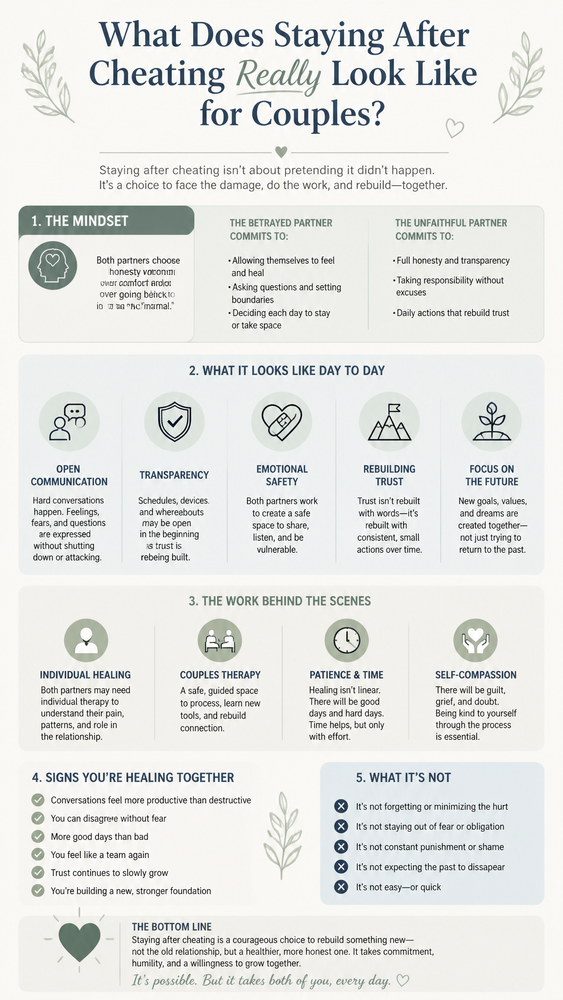
Staying after cheating is a conscious decision to build an entirely new relationship, not restore the one that existed before. The clinical term for this process is infidelity recovery, and it is one of the most demanding forms of relational repair a couple can undertake. Beyond the affair, what staying actually looks like after cheating bears little resemblance to simply forgiving and moving on. It requires the unfaithful partner’s full accountability, the betrayed partner’s willingness to remain open, and both people’s commitment to sustained behavioral change. Research confirms that couples who work through infidelity thoroughly often report more honest and intimate relationships than before. That outcome is real, but it is never automatic.
what does the recovery timeline actually look like?
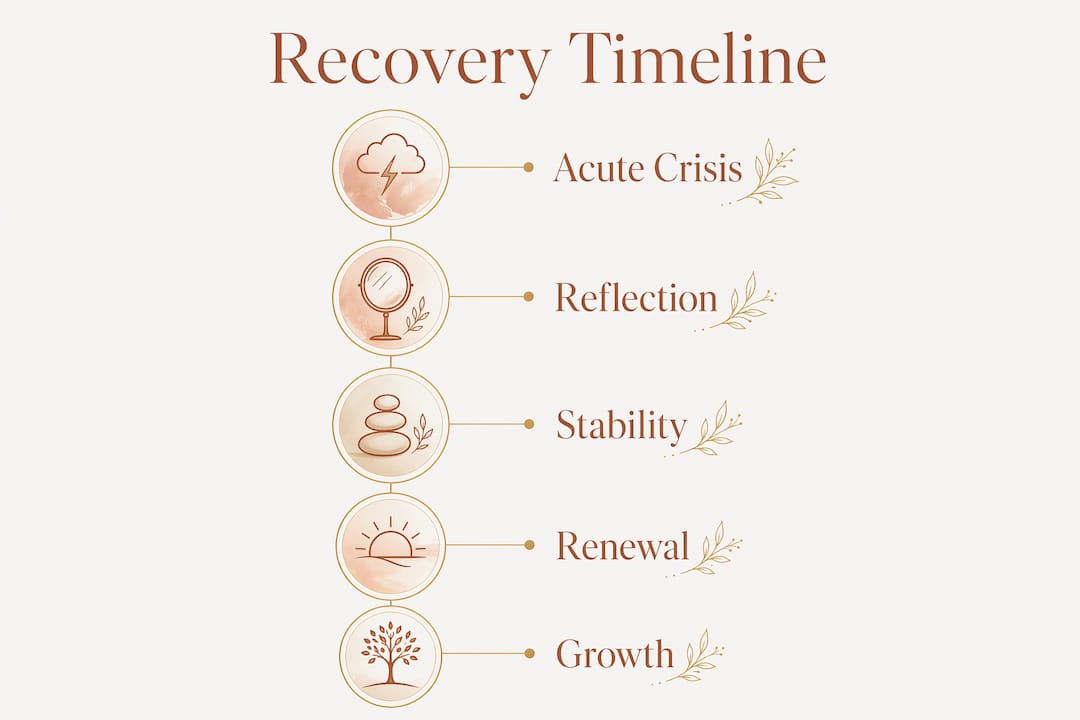
Recovery from infidelity does not follow a straight line. Most people expect to feel better within weeks. The clinical reality is different. Meaningful crisis reduction typically appears at 6–12 months, with a major turning point at 18 months and full restoration potentially taking 2–5 years of consistent work. That timeline is not a sentence. It is a map.
The first phase, roughly the first six months, is acute crisis. Intrusive thoughts, physical symptoms of shock, and emotional flooding are normal during this period. The nervous system is in a state of threat response, and the brain cannot yet process what happened with clarity. Trying to make permanent decisions during this phase, such as whether to stay or leave, often leads to choices people later regret.
Pro Tip: Experts advise waiting at least several months before making major irreversible decisions after discovery. Nervous system regulation must come before clear judgment.
The 18-month mark is significant for a specific reason. By that point, most people report a measurable decrease in acute pain and a clearer sense of whether the relationship is genuinely changing. This does not mean the work is over. It means the foundation is stable enough to build on. The stages of healing after an affair follow a biological sequence: safety first, then connection, then cognitive processing.
| Phase | Approximate timeframe | What to expect |
|---|---|---|
| Acute crisis | Months 1–6 | Shock, intrusive thoughts, emotional flooding |
| Stabilization | Months 6–18 | Reduced acute pain, clearer thinking, early trust-building |
| Active rebuilding | Months 18–36 | Relational reinvention, deeper communication, new norms |
| Integration | Years 3–5 | Sustained trust, posttraumatic growth, new relationship identity |
How does trust rebuild, and what behavioral changes truly matter?
Trust is a behavioral inference, not a feeling. The betrayed partner’s nervous system updates its sense of safety based on thousands of small, consistent actions over time. Verbal assurances alone cannot update the internal trust model. Only verifiable, repeated behavior does that.
The unfaithful partner carries a specific responsibility in this process. Defensiveness is one of the most common barriers to trust rebuilding, and it is rarely arrogance. Defensiveness often masks intense shame that the unfaithful partner cannot yet tolerate. Recognizing this distinction matters. The work is not to suppress shame but to stay emotionally present with it rather than deflecting it onto the betrayed partner.
Therapeutic frameworks like the Gottman Trust Revival Method and Accelerated Experiential Dynamic Psychotherapy (AEDP) both emphasize what clinicians call corrective emotional experiences. These are moments when the betrayed partner expresses vulnerability and the unfaithful partner responds with care rather than withdrawal. Each such moment rewires the betrayed partner’s threat response. The rebuilding trust timeline is built from these moments, not from grand gestures.
Concrete trust-building behaviors include:
- Radical transparency: Sharing location, passwords, and schedules without being asked, and doing so consistently rather than selectively.
- Emotional availability: Staying present during the betrayed partner’s pain without shutting down, changing the subject, or minimizing.
- Consistent follow-through: Doing what was promised, every time, even when it feels unnecessary or repetitive.
- Proactive check-ins: Initiating conversations about the relationship rather than waiting to be asked.
- Accountability without conditions: Owning the behavior fully, without attaching “but” statements that shift blame.
Pro Tip: The ways to rebuild trust that work are not dramatic. They are small, repeated, and boring. Consistency is the point.
What emotional challenges do couples face when choosing to stay?
Betrayal trauma affects the nervous system in ways that mirror post-traumatic stress. Intrusive memories, hypervigilance, emotional numbness, and sudden grief are not signs of weakness. They are the body’s predictable response to a threat that came from inside the relationship. Healing from betrayal trauma is nonlinear, and triggers can cause momentary regression even months after significant progress.
This is one of the most disorienting parts of life after cheating. A couple can have three good weeks and then one conversation sends the betrayed partner back to the floor. That regression does not erase the progress. It is part of the process. Understanding this prevents both partners from catastrophizing setbacks as proof that recovery is impossible.
“Posttraumatic growth can offer individuals greater clarity, stronger boundaries, and more authentic relationships after overcoming betrayal trauma.” — Betrayal Trauma Recovery research
Identity is also at stake. The betrayed partner often loses their sense of who they were in the relationship and who they are as a person. This is painful, but it also creates space. Many people who do the work of personal growth after betrayal report developing stronger self-knowledge and clearer personal values than they had before the affair.
Key emotional realities to hold during recovery:
- Emotional vulnerability cycles are normal, not failures.
- Avoiding major decisions during acute crisis protects both partners.
- Anger, grief, and love can coexist without contradiction.
- Betrayal trauma symptoms require acknowledgment, not suppression.
- Self-compassion is not optional. It is a clinical requirement for sustained healing.
How do couples rebuild communication and reinvent their relationship?
The original relationship is gone. That is not a pessimistic statement. It is a clinical fact that opens a door. Couple resiliency after infidelity is a dynamic, ongoing process involving open communication, therapy, shared meaning-making, and reinvented normalcy. The couples who recover most fully are those who stop trying to get back to what they had and start building something new.
Therapy is the most reliable structure for this work. Both individual and couples counseling serve different functions. Individual therapy helps each partner process their own trauma, shame, and identity questions. Couples therapy creates a structured space to practice new communication patterns with a skilled witness. Therapeutic support is not a sign that the relationship is broken beyond repair. It is the mechanism of repair.
Outside the therapy room, couples benefit from deliberate emotional bonding practices. Daily rituals like shared walks and consistent morning routines rebuild emotional intimacy at a pace that does not pressure physical reconnection. Physical intimacy follows emotional safety, not the other way around.
Rebuilding communication requires a structured approach:
- Establish a weekly check-in. Set aside 30 minutes each week to discuss the relationship without phones, distractions, or unrelated conflict.
- Use structured listening. One partner speaks without interruption while the other reflects back what they heard before responding.
- Name the need, not the complaint. Replace “You never tell me where you are” with “I need to know your location to feel safe right now.”
- Return to therapy at the first sign of resentment. True relationship change requires both partners to stay engaged, especially when returning to therapy during challenges, to avoid silent resentment building.
- Create new shared meaning. Identify values, rituals, and goals that belong to the new relationship, not the old one.
| Old relationship pattern | New relationship practice |
|---|---|
| Conflict avoidance | Scheduled, structured check-ins |
| Assumed trust | Demonstrated, consistent transparency |
| Implicit expectations | Explicitly stated needs and agreements |
| Physical intimacy as default connection | Emotional bonding as the foundation |

Key Takeaways
Staying together after infidelity requires building a new relationship through sustained behavioral accountability, nervous system regulation, and structured therapeutic support, not simply restoring what existed before.
| Point | Details |
|---|---|
| Recovery takes years, not weeks | Meaningful stability appears at 6–12 months; full restoration takes 2–5 years of consistent work. |
| Trust is behavioral, not verbal | Consistent, verifiable actions rebuild the betrayed partner’s internal safety model over time. |
| Trauma regression is normal | Setbacks during healing do not erase progress; they are a predictable part of nonlinear recovery. |
| Therapy is the mechanism of repair | Both individual and couples counseling provide structure that self-help alone cannot replicate. |
| A new relationship must be built | Couples who recover fully stop trying to restore the old bond and build something more honest instead. |
What staying together truly demands: a clinical perspective
I have worked with couples at every stage of infidelity recovery, and the most consistent mistake I see is treating staying as a passive decision. People say “we decided to stay together” as if that settles it. It does not. Staying is a daily practice, not a one-time choice.
The couples who make it are not the ones who love each other most. They are the ones who are willing to be uncomfortable for a sustained period. The unfaithful partner must sit with shame without running from it. The betrayed partner must risk vulnerability again before trust is fully restored. Both of those things are genuinely hard, and neither can be rushed.
What I have found most useful to tell people is this: you are not trying to get your relationship back. You are trying to build one that is more honest than the one you had. That reframe changes everything. It removes the pressure to return to a version of the relationship that, in many cases, had its own unaddressed problems. It also gives both partners something to work toward rather than something to mourn.
The nervous system piece is underestimated. People try to have productive conversations about the affair when they are still in a threat state. The brain cannot process complex emotional information when it is flooded. Safety must come before connection, and connection must come before meaning-making. Skipping that sequence is why so many couples feel like they are going in circles.
Finally, I want to say clearly: choosing to leave is also a legitimate outcome. Recovery is possible, but it is not guaranteed, and it requires both partners to show up fully. If one person is not doing the work, staying becomes its own form of harm. The goal is not to save the relationship at any cost. The goal is to build something worth staying for.
— S.J.Howe
Structured support for healing beyond the affair
Recovery from infidelity is too complex to navigate without a clear roadmap. Aftertheaffair provides evidence-informed resources designed specifically for the stages of healing that follow betrayal, from the first weeks of crisis through long-term relational growth.
The 7 Steps Infidelity Recovery Checklist gives you a structured framework for moving through each phase of recovery without losing your footing. For couples ready to go deeper, the relationship growth resources on Aftertheaffair combine therapeutic frameworks with practical exercises that support both partners. Whether you are working with a counselor or starting on your own, these tools give the process shape and direction.
FAQ
How long does healing after infidelity take?
Recovery typically shows meaningful crisis reduction at 6–12 months, with a significant turning point at 18 months. Full restoration commonly takes 2–5 years of consistent work.
Can trust actually be rebuilt after cheating?
Yes. Trust rebuilds through thousands of small, consistent behavioral moments over time, not through promises or single grand gestures.
Is it normal to feel worse some days even after progress?
Betrayal trauma recovery is nonlinear. Triggers can cause temporary regression even months after significant improvement, and this does not indicate failure or mean the relationship cannot heal.
When should couples start therapy after an affair?
Couples benefit from starting individual therapy as soon as possible after discovery and couples therapy once both partners are stable enough to engage. Experts recommend waiting at least several weeks before making major irreversible decisions.
What does the unfaithful partner need to do for recovery to work?
The unfaithful partner must take full accountability without defensiveness, demonstrate radical transparency consistently, and stay emotionally present during the betrayed partner’s pain rather than withdrawing when shame becomes intense.
Recommended
- Stay or Leave After Cheating – After the Affair Series
- When It’s Time to Leave After Infidelity
- After Cheated: Now What? – After the Affair Series
- Betrayal Trauma Symptoms – After the Affair Series