TL;DR:
- Betrayal trauma is a neurobiological injury caused by affairs, leading to persistent physical and emotional symptoms. Recovery requires ongoing safety cues, full accountability, and trauma-informed therapy over 18 to 24 months or more. Rebuilding a relationship involves constructing a new foundation with honesty, transparency, and consistent behavior.
- Why affairs hurt long-term: betrayal trauma explained
- How do emotional affairs differ from physical affairs in long-term damage?
- What factors influence the potential for long-term healing after an affair?
- What practical steps can individuals and couples use to heal from affair wounds?
- Key Takeaways
- What I’ve learned about why betrayal pain doesn’t just fade
- Aftertheaffair’s resources for long-term infidelity recovery
- FAQ
- Recommended
Affairs cause lasting harm because they trigger betrayal trauma, a neurobiological injury that dismantles emotional safety at its foundation. This is not ordinary heartbreak. The clinical term is betrayal trauma, and it produces PTSD-like symptoms that can persist for months or years after discovery. Understanding why affairs hurt long-term requires looking past the surface-level shock and into the body’s survival response, the collapse of shared identity, and the slow, non-linear work of rebuilding what was lost. Aftertheaffair exists to guide you through exactly that process with evidence-informed, compassionate support.
Why affairs hurt long-term: betrayal trauma explained
Betrayal trauma is defined as a neurobiological injury that occurs when a primary attachment figure, the person you depend on for safety, violates that trust. The brain does not process this as a relationship problem. It processes it as a survival threat. That distinction explains everything about why the pain is so persistent and so physical.
Betrayal trauma symptoms include chronic hypervigilance, intrusive thoughts, emotional flooding, sleep disturbances, and difficulty concentrating. These are not signs of weakness or overreaction. They are the body’s alarm system stuck in the “on” position because the source of danger is also the source of comfort. The nervous system cannot resolve that contradiction quickly.
The physiological effects go further than most people expect. Betrayal trauma activates the HPA axis, the body’s core stress response system, producing insomnia, appetite changes, gastrointestinal distress, chest tightness, immune suppression, and fatigue. These symptoms are biological consequences of prolonged threat detection, not emotional fragility.
Healing from betrayal trauma is neurobiological, not cognitive. No amount of logic alone resolves the trauma until the nervous system receives repeated safety cues over time. That is why telling yourself “I should be over this by now” does not work. The brain needs evidence, not arguments.
Pro Tip: Track physical symptoms like sleep disruption, appetite changes, and chest tightness alongside emotional ones. Recognizing the body’s role in betrayal trauma helps you seek the right support, not just talk therapy, but somatic and nervous system regulation approaches too.
- Hypervigilance: scanning for threats constantly, even in safe moments
- Intrusive thoughts: unwanted mental replays of the betrayal
- Emotional flooding: sudden, overwhelming waves of grief, rage, or despair
- Physical symptoms: insomnia, nausea, fatigue, and immune changes
- Identity disruption: loss of the shared story and sense of self within the relationship
How do emotional affairs differ from physical affairs in long-term damage?
Emotional affairs cause pain comparable to or greater than physical affairs. The reason is specific: the heart feels replaced, not just the body. When a partner withdraws emotional intimacy and redirects it elsewhere, the betrayed person loses the connection they valued most.
Secrecy compounds the wound significantly. Secrecy and loss of emotional connection surrounding affairs often cause the greatest long-term damage. Trust cannot be rebuilt while information is hidden. Every lie, omission, or minimization adds a new layer of injury on top of the original betrayal.
Emotional affairs also frequently precede physical ones. By the time the physical affair is discovered, the emotional bond with the affair partner may already be deep. That means the betrayed person is grieving two losses at once: the relationship they thought they had, and the partner they believed was emotionally present.
| Dimension | Emotional affair | Physical affair |
|---|---|---|
| Primary wound | Loss of emotional intimacy and connection | Loss of physical exclusivity and trust |
| Secrecy impact | Often prolonged, harder to detect | May be shorter but equally concealed |
| Feeling of replacement | Strong: heart feels substituted | Moderate: body feels substituted |
| Disclosure complexity | Harder to define and prove | Clearer facts but still painful to hear |
| Recovery challenge | Rebuilding emotional safety and presence | Rebuilding physical trust and transparency |
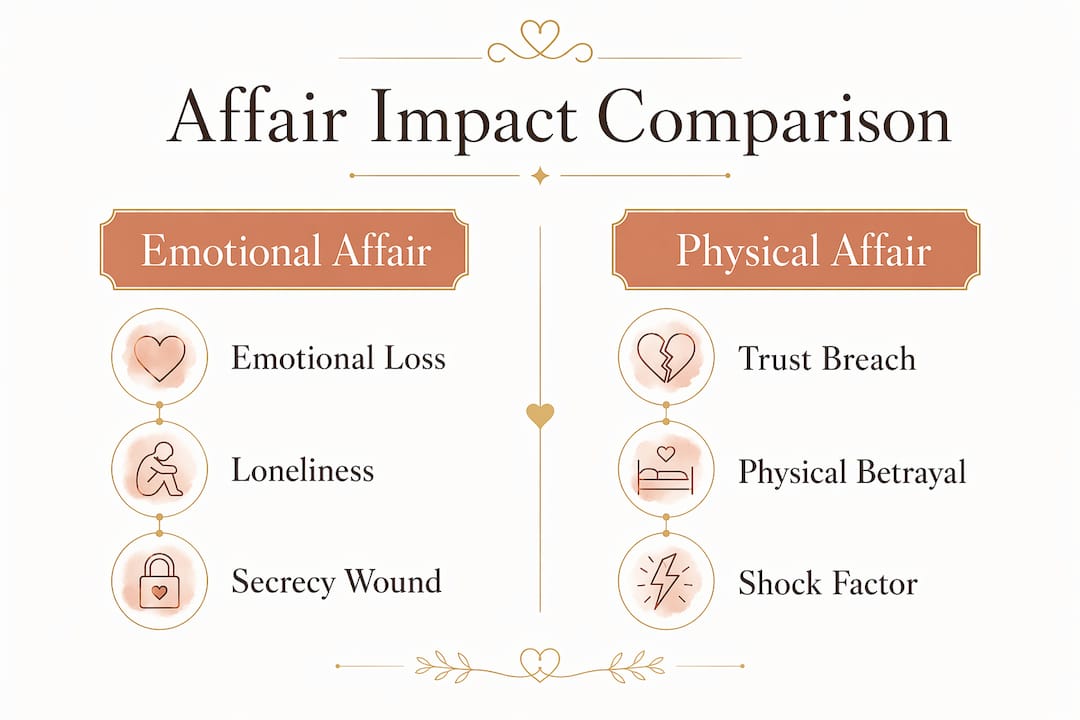
The feelings that follow an emotional affair include a specific kind of loneliness. You were in the room, but your partner was somewhere else entirely. That emotional abandonment leaves a mark that logic cannot easily erase. Recognizing what emotional infidelity actually involves is the first step toward naming the wound accurately.
What factors influence the potential for long-term healing after an affair?
Recovery depends heavily on the unfaithful partner’s full accountability. Confession and sustained transparency predict relational repair, while rushing healing causes setbacks. Accountability is not a single conversation. It is a sustained behavioral commitment that continues even when it is uncomfortable.
The nervous system stabilizes slowly. Healing after infidelity can require 18–24 months or more to rebuild emotional safety and trust. Progress is non-linear. Triggers appear long into recovery, and setbacks do not mean failure. They mean the nervous system is still processing a real injury.
The unfaithful partner’s internal state matters more than most people realize. Hidden guilt and shame in the unfaithful partner can trigger defensiveness that stalls transparency. When shame goes unaddressed, it produces the exact behaviors that prevent healing: minimizing, deflecting, and withdrawing. Both partners need support to move forward.
- End all contact with the affair partner completely and immediately.
- Commit to full transparency including passwords, location, and honest answers to questions.
- Seek individual therapy to address shame, guilt, and the conditions that led to the affair.
- Engage in couples therapy with a trauma-informed therapist who understands betrayal.
- Sustain consistent behavior over months, not days, to rebuild the nervous system’s sense of safety.
- Accept non-linear progress and resist the urge to declare healing complete prematurely.
Pro Tip: The betrayed partner’s nervous system heals through repeated experiences of safety, not through reassurances. The unfaithful partner’s most powerful tool is consistent, predictable behavior sustained over time, even on hard days.
The rebuilding trust timeline is longer than most couples expect. Setting realistic expectations from the start prevents the secondary injury of feeling like healing is “taking too long.”
What practical steps can individuals and couples use to heal from affair wounds?
The first stage of healing is nervous system stabilization. Before any productive conversation about the relationship can happen, the betrayed partner’s body needs to feel safe enough to think clearly. This means prioritizing sleep, reducing stimulants, and limiting exposure to triggering content in the early weeks.
Trauma-informed couples therapy is the most effective clinical intervention for infidelity recovery. Therapy types that address betrayal trauma specifically, including Emotionally Focused Therapy (EFT) and trauma-informed approaches, outperform generic couples counseling because they target the attachment injury directly. A therapist who does not understand betrayal trauma may inadvertently cause harm by pushing premature forgiveness.
The concept of “Relationship 2.0” reframes recovery as construction rather than repair. The old relationship is effectively over after an affair. Healing requires building a new, more honest, and more resilient relationship model with new boundaries, deeper honesty, and structural changes. Couples who try to return to exactly what they had before typically struggle. Those who build something new with better foundations have a stronger chance.
- Regulate first, process second. Breathwork, grounding exercises, and physical movement help calm the nervous system before difficult conversations.
- Create a disclosure agreement. Decide together what information will be shared, when, and how, to prevent repeated traumatic revelations.
- Rebuild through small, consistent actions. Trust is rebuilt in micro-moments of reliability, not grand gestures.
- Grieve the old relationship. Mourning what was lost is not giving up. It is a necessary step before building what comes next.
- Invest in personal growth. Individual therapy, journaling, and self-care practices rebuild the betrayed partner’s sense of self outside the relationship.
Pro Tip: Journaling with structured prompts, rather than open-ended venting, helps the nervous system process betrayal more effectively. Aftertheaffair’s guided resources offer exactly this kind of structured support for both partners.
The stages of healing after an affair are well-documented. Knowing which stage you are in reduces the fear that you are stuck or broken. Each stage has its own tasks, and moving through them takes time, not willpower.
Key Takeaways
Affairs cause lasting harm because betrayal trauma is a neurobiological injury that requires sustained safety cues, full accountability, and trauma-informed support to heal, not just time or willpower.
| Point | Details |
|---|---|
| Betrayal trauma is biological | The HPA axis activates under betrayal, producing physical symptoms that require more than emotional processing to resolve. |
| Emotional affairs wound deeply | The loss of emotional intimacy can equal or exceed the pain of a physical affair, especially when secrecy is prolonged. |
| Accountability drives recovery | Sustained transparency from the unfaithful partner is the single strongest predictor of successful healing. |
| Healing takes 18–24 months or more | Non-linear progress and nervous system triggers are normal; setbacks do not mean failure. |
| Relationship 2.0 is the goal | Rebuilding means constructing a new relationship with better honesty and boundaries, not restoring the old one. |
What I’ve learned about why betrayal pain doesn’t just fade
After working with people navigating infidelity for years, the question I hear most often is some version of: “Why can’t I just get over it?” The honest answer is that betrayal trauma is not an emotional response you can think your way out of. It is a biological event. The body keeps the score, and the nervous system does not care how much you want to move on.
What I have seen consistently is that the people who heal most fully are not the ones who forgive fastest. They are the ones who are given the conditions to heal: a partner who shows up consistently, a therapist who understands trauma, and a framework that validates what they are experiencing as real and serious. Without those conditions, time alone changes very little.
The other thing I want you to hear is this: the pain you feel is proportional to the love you had. Affairs hurt long-term because the relationship mattered. That is not a weakness. That is evidence of your capacity for genuine connection, and that capacity does not disappear. It becomes the foundation for whatever comes next, whether that is a rebuilt relationship or a rebuilt self.
If you are the unfaithful partner reading this, your shame is real, and it needs attention too. Unaddressed shame produces the defensiveness that prevents your partner from healing. Getting support for your own internal experience is not self-indulgent. It is one of the most important things you can do for both of you.
Healing is possible. It is not fast, and it is not linear. But the people who commit to the real work, not the quick fix, find something on the other side that is often stronger than what they had before.
— S.J.Howe
Aftertheaffair’s resources for long-term infidelity recovery
Recovering from an affair requires more than good intentions. It requires a structured path that accounts for the neurobiological reality of betrayal trauma, the complexity of rebuilding trust, and the specific challenges each stage of healing brings.
Aftertheaffair offers a 7-step infidelity recovery checklist designed to guide you through each phase of healing with clarity and evidence-informed support. For those focused on rebuilding the relationship itself, the relationship growth resources address accountability, emotional safety, and the practical steps of constructing Relationship 2.0. Whether you are in the first weeks of shock or months into a difficult recovery, Aftertheaffair provides the structured, compassionate guidance that fills the gaps traditional therapy often leaves.
FAQ
What is betrayal trauma and why does it last so long?
Betrayal trauma is a neurobiological injury triggered when a trusted attachment figure violates that trust. It lasts because the nervous system cannot resolve the paradox of needing safety from the same person who caused the threat, and healing requires repeated safety cues over time, not just a decision to move on.
Can a relationship actually survive an affair?
Yes, relationships can survive infidelity, but recovery requires full accountability, sustained transparency, and trauma-informed couples therapy. Couples who build a new relationship model with deeper honesty, rather than trying to return to the old one, report the strongest long-term outcomes.
How long does it take to heal from infidelity?
Healing after infidelity typically requires 18–24 months or more to rebuild emotional safety and trust. Progress is non-linear, and setbacks during recovery are a normal part of the nervous system’s stabilization process.
Are emotional affairs as damaging as physical ones?
Emotional affairs cause pain comparable to or greater than physical affairs because the loss of emotional intimacy feels like a deeper form of replacement. The secrecy involved often intensifies the betrayal wound beyond what the act itself would cause.
What is the most important factor in recovering from an affair?
The unfaithful partner’s sustained accountability is the strongest predictor of recovery. Consistent, transparent behavior over months, not a single confession or apology, is what allows the betrayed partner’s nervous system to gradually rebuild its sense of safety.
Recommended
- Why Infidelity Hurts? – After the Affair Series
- Can Couples Recover From Multiple Affairs? – After the Affair Series
- How to heal when the affair partner won’t leave: 5 steps – After the Affair Series
- Healing After Infidelity – After the Affair Series