Table of Contents
- Quick Comparison: Top Courses for High Conflict Divorce
- How We Evaluated These Courses
- Communication Skills for High Conflict Co-Parenting
- High Conflict Co-Parenting Strategies That Work
- Parallel Parenting vs Co-Parenting in High Conflict Situations
- Impact of High Conflict Divorce on Children
- Self-Paced vs. Live Facilitated Courses: Which Is Right for You?
- Court Acceptance and Legal Compliance Verification
Best Courses for High Conflict Divorce: 2026 Guide
Last Updated: July 25, 2026
Quick Comparison: Top Courses for High Conflict Divorce
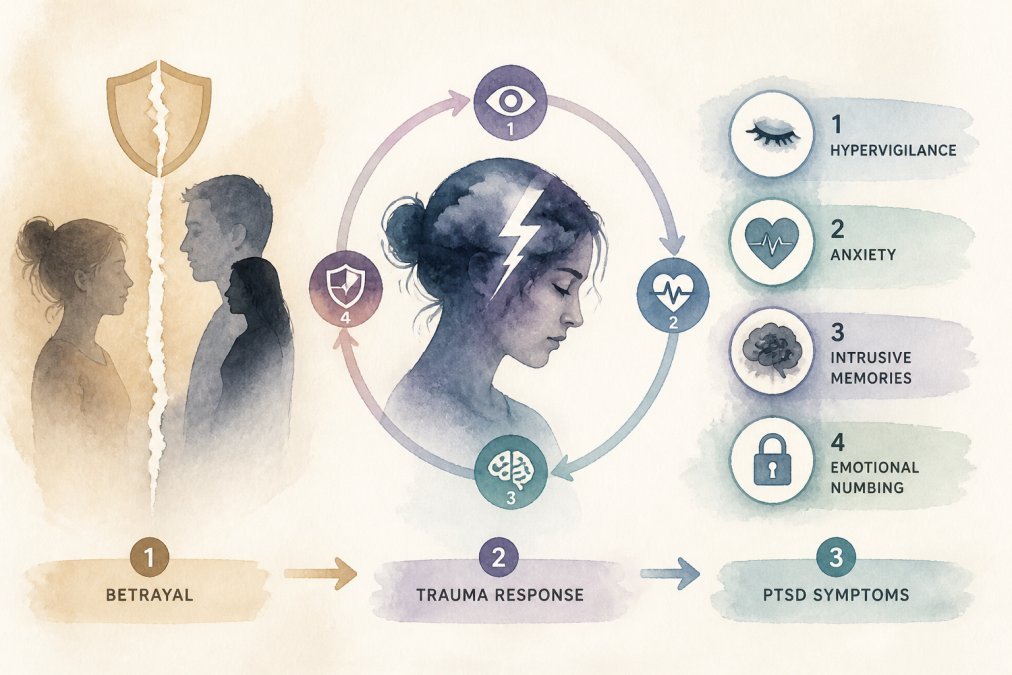
When parents navigate the aftermath of betrayal and separation, finding the right course can mean the difference between escalating conflict and establishing boundaries that protect everyone involved. The best courses for high conflict divorce provide structured frameworks, practical communication tools, and trauma-informed strategies specifically designed for situations where traditional co-parenting approaches fail. After the Affair Series has identified eight leading programs that address high-conflict co-parenting, each with distinct strengths for different circumstances and learning preferences.
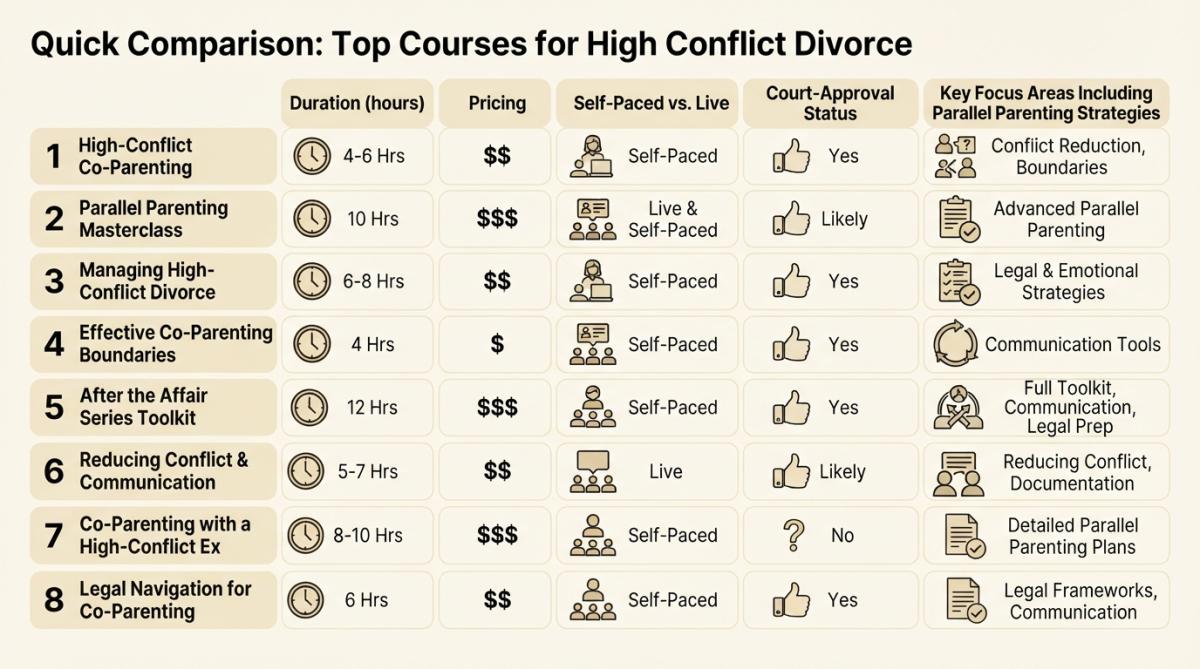
The programs reviewed here range from affordable self-paced online classes ($39.99 to $129.95) to personalized coaching services. Some exceed court-mandated requirements, while others focus specifically on managing hostile interactions and protecting children’s emotional wellbeing. A course designed for mildly contentious divorces may not equip you for situations involving personality disorders, manipulation, or genuine threats to child safety.
Court-mandated parenting classes often have minimum hour requirements (typically 4-8 hours). Many online courses exceed these thresholds deliberately; the extra content addresses high-conflict dynamics that standard classes skip entirely.
How We Evaluated These Courses
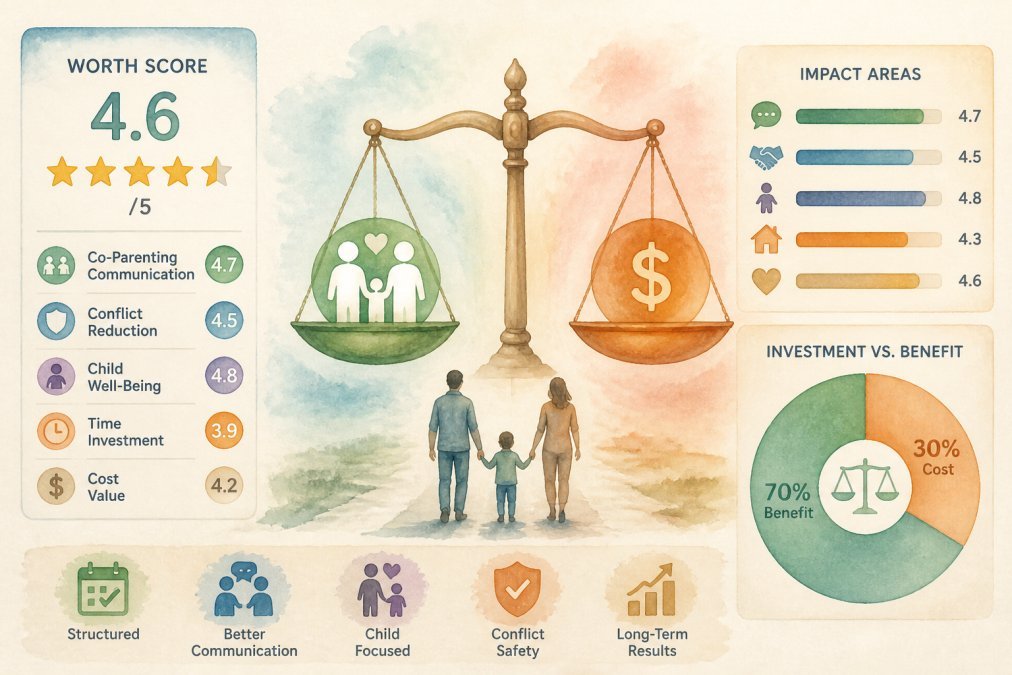
Evaluating courses for high conflict divorce requires looking beyond marketing claims to actual outcomes: Do parents report reduced conflict? Do courts accept the certificates? Can the strategies work when one parent refuses to cooperate?
Our evaluation framework examined five core dimensions:
After the Affair Series applies these same criteria when recommending resources to individuals navigating betrayal and separation. The courses listed here represent programs that meet at least four of these five standards consistently.
The best courses for high conflict divorce teach you how to change YOUR behavior and communication, not how to “fix” your ex. This distinction separates effective programs from those that waste your time.
- Curriculum depth: Does the course address parallel parenting, boundary-setting, and trauma-informed approaches?
- Court acceptance: Is the certificate recognized by family courts in multiple states?
- Practical application: Do modules include scripts, frameworks, and real-world scenarios?
- Trauma-informed design: Does the course acknowledge emotional dysregulation and abuse dynamics?
- Accessibility: Can parents complete it while managing custody schedules, with reduced-cost options available?
Communication Skills for High Conflict Co-Parenting
Effective communication in high-conflict situations requires abandoning the assumption that your ex will respond to reason or empathy. Instead, structured communication techniques create boundaries that reduce opportunities for escalation.
In high-conflict dynamics, every word becomes ammunition. A parent with high-conflict personality traits may deliberately misinterpret your meaning, use your words against you in court, or escalate minor disagreements into crises.
The best courses teach specific communication frameworks:
- Gray Rock Method: Respond to provocations with minimal emotional content, using short, boring responses that remove the “reward” of getting a reaction
- BIFF Response: Brief, Informative, Friendly, Firm, a four-part structure for written communication that documents exchanges without inviting argument
- Parallel parenting communication: Shift from joint decision-making to parallel decision-making, where each parent handles their own household rules
- Email-only protocols: Establish written-only communication for contentious topics, creating a documented record and removing real-time escalation triggers
New Ways for Families Online Class, developed by the High Conflict Institute, teaches these skills across 12 video-based lessons with quizzes and exercises. The course emphasizes “managed emotions, flexible thinking, moderate behavior, and checking yourself”, core skills that remain useful even when the other parent doesn’t change.
The Udemy-based High-Conflict Divorced Co-Parenting Communication Course offers a four-step framework for recognizing triggers and responding instead of reacting. Parents report that the practical phrases and templates for boundary-setting justify the investment.

High Conflict Co-Parenting Strategies That Work
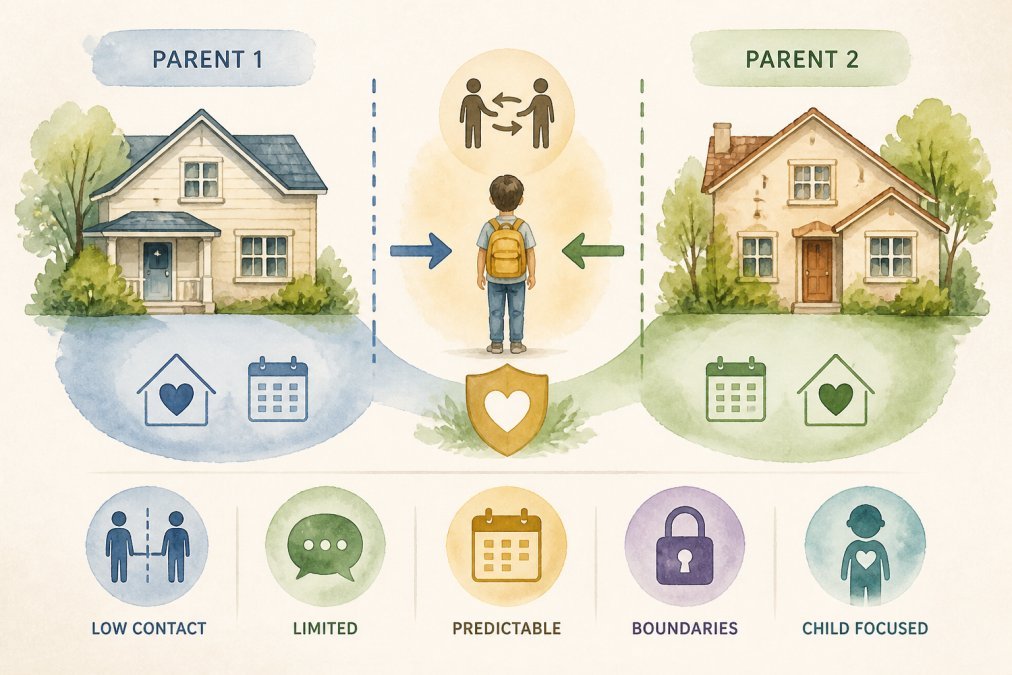
When two parents cannot cooperate, parallel parenting becomes the default structure. Each parent makes decisions independently within their custody time, eliminating endless negotiation cycles and removing opportunities for sabotage.
However, parallel parenting requires boundaries that many parents struggle to implement. Effective courses teach parents how to:
- Document parenting time and exchanges to prevent false accusations
- Respond to unreasonable demands with simple refusals
- Avoid discussing the other parent in front of children
- Use co-parenting apps (like OurFamilyWizard) to create neutral communication channels
- Recognize manipulation tactics specific to personality-disordered individuals
The High-Conflict Co-Parenting Course from D’Arienzo Psychology, developed by a Board-Certified Clinical Psychologist, explicitly addresses child safety concerns, parental alienation, and conflict adjustment, topics that generic parenting courses avoid.
Crossroads of Coparenting from Active Parenting teaches five steps to cooperative co-parenting but acknowledges that some situations require accepting that cooperation won’t happen. The course helps parents shift from fighting for “fair” arrangements to protecting their children from exposure to conflict itself.
If your ex uses your communication attempts as evidence of “harassment” in court, you need a course that teaches documentation and legal-compliant communication. Many courses skip this critical element.
Parallel Parenting vs Co-Parenting in High Conflict Situations
The choice between parallel parenting and co-parenting is a structural response to conflict level, not a parenting philosophy.
Co-parenting works when both parents prioritize children’s wellbeing over conflict. It requires ongoing communication, compromise, and the ability to separate parental decisions from personal feelings.
Parallel parenting works when conflict is too high for joint decision-making. Each parent maintains full authority during their custody time. Communication stays minimal, focused only on logistics. Research shows children adjust better to this than to constant parental conflict.
Children in high-conflict co-parenting situations experience more anxiety, depression, and behavioral problems than children in parallel parenting arrangements. The conflict itself, not the separation, causes the harm.
High-conflict co-parenting communication courses teach parents to recognize when their situation requires parallel parenting rather than continued attempts at cooperation. A4CT’s High Conflict Co-Parenting Class teaches parents how to “remain calm, stay consistent, and avoid or resolve conflict” while accepting that the other parent may never change.
Impact of High Conflict Divorce on Children
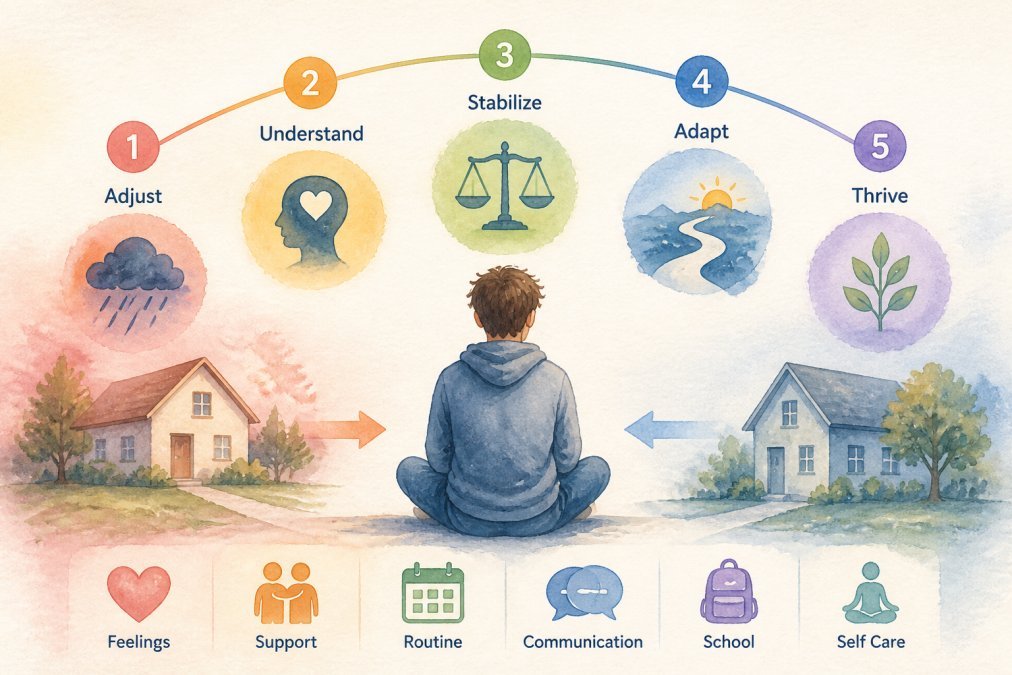
Understanding how conflict affects children motivates parents to change their own behavior. Children in high-conflict divorce situations experience elevated stress hormones, difficulty concentrating, sleep disturbances, and increased risk of anxiety and depression.
Critically: the conflict itself causes these effects, not the divorce. Children in low-conflict separated families show no elevated mental health risks compared to children in intact families. Children in high-conflict intact families show the same psychological damage as children in high-conflict divorces.
This distinction is critical. A parent might think staying in the marriage protects children, but research shows the opposite: staying in a high-conflict marriage harms children more than separating does.
The best courses help parents understand this research and use it as motivation to reduce conflict behavior. When a parent understands that their hostile communication directly increases their child’s anxiety, they’re more likely to change how they respond to provocations.
After the Affair Series emphasizes protecting children’s emotional wellbeing through specific frameworks. Courses like New Ways for Families specifically address how to keep children out of the middle, not speaking negatively about the other parent, not using children as messengers, and not asking children to choose sides.
Self-Paced vs. Live Facilitated Courses: Which Is Right for You?
The format you choose affects both learning outcomes and your ability to implement what you learn.
| Course Format | Best For | Time Commitment | Cost | Support Available |
|---|---|---|---|---|
| Self-paced online | Parents with unpredictable schedules, limited budget | 6-12 hours spread over weeks | $39.99-$129.95 | Video content, worksheets, email support |
| Live facilitated (virtual) | Parents who need accountability, real-time answers | 2-3 hours per week for 4-6 weeks | $150-$500+ | Instructor feedback, group discussion, live Q&A |
| Personalized coaching | Parents in acute crisis, custody battles, trauma responses | Ongoing (8-12 sessions) | $100-$300+ per hour | One-on-one strategy, legal coordination, crisis support |
Self-paced courses work best when you’re ready to learn but your schedule is chaotic. High Conflict Solutions offers 8 hours of interactive video content with a 365-day access window. The downside: you don’t have an instructor to help when a specific situation doesn’t fit the frameworks.
Live facilitated courses create accountability. Knowing you have a group meeting on Thursday means you’re more likely to complete homework and practice skills. New Ways for Families can be taken independently or with a coach; the coach version includes personalized feedback.
Personalized coaching becomes necessary in acute crisis, custody battles, or situations involving threats or abuse. High-Conflict Divorce Coaching from Jody Willson provides trauma-informed strategy and emotional support alongside legal preparation.
If you’ve already tried therapy or parenting classes and still feel stuck, you likely need a high-conflict-specific approach. Generic parenting courses teach cooperation skills that don’t work when one parent refuses to cooperate.
Court Acceptance and Legal Compliance Verification
Before enrolling, verify that the certificate will satisfy your court’s requirements. “Court-approved” is not universal; courts in different jurisdictions recognize different providers.
Many high-conflict co-parenting courses exceed court minimums deliberately. A court might require 4 hours; a course might provide 8-12 hours to ensure comprehensive coverage of high-conflict dynamics.
Courts typically recognize:
- New Ways for Families (developed by the High Conflict Institute, widely accepted)
- High Conflict Solutions (explicitly marketed as court-approved)
- Active Parenting programs (established 30+ years, recognized nationally)
- State-specific parenting education providers (varies by jurisdiction)
When verifying court acceptance, ask specifically: Does the court accept this provider? What’s the minimum hour requirement? Does the certificate need to be notarized?
The best courses make court acceptance transparent. High Conflict Solutions explicitly states that its 8-hour program exceeds Level 2 co-parenting requirements in most states. Courses that are vague about court recognition should be approached with caution.
Finding the right course for high conflict divorce means matching your specific situation to a program that addresses those dynamics rather than generic parenting theory. After the Affair Series provides structured frameworks and actionable scripts for managing hostile interactions and protecting your children’s emotional wellbeing. The platform’s 50+ age-appropriate scripts, Gray Rock Method training, and free 23-point assessment help you move from survival mode to strategic clarity. Start with the free assessment to understand your specific conflict patterns, then choose a course format that fits your schedule and crisis level.