Last Updated: July 29, 2026
- Scripts for Communicating With Unfaithful Spouse: Foundation Principles
- Communication After Infidelity: The Discovery Conversation
- Setting Boundaries After Infidelity: Hard-Line Scripts
- Infidelity Disclosure Guidelines: Legal-Aware Communication
- Rebuilding Trust After Infidelity: Accountability Scripts
- Managing Emotional Triggers: Scripts for Staying Grounded
- Common Mistakes When Using Scripts for Communicating With Unfaithful Spouse
- Conclusion: Moving Forward With Clarity and Protection
- Frequently Asked Questions
When infidelity surfaces, the conversations that follow can make or break your ability to protect yourself emotionally and legally. Most people enter these discussions unprepared, cycling through anger, denial, and desperate attempts to salvage the relationship while their unfaithful spouse controls the narrative through gaslighting, trickle truth, and blame shifting. Scripts for communicating with unfaithful spouse become essential tools. Unlike generic relationship advice, After the Affair Series provides structured frameworks that keep you grounded, prevent manipulation, and document critical information you may need later.
Research shows that how you communicate during the discovery phase directly impacts your ability to establish accountability, set boundaries, and move forward without further harm. American Psychological Association research on infidelity trauma documents that betrayed spouses who maintain emotional regulation during initial confrontations report significantly better long-term outcomes in both reconciliation and co-parenting scenarios.
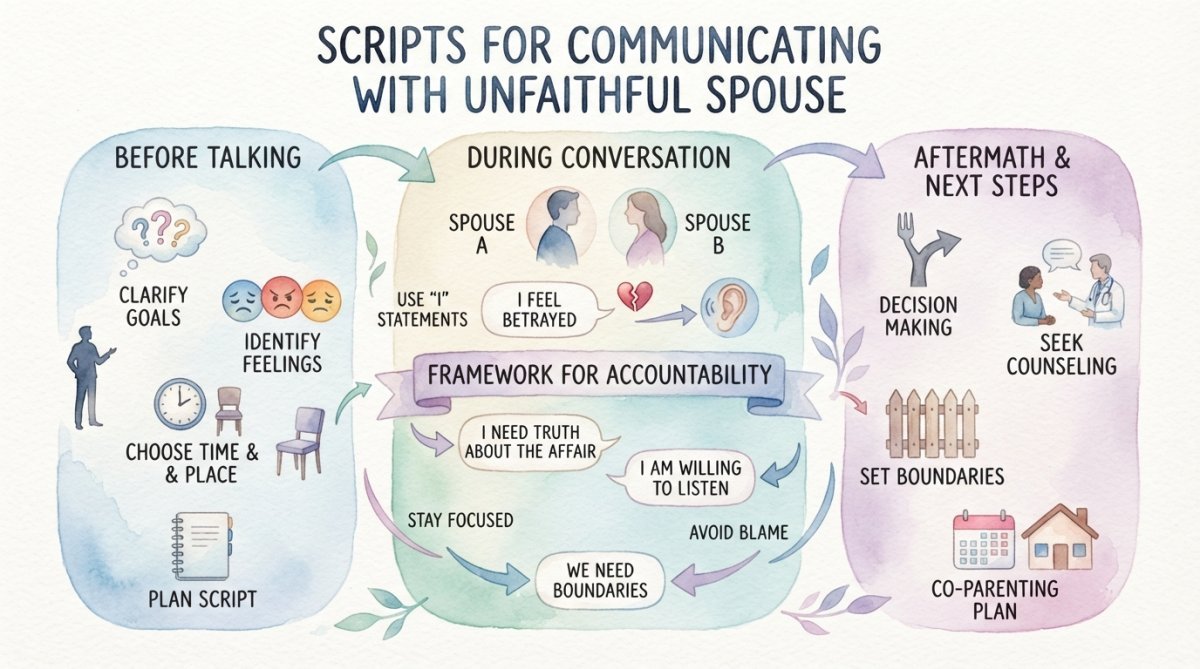
Scripts for Communicating With Unfaithful Spouse: Foundation Principles
Your instinct upon discovering infidelity is to confront immediately. That impulse is natural, and often your biggest mistake.
Standard communication breaks down after infidelity because the betrayed spouse is in acute trauma while the unfaithful spouse is defensive, minimizing, or actively deceptive. You need a different framework entirely. Scripts remove emotional hijacking and keep you from making threats you won’t keep, asking questions that invite more lies, or accepting partial truths as reconciliation.
Before using any script, anchor yourself to three core principles:
1. Assume deception until proven otherwise. Your spouse has already lied repeatedly. The default assumption should be that you’re hearing a partial truth or an outright lie.
2. Document everything. Write down the date, time, what was said, and by whom. Follow up in writing: “To confirm what you told me on [date], you said [specific statement]. Is that accurate?”
3. Separate the conversation from the decision. Having a conversation about infidelity does not mean you’ve decided to stay or leave.
The most common mistake is treating the first conversation as the final conversation. Expect trickle truth, your spouse will reveal more details over weeks or months. Scripts help you manage each conversation independently without collapsing under cumulative betrayal.
Communication After Infidelity: The Discovery Conversation
Your first conversation after discovering infidelity will set the tone for everything that follows. This is not the time for softening your language.
Scripts for Initial Confrontation
The goal is to state what you know, establish that you’re serious, and gather a baseline account. You’re not here to convince your spouse to confess or negotiate the terms of the affair.
Script 1: Direct Statement Without Accusation
“I know about [specific detail]. I need you to tell me the full truth about what happened. Not a version of it. Not what you think I can handle. The actual truth. I’m not asking, I’m telling you this is what needs to happen next.”
This removes the question mark. Your spouse will likely deny or deflect. Your response:
“I understand you’re denying this. But I have [evidence]. I need the truth from you, not a story. We can talk about this now, or we can talk about it with a lawyer. Your choice.”
Script 2: When You Have Partial Information
“I found [evidence]. I’m not interested in a version of events that minimizes what happened or blames me for it. I want to know who, what, when, where, and how long. If you can’t give me that, we’re done talking.”
Script 3: When Your Spouse Admits But Minimizes
“I appreciate that you’re admitting to this. But ‘it just happened once’ or ‘it didn’t mean anything’ are not explanations, they’re minimizations. I need to understand the full context. How did this start? How many times? What did you do to stop it?”
Accepting the first admission as “the truth” is a common mistake. It rarely is. Unfaithful spouses typically admit to the minimum they think you already know, then reveal more details only when confronted with additional evidence. Prepare yourself for trickle truth.
Managing Trickle Truth and Demanding Transparency
Trickle truth is when your spouse reveals infidelity in installments, admitting to new details only when you present evidence. It’s a deliberate strategy to control the narrative and minimize damage.
Script 4: Calling Out Trickle Truth
“Over the past [timeframe], you’ve told me three different versions of what happened. First it was [version 1], then [version 2], now [version 3]. That tells me you’re still lying. You’re going to tell me everything right now. Not in pieces. Not when I find evidence. Everything. If I find out later that you left something out, this conversation is over and we’re talking to a lawyer.”
Script 5: Demanding Full Transparency
“I need complete transparency going forward. That means full access to your phone, email, and all social media accounts; a timeline of the infidelity with specific dates and details; the identity of the other person; how contact ended and proof that it has ended; and answers to any question I ask, whenever I ask it. This isn’t negotiable. If you want any chance of us moving forward, this is the baseline.”
Script 6: When Your Spouse Claims “I’ve Told You Everything”
“You’ve said that before, and then I found out more. I need you to sit down and write out a complete timeline of the infidelity. Dates, locations, what happened, how it ended. I’m going to ask you detailed questions about each entry. If I find inconsistencies, we’re done.”
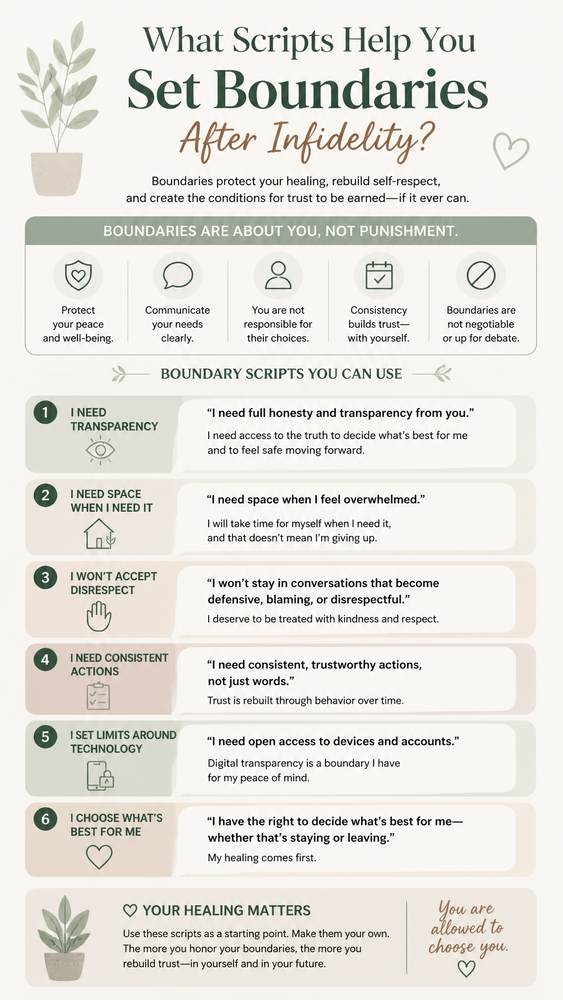
Setting Boundaries After Infidelity: Hard-Line Scripts
Infidelity creates a power vacuum. Your spouse will often try to regain control through manipulation, gaslighting, and blame shifting. You need scripts that establish and enforce boundaries without negotiation.
Scripts for Self-Protection During Emotional Manipulation
Your spouse will try to make you feel guilty for asking questions or protecting yourself. These are manipulation tactics designed to silence you.
Script 7: When Your Spouse Says You’re “Being Obsessive”
“I’m not being obsessive. I’m being cautious. You broke my trust. My questions are the direct result of your choices. If you don’t like being asked questions, you should have thought about that before you had an affair.”
Script 8: When Your Spouse Gets Angry About Your Boundaries
“Your anger doesn’t change what happened or what I need right now. I’m not here to manage your emotions. I’m here to protect myself. If you can’t handle that, you’re welcome to leave.”
Script 9: When Your Spouse Says “You Need to Move On”
“I will move on at my own pace, not on your timeline. You don’t get to decide how long I process this or what I need from you while I do. If you’re not willing to provide what I need, that’s information I’ll use to make decisions about our future.”
Boundary-Setting Phrases for Gaslighting and Blame Shifting
Script 10: When Your Spouse Gaslights You
“I know what I saw. I know what you said. I know what happened. You can deny it, reframe it, or claim I’m remembering wrong. But that doesn’t change reality. What it does tell me is that you’re not being honest with me. And that’s a problem.”
Script 11: When Your Spouse Blames You for the Affair
“I understand you’re saying I caused this. But I didn’t make the choice to cheat. You did. You could have come to me and said the relationship wasn’t working. You could have suggested therapy. You could have asked for a separation. Instead, you lied and cheated. That was your choice. Own it.”
Script 12: When Your Spouse Uses “It Was Just Sex” to Minimize
“Whether it was emotional or physical doesn’t matter. You broke our agreement. You lied to me repeatedly. You risked my health. You risked our family’s stability. ‘It was just sex’ is not an explanation, it’s an attempt to make this smaller than it is.”
The most powerful boundary-setting phrase is silence followed by action. When your spouse gaslights or blames you, sometimes the best response is to say nothing and then follow through on a consequence.
Infidelity Disclosure Guidelines: Legal-Aware Communication
Every conversation you have with your unfaithful spouse about infidelity is potentially discoverable in a divorce proceeding. Structure conversations carefully.
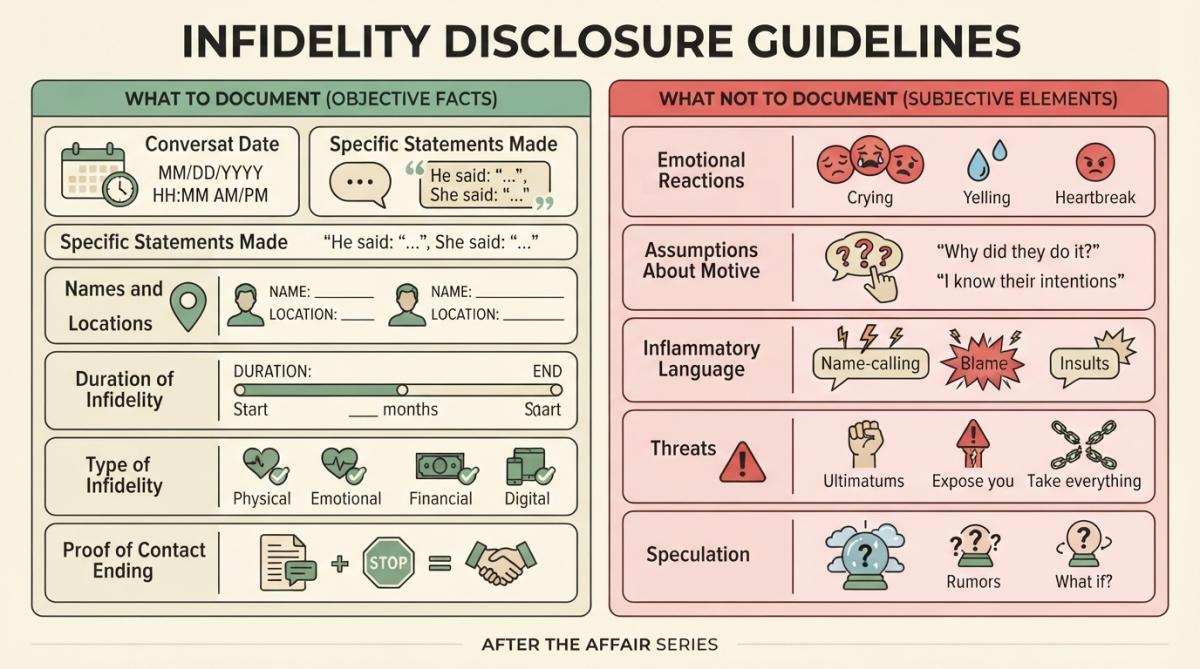
What to Document and How to Phrase It
What to Document:
- Date and time of the conversation
- Specific statements your spouse made (use direct quotes when possible)
- Names, dates, and locations mentioned
- Duration of the infidelity
- Whether the infidelity was emotional, physical, or both
- Whether your spouse has ended contact with the other person
- Any promises your spouse made about transparency or therapy
What NOT to Document:
- Your emotional reactions or interpretations
- Assumptions about your spouse’s motives
- Inflammatory language or insults
- Threats you made
- Speculation about what “really” happened
(/how-to-navigate-affair-disclosure-a-step-by-step-guide/): Legal-Aware Communication]
Script 13: Documenting Admissions in Writing
After a conversation, follow up with a written message: “I want to confirm what you told me on [date] at [time]. You said [specific statement about the infidelity]. Is that accurate? Please confirm in writing so we have a clear record.”
Script 14: Setting Expectations for Honesty
“Going forward, I need complete honesty from you. If I ask you a direct question about the infidelity, you answer it completely and truthfully. If I later find out you lied or left something out, that’s grounds for separation. Do you understand?”

Scripts for Co-Parenting During Discovery
If you have children, infidelity creates an additional layer of complexity.
Script 15: When Your Spouse Wants to Discuss Infidelity in Front of Children
“We are not discussing this in front of the kids. Period. If you want to talk about this, we do it when they’re not home, or we do it with a therapist.”
Script 16: When Your Spouse Wants to Tell the Children About the Affair
“If you want to tell the kids about this, we need to do it together, with a family therapist present. We need to agree on what we’re saying and how we’re framing it. This isn’t something you get to do unilaterally.”
Script 17: Establishing Boundaries on Infidelity Talk During Custody Exchanges
“When we’re exchanging the kids, we don’t talk about the infidelity. We keep it brief and business-like. If you want to discuss this, we do it on a scheduled call or in writing.”
Rebuilding Trust After Infidelity: Accountability Scripts
If reconciliation is on the table, your spouse needs to demonstrate genuine accountability. This is different from remorse. Remorse is feeling sorry. Accountability is changing behavior and accepting consequences.
Scripts That Require Real Accountability From Your Spouse
Script 18: Demanding Accountability, Not Apologies
“I don’t need you to apologize. I need you to show me that you understand what you did and that you’re committed to never doing it again. That means full transparency without me asking, willingness to answer any question anytime, specific changes to your behavior and how you spend your time, therapy to understand why you made this choice, and understanding that rebuilding trust will take years, not months. If you’re not willing to do all of that, we’re done.”
Script 19: When Your Spouse Says “I’ll Do Whatever It Takes”
“That’s good to hear. Here’s what that looks like: [specific list]. I’m going to hold you to this. If you slip, if you lie, if you resist, we’re done. This isn’t a negotiation. This is what reconciliation requires.”
Script 20: Establishing Ongoing Accountability
“Every week, we’re going to have a conversation about how you’re doing with transparency, therapy, and rebuilding trust. If you’re not willing to check in regularly, that tells me you’re not serious about reconciliation.”
Red Flags in Your Spouse’s Responses
Watch for these red flags indicating your spouse is not demonstrating genuine accountability: defensiveness instead of acceptance, explaining instead of owning, conditional apologies, minimizing the impact, rushing the timeline, refusing transparency, or blaming external factors. If you see these patterns, your spouse is performing remorse, not demonstrating accountability.
Managing Emotional Triggers: Scripts for Staying Grounded
Infidelity creates triggers. A song, a date, a location can suddenly throw you back into the trauma of discovery. You need scripts to manage these moments without falling apart or making reactive decisions.
Script 21: When Your Spouse Gets Defensive
“Your defensiveness tells me you’re not ready to have this conversation. We can try again later, or we can do this with a therapist. But I’m not going to sit here and be made to feel guilty for asking questions about your affair.”
Then stop talking. Don’t explain yourself. Just end the conversation.
Script 22: When Your Spouse Turns It Around on You
“I hear what you’re saying about my flaws. We can address those separately, in therapy. But right now, we’re talking about your infidelity. Your unhappiness with me doesn’t justify lying and cheating. Those are two separate issues.”
Script 23: Managing Your Own Emotional Triggers
When you feel triggered, pause before responding: “I’m feeling triggered right now. I need to take a break. We can continue this conversation in [specific timeframe].”
Protecting Yourself From Hysterical Bonding and False Reconciliation
Hysterical bonding is the sudden surge of intimacy after infidelity is discovered. It feels like reconciliation. It’s not. It’s trauma bonding.
Script 24: Setting Boundaries on Intimacy During Early Recovery
“I’m not ready for physical intimacy right now. I need time to process this and rebuild trust. Pushing for sex is not going to help that process.”
Script 25: When Your Spouse Interprets Reduced Conflict as Reconciliation
“The fact that we’re not fighting right now doesn’t mean we’re reconciled. It means I’m in a holding pattern while I figure out what I want to do. Don’t confuse the absence of conflict with acceptance.”
Common Mistakes When Using Scripts for Communicating With Unfaithful Spouse
Even with scripts, betrayed spouses make predictable errors that undermine their effectiveness.
Mistake 1: Using Scripts as Questions Instead of Statements
WRONG: “Don’t you think you owe me complete transparency?”
RIGHT: “You need to give me complete transparency. This is non-negotiable.”
Mistake 2: Accepting Partial Answers
“You didn’t answer my question about [specific detail]. I need you to answer that part too.”
Mistake 3: Allowing Your Spouse to Control the Pace
“I understand you’re uncomfortable. We’re talking about this anyway. Your comfort is not my priority right now.”
Mistake 4: Sharing Scripts With Your Spouse in Advance
Don’t tell your spouse you’re using “scripts.” That tips them off and allows them to prepare defensive responses.
Mistake 5: Expecting Scripts to Fix the Relationship
Scripts are tools for protecting yourself and gathering information. They’re not magic words that will make your spouse confess or become trustworthy.
Mistake 6: Abandoning Scripts When Your Spouse Gets Angry
“I understand you’re angry. We’re still having this conversation.”
| Common Mistake | What It Looks Like | How to Fix It |
|---|---|---|
| Using scripts as questions | “Don’t you think you should be transparent?” | Make statements: “You need to give me complete transparency.” |
| Accepting partial answers | Your spouse answers one part and avoids the rest | Repeat the unanswered question: “I still need you to answer the part about…” |
| Allowing spouse to control pace | “Can we talk about this later?” | Reject: “We’re talking about it now.” |
| Sharing scripts in advance | Warning your spouse: “I’m going to ask you some hard questions” | Use scripts naturally without announcing them |
| Expecting scripts to fix things | Thinking scripts will make them confess or change | Use scripts for protection and information, not transformation |
| Abandoning scripts during conflict | Stopping when your spouse gets angry | Stay calm and continue: “Your anger doesn’t change what we’re discussing” |
The biggest mistake is believing that if you just say the right thing, your spouse will suddenly become honest and accountable. They won’t. Some people are fundamentally committed to deception. Scripts protect you from those people, they don’t transform them.
Conclusion: Moving Forward With Clarity and Protection
Discovering infidelity shatters the foundation of your relationship. The conversations that follow will determine whether you can rebuild that foundation or walk away. Having scripts for communicating with unfaithful spouse isn’t about manipulation, it’s about protecting yourself from further harm while you figure out what comes next.
After the Affair Series provides structured frameworks and specific scripts designed for exactly these moments. Rather than offering general relationship advice, the platform delivers immediate, practical solutions for the most difficult conversations you’ll face, including scripts that protect you legally, emotionally, and psychologically.
Get started with After the Affair Series and equip yourself with the tools to navigate infidelity conversations with clarity, power, and protection.
Frequently Asked Questions
How do you talk to a cheating spouse without losing control of the conversation?
Use I-statements paired with clear facts: ‘I found evidence of infidelity on [date]. I need complete transparency about what happened.’ Avoid accusations (‘You’re a liar’) and stick to observable behavior. Plan the conversation in advance, choose a neutral time (not during stress), and have an exit strategy if the conversation becomes abusive. Scripts for communicating with unfaithful spouse work best when you stay factual and refuse to engage in blame shifting or defensiveness from your spouse.
What should you not say to a cheating spouse during confrontation?
Avoid: character attacks (‘You’re a terrible person’), threats made in anger (‘I’m taking the kids’), or ultimatums you can’t enforce. Don’t ask ‘Why?’ repeatedly, this invites justification and manipulation. Don’t apologize for the affair or accept blame for ‘causing’ it. Don’t make promises about reconciliation you haven’t decided on. Phrases like ‘I can’t believe you’d do this to me’ invite gaslighting responses. Instead, stick to factual observations and your boundaries: ‘This is infidelity. I need time to process before we discuss next steps.’
How can I rebuild trust after infidelity if my spouse keeps making excuses?
Rebuilding trust after infidelity requires your spouse to demonstrate accountability, not just apology. Use scripts that require specific actions: ‘I need you to [specific behavior] to show this won’t happen again.’ Examples: full transparency on devices, therapy attendance, or written timeline of the affair. If your spouse continues blame shifting (‘You were distant’) or minimizing (‘It was just emotional’), that’s a red flag that reconciliation may not be possible. Real trust-building shows up in changed behavior over months, not words in one conversation.
Is it risky to use communication scripts if my spouse is hostile or unpredictable?
Scripts actually protect you in high-conflict situations by keeping you grounded and reducing reactive responses your spouse can weaponize. However, if your spouse is abusive, threatening, or refuses to engage respectfully, scripts alone aren’t enough, you may need legal guidance on documentation and safety planning. Infidelity disclosure guidelines recommend keeping written records of important conversations. Consider using a mediator or parallel parenting approach if direct communication escalates conflict. The goal is clarity and self-protection, not forcing reconciliation with someone who won’t engage honestly.