Last Updated: August 4, 2026
- Understanding Betrayal Trauma and Your Immediate Response
- Managing Intrusive Thoughts After Betrayal
- Stages of Healing After Infidelity and What to Expect
- How to Rebuild Trust After Cheating Through Transparency and Accountability
- Couples Therapy for Infidelity: Finding Professional Support
- Co-Parenting During Recovery and Protecting Your Children
- Practical Tools to Survive the Aftermath of Affairs
Discovering infidelity shatters the foundation of trust you’ve built. The emotional aftermath can feel unbearable, intrusive thoughts flood your mind, your body feels broken, and you’re paralyzed by whether to stay or leave. Surviving this requires structured tools and honest support, not platitudes about forgiveness. At After the Affair Series, we provide concrete steps to regain control when everything feels chaotic. Below, we’ll walk you through the exact stages of healing, the psychological frameworks explaining what’s happening to your brain, and practical communication strategies that work even when your partner seems unwilling to change.
Understanding Betrayal Trauma and Your Immediate Response
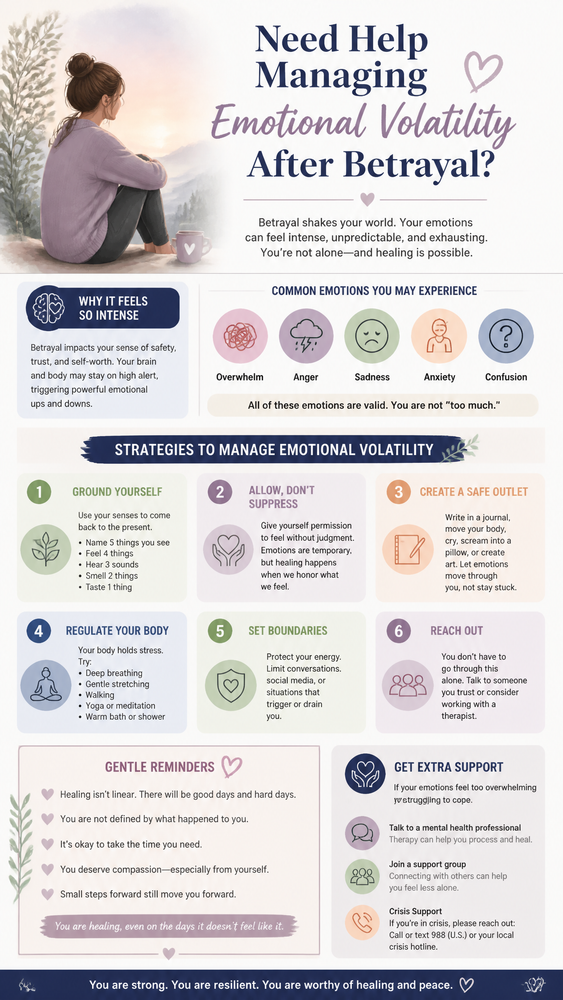
Your brain experienced a threat to your core attachment system. Betrayal trauma is the specific psychological injury that occurs when someone you depend on violates your trust fundamentally. The discovery of infidelity activates your nervous system’s threat-detection pathways, flooding your body with cortisol and adrenaline as if you’re physically in danger.
Post-discovery shock typically lasts 48 to 72 hours, though some experience it for weeks. During this window, your mind oscillates between rage and numbness, between fighting for the relationship and wanting to end it. Your brain’s predictive model of reality has collapsed. Every interaction you remember now feels suspect as your nervous system searches obsessively for threat signals, a survival mechanism, not weakness.
The emotional flooding you experience is your nervous system cycling through survival states. These aren’t mood swings; they’re your brain attempting to process an impossible contradiction: the person you trusted most has harmed you deliberately.
Betrayal trauma is not weakness or oversensitivity. It’s a specific psychological injury that disrupts your attachment system and activates your threat-detection pathways. Understanding this distinction changes how you treat yourself during recovery.
Managing Intrusive Thoughts After Betrayal
Intrusive thoughts are unwanted mental images or narratives that feel impossible to dismiss. After discovering infidelity, these typically center on vivid replays of the betrayal or graphic imagery of your partner with the other person. These thoughts feel like truth, but they’re not predictions, they’re your traumatized nervous system cycling through threat scenarios. The goal is not to eliminate them but to change your relationship to them.
Trigger identification and response protocols start with noticing what activates your intrusive thought cycles. Common triggers include your partner’s phone buzzing, certain times of day, or locations where the affair occurred. When triggered, you have three options:
Avoid the trigger temporarily. In early recovery (first 3-6 months), avoidance is strategic. Ask your partner not to mention certain details. Skip social media. Avoid locations tied to the affair.
Create a grounding protocol for when the trigger fires. Name the intrusive thought: “This is my traumatized brain replaying the threat.” Then ground yourself physically: feel your feet on the floor, name five things you see, hold ice in your hand.
Process the trigger systematically. Later in recovery, you can choose to process difficult triggers with a therapist, examining it once, understanding what it means, and releasing it.
Grounding techniques for emotional regulation work because they interrupt the amygdala’s threat response by engaging your prefrontal cortex. The 5-4-3-2-1 technique is simple: name five things you see, four you can touch, three you hear, two you smell, one you taste. This forces your brain to focus on present sensory data instead of past trauma.
Rumination feels productive because it feels like you’re solving the problem. You’re not. Cycling through the same thoughts repeatedly deepens the neural pathways that make those thoughts more intrusive. Set a time limit for processing difficult thoughts, 15 minutes, then redirect your attention deliberately.
The Gray Rock Method helps when your partner’s presence itself triggers floods of intrusive thoughts. By keeping communication neutral and boring, you reduce the emotional charge of interactions, which naturally reduces activation of your threat system.
Stages of Healing After Infidelity and What to Expect
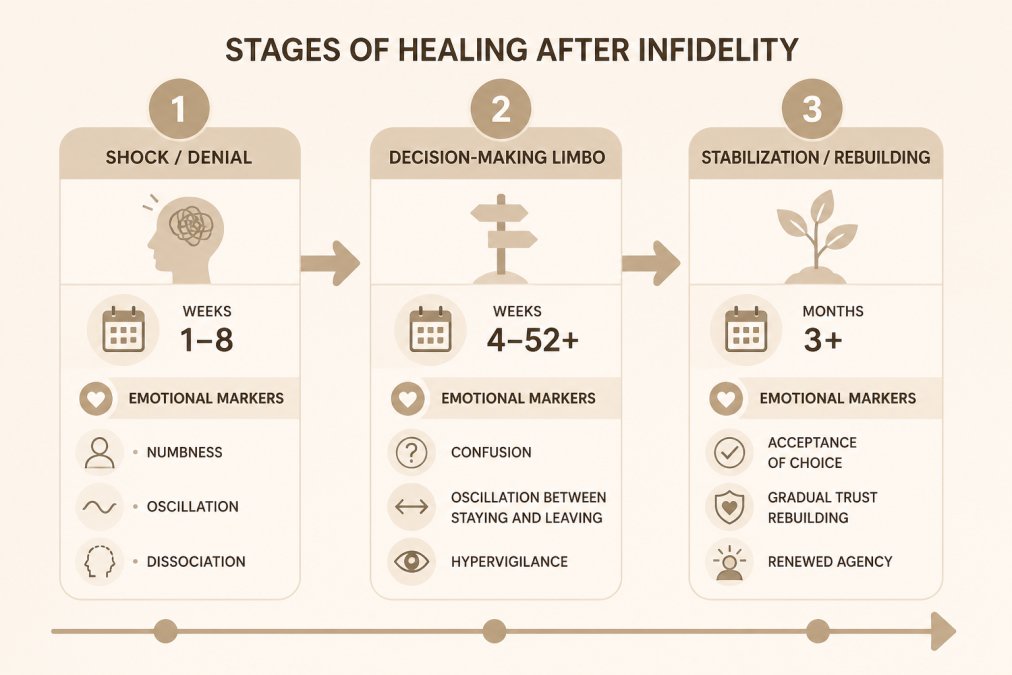
Healing from infidelity moves through identifiable phases, each with distinct emotional terrain and specific tasks. Understanding these stages prevents you from believing you’re failing recovery when you’re actually exactly where you should be.
The shock and denial phase typically lasts 2-8 weeks after discovery. Your brain is still processing the betrayal. You might feel numb or oscillate between extreme emotions. Some people experience dissociation, a feeling of watching themselves from outside their body. This is your nervous system protecting you from overwhelming pain. During shock, decision-making is nearly impossible, your prefrontal cortex is offline. This is why experts recommend delaying major decisions for at least 30 days after discovery.
The decision-making limbo phase typically begins 4-12 weeks after discovery and can last months or years. Initial shock wears off enough that you can think, but not clearly enough to decide. You find yourself asking: Do I stay or leave? Can this relationship be repaired? Is my partner genuinely remorseful? This limbo is agonizing, but it’s the normal process of integrating new information about your relationship and your future.
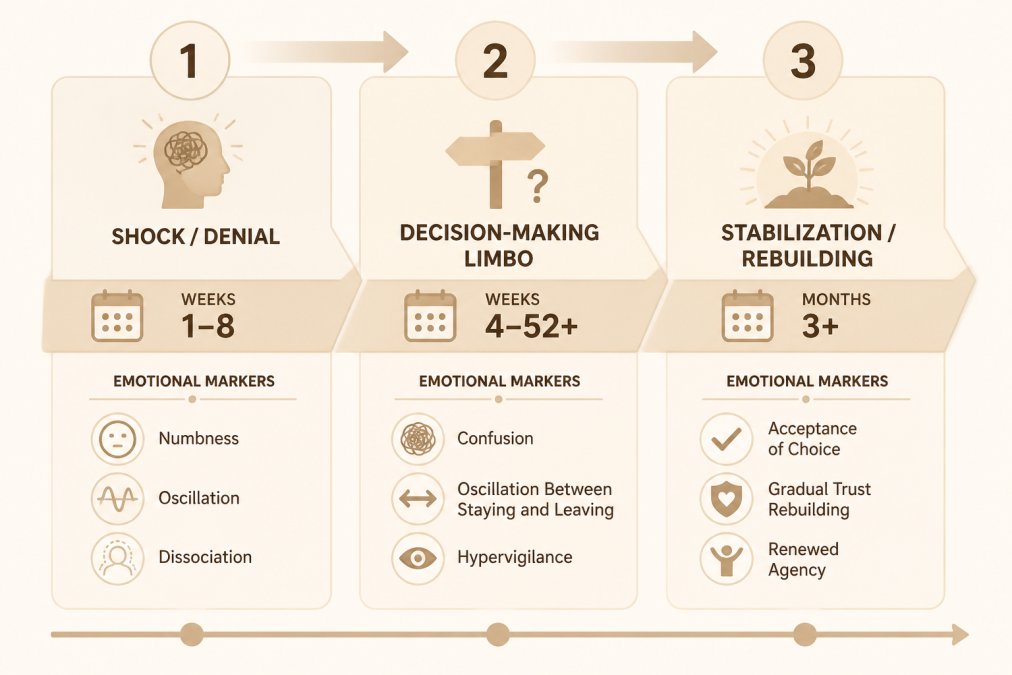
The stabilization and rebuilding phase begins when you’ve made a clear decision about the relationship and your nervous system starts to believe you’re safe again. If you’ve chosen to stay, this phase involves rebuilding trust through consistent transparency and accountability. If you’ve chosen to leave, this phase involves grieving the relationship you thought you had and building a new life.
How to Rebuild Trust After Cheating Through Transparency and Accountability
Trust cannot be rebuilt through words alone. It’s rebuilt through consistent behavior over time, specifically through transparency that removes the possibility of hidden betrayal and accountability that proves your partner takes responsibility for the harm they caused.
Establishing digital boundaries and social media protocols is the foundation of rebuilding safety. Your partner needs to understand that their phone, email, and social media accounts are no longer private spaces. This isn’t punishment; it’s the cost of rebuilding trust after violating it.
Specific protocols that work:
Phone and email access: Your partner shares passwords and grants you access to their phone, email, and messaging apps.
Location sharing: Your partner enables real-time location sharing via phone.
Social media transparency: Your partner unfollows or blocks the affair partner and doesn’t have private messages with people of the sex they’re attracted to.
Communication about contact: If your partner must interact with the affair partner (co-parenting, shared workplace), they tell you beforehand and report afterward.
Financial transparency as a foundation for trust is often overlooked but critical. Infidelity frequently involves financial deception, hidden credit cards, secret hotel charges, money spent on gifts or dates. Until your partner demonstrates financial transparency, you cannot fully trust them.
Specific financial protocols:
Joint account visibility: All bank accounts and credit cards are visible to both partners.
Expense tracking: Large purchases are discussed beforehand.
Debt disclosure: Your partner fully discloses any debts incurred during the affair.
Financial transparency often reveals additional deception that wasn’t part of the original affair. This is common and normal. Discovering these doesn’t mean the relationship can’t be repaired, but it does mean trust-rebuilding will take longer because the foundation of deception was deeper.
Couples Therapy for Infidelity: Finding Professional Support
Attempting to rebuild trust without professional support is possible but significantly harder. A trauma-informed therapist trained in infidelity recovery helps your partner understand the impact of their betrayal, teaches you both the communication skills necessary to process what happened, and helps you decide whether reconciliation is actually possible.
What to expect from trauma-informed therapy differs significantly from standard couples counseling. A trauma-informed therapist understands that infidelity is a specific form of relational trauma. They won’t ask you to “just forgive” or suggest that the affair happened because something was wrong in the relationship.
The therapy process typically involves:
Full disclosure: Your partner tells you the complete truth about the affair.
Impact processing: Your therapist helps your partner understand specifically how the betrayal has affected you.
Accountability work: Your partner learns to take full responsibility without minimizing or blaming circumstances.
Communication skills: You both learn to discuss the affair and your relationship without cycling into the same arguments.
Rebuilding phase: If you both choose to continue, therapy shifts toward rebuilding emotional intimacy and trust.
When therapy is and isn’t the right choice requires honest assessment. Therapy is the right choice if both partners genuinely want to repair the relationship, your partner is willing to be fully transparent and accountable, you’re not in immediate danger, and you have financial resources for ongoing sessions.
Therapy is NOT the right choice if your partner is still lying or minimizing the affair, unwilling to end contact with the affair partner, blaming you for the infidelity, you’re staying only because you’re afraid of being alone, or your partner is abusive or controlling. If therapy isn’t appropriate, individual therapy for yourself is still valuable.
Co-Parenting During Recovery and Protecting Your Children
Age-appropriate communication scripts for different situations help you navigate difficult conversations without oversharing or lying.
If you have children, infidelity and its aftermath become exponentially more complex. Your children are watching your responses and absorbing the conflict. Your job during recovery is to shield them from the worst of it while being honest about what’s happening.
For young children (ages 5-8):
“Mom and Dad have some grown-up problems we’re working on. This is not your fault. We both love you very much, and that won’t change.”
For older children (ages 9-12):
“Mom/Dad made a choice that hurt our family. We’re working with a therapist to figure out what happens next. You might see us sad or frustrated sometimes, but we’re handling it with help.”
For teenagers (ages 13+):
“One of us was unfaithful in our marriage. I know this is hard to process. You can ask me questions, but I won’t bad-mouth your other parent or put you in the middle.”
Managing hostile interactions while shielding your kids requires specific protocols. If your co-parent is hostile or attempting to turn your children against you:
Keep exchanges brief and businesslike. Use neutral language. Stick to logistics: schedules, medical appointments, school events.
Use a third-party communication app like OurFamilyWizard that timestamps all communication and creates accountability.
Never discuss the affair or relationship problems with your children present. If your co-parent brings it up during exchanges, say: “This isn’t the time or place.”
Validate your children’s feelings without taking sides. If your child says “Mom/Dad says you’re the reason they cheated,” respond: “That’s not accurate. Your parent made their own choices.”
Seek a parenting coordinator or mediator if conflict is escalating.

Practical Tools to Survive the Aftermath of Affairs
Beyond psychological frameworks, surviving infidelity requires concrete communication tools and boundary-setting strategies that work in real conversations.
Structured communication frameworks for high-conflict situations give you a way to discuss the affair without cycling into the same arguments repeatedly. The OARS method, adapted for infidelity, includes:
Open-ended questions: “Can you help me understand what you were thinking when you decided to…” instead of “Why did you betray me?”
Affirmations: Acknowledge one true thing about your partner before the conversation.
Reflective listening: Repeat back what you heard before responding.
Summarizing: At the end, state what you understand.
The Pause Protocol for when conversations become heated:
Recognize the escalation. Your heart rate increases, you’re raising your voice, you feel rage or panic.
Call the pause. Either partner can say: “I need to pause this conversation. I’m getting too activated.”
Step away for 20-30 minutes. Do something that calms your nervous system: walk, breathe, listen to music.
Reconvene with intention. Return to the conversation only when you’re both calmer.
Boundary-setting strategies that actually work require clarity about what you need and consistency in enforcing those boundaries.
Ineffective boundaries sound like: “You need to be more transparent” or “You should spend more time with the family.”
Effective boundaries are specific and enforceable:
Instead of “Be more transparent,” try: “I need access to your phone, email, and location at all times. If you refuse, I’ll need to reconsider this relationship.”
Instead of “Spend more time with us,” try: “I need you home by 6 PM on weeknights and present during family dinner without your phone.”
Instead of “Stop lying,” try: “If I discover you’ve lied about anything, your whereabouts, your communications, your finances, I will consider that a deal-breaker.”
Boundaries work only if you’re willing to enforce them. If your partner violates a boundary and you don’t follow through with consequences, the boundary becomes meaningless.
Setting boundaries often triggers your partner’s fear and defensiveness. They may accuse you of being controlling or punitive. Stay firm. Boundaries after infidelity are not punishment; they’re the minimum requirements for rebuilding trust. If your partner won’t accept them, that’s information about whether they’re capable of genuine change.
Conclusion
Surviving the aftermath of affairs is not about forgiveness or moving past the pain quickly. It’s about reclaiming your agency, understanding what happened to your nervous system, and making a clear-eyed decision about your future. Whether you choose to stay and rebuild or leave and rebuild separately, you need structured tools and honest support.
After the Affair Series provides exactly that: specific frameworks for managing intrusive thoughts, communication scripts for high-conflict situations, age-appropriate protocols for protecting your children, and the clarity to make decisions from a place of strength rather than fear. Take the free 23-point assessment to understand where you are in the recovery process and what your next steps should be.