Acute betrayal shock is the sudden, disorienting trauma response your nervous system produces in the hours and days after a serious breach of trust by someone you depended on — a partner’s affair, a hidden financial life, a secret addiction. It is the initial stage of what clinicians call betrayal trauma, and it is a genuine psychological injury, not an overreaction.
If you are in the first hours of this, watch for these three immediate signs:
- Dissociation or blankness — feeling detached from your body, as if watching yourself from outside
- Intrusive replay — the discovery moment looping in your mind on repeat, unbidden
- Physical shock symptoms — shaking, nausea, chest tightness, or sudden exhaustion
The single most important thing you can do right now: get physically safe, plant your feet on the floor, and make no irreversible decisions today.
Key Takeaways
Acute betrayal shock is a real, neurologically grounded trauma response — not an overreaction — and the most protective action in the first hours is to stay safe, ground your body, and delay irreversible decisions.
| Point | Details |
|---|---|
| Shock is a normal response | The nervous system’s acute reaction to betrayal by an attachment figure is expected, not a sign of weakness. |
| Delay major decisions | Prefrontal cortex impairment in the acute phase makes irreversible choices — divorce, finances, confrontations — genuinely risky to act on immediately. |
| Nervous-system timeline | Meaningful stabilization takes weeks; deeper nervous-system shifts commonly require 12–24 months of consistent, body-aware work. |
| Seek clinical support early | Trauma-informed CBT, EMDR, and somatic therapies all have evidence support; a betrayal-informed therapist is the most effective match. |
| Aftertheaffair resources | The 7-step recovery checklist and Navigating Infidelity provide structured, immediate guidance for the acute survival phase. |
Table of Contents
- What acute betrayal shock is and where it fits in betrayal trauma
- Why betrayal shock is uniquely disorienting: theory and nervous-system mechanics
- Signs and symptoms of the shock phase, organized by domain
- How long does the shock phase last, and what affects the timeline?
- What to do in the first hours and days
- When and how to seek professional help
- Practical support options and your next three steps
- The shock response is not a sign you are broken
- Structured support for the acute phase
- Sources
- FAQ
What acute betrayal shock is and where it fits in betrayal trauma
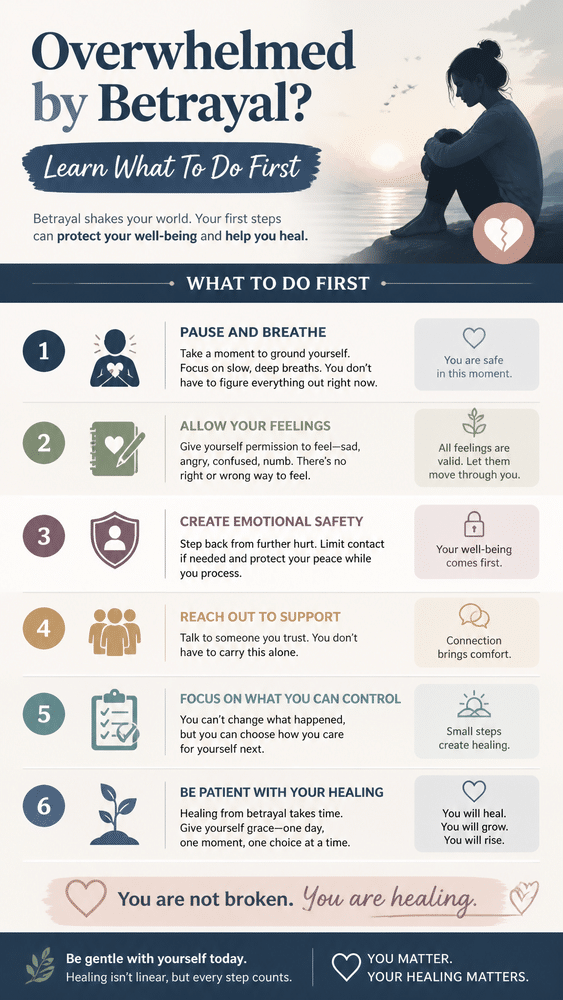
The shock phase is the first stage in a recognizable betrayal-trauma progression. Think of it as three broad movements: shock and disorientation, then the rumble of decision-making and grief, then the longer work of rebuilding. Acute betrayal shock sits entirely in that first movement, typically spanning the first hours to the first few weeks after discovery.
It overlaps with what the NIMH describes as an acute stress reaction: intrusions, hypervigilance, avoidance, and emotional numbing. The difference is relational. In stranger-perpetrated trauma, you can flee the threat. In betrayal trauma, the threat came from the person you relied on for safety, which scrambles the normal fight-or-flight calculus entirely. You cannot simply run from someone who is also your attachment figure, your co-parent, or your financial partner.
Common triggers for this kind of discovery shock include:
- Finding evidence of a partner’s affair or secret sexual life
- Discovering hidden debt, gambling, or financial deception
- Learning about a concealed addiction or compulsive behavior
- Institutional betrayal — abuse or cover-up by a trusted organization or authority figure
Each of these shares the same core injury: the person or institution you trusted to protect you was the source of harm.
Why betrayal shock is uniquely disorienting: theory and nervous-system mechanics
Jennifer Freyd coined the term betrayal trauma to describe a specific injury that occurs when a person you depend on for survival or safety is the one causing harm. Her concept of betrayal blindness explains something counterintuitive: the mind may unconsciously suppress awareness of the betrayal to preserve the attachment relationship. When that relationship is necessary for survival — financially, emotionally, or practically — full conscious knowledge of the betrayal becomes dangerous to hold. The result is dissociation, memory gaps, and a strange inability to trust your own perceptions.
This is why betrayal-laden traumas produce higher levels of dissociative and depressive symptoms than traumas perpetrated by strangers. The nervous system is caught between two incompatible needs: protect yourself from the threat, and maintain the bond with the person who is the threat.
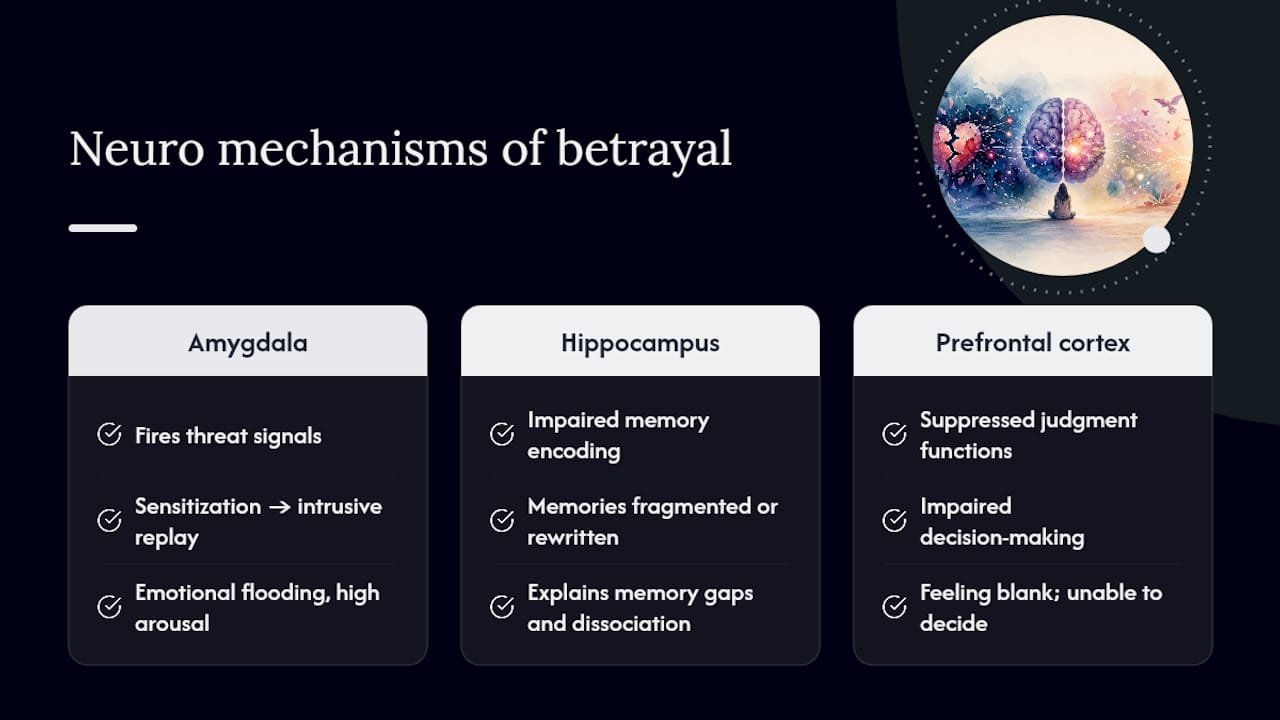
At the neurobiological level, trauma research shows that acute stress deregulates the amygdala (which fires threat signals), impairs hippocampal memory encoding (which explains why memories feel fragmented or rewritten), and suppresses prefrontal cortex function (which governs judgment and decision-making). This is why, in the acute phase, you may feel simultaneously flooded with emotion and strangely blank, unable to recall details clearly, and incapable of making a simple decision. The neurobiological effects of betrayal on the brain are not metaphorical — they are measurable.
A clinical synthesis on betrayal trauma describes amygdala sensitization and hippocampal disruption as the core mechanisms behind intrusive replay, emotional fog, and numbing in the acute phase. Practitioners also observe what is sometimes called a competence defense in high-functioning people: outwardly they appear to be managing, while internally they are running on cortisol, losing sleep, and experiencing autoimmune flares. The calm exterior is not evidence that the person is fine.
Pro Tip: If you feel strangely calm or “fine” in the first 24–48 hours, that is often dissociation, not resilience. Somatic symptoms — tight chest, jaw clenching, disrupted sleep — are the body’s honest report.
Signs and symptoms of the shock phase, organized by domain
The symptoms of acute betrayal vary by person, but they cluster predictably across four domains:
Emotional
- Shock, numbness, or emotional blankness
- Sudden waves of rage, grief, or panic
- Profound shame or self-blame
- Feeling of unreality (“this can’t be happening”)
Cognitive
- Intrusive, looping thoughts about the discovery
- Inability to concentrate or complete simple tasks
- Fragmented or unreliable memory of events
- Obsessive need to gather information or “make sense” of it
Physical
- Shaking, trembling, or physical weakness
- Nausea, appetite loss, or overeating
- Sleep disruption — insomnia or hypersomnia
- Headaches, chest tightness, or immune-system effects
Behavioral
- Compulsive checking (phone, email, location)
- Withdrawal from friends, family, or work
- Impulsive urges to confront, leave, or make sweeping changes
- Difficulty performing routine daily tasks
Consider a typical presentation: someone discovers their partner’s affair on a Tuesday evening. By Wednesday morning they have not slept, cannot eat, and have sent seventeen texts they barely remember writing. They feel simultaneously certain they need to end the relationship immediately and completely unable to move from the couch. Both responses are normal. Both are the nervous system in acute overload.
Symptom variability is real. Some people cry constantly; others feel nothing for days. Neither response is pathological on its own. Where symptoms overlap with depression, anxiety disorders, or prior trauma histories, a clinician’s assessment becomes more important, not less.
How long does the shock phase last, and what affects the timeline?
The acute shock phase typically runs in three rough windows. The first hours bring the most intense physiological response: shaking, dissociation, and the inability to think clearly. Over the first days to two weeks, most people move into a more functional but still highly deregulated state — sleeping poorly, cycling between numbness and flooding, and struggling to work or parent. Meaningful stabilization from acute symptoms generally takes a few weeks, though this varies considerably.
What extends the acute phase:
- Severity and duration of the betrayal — a years-long double life produces a more complex shock response than a single incident
- Ongoing exposure to the betrayer — living together, co-parenting, or financial entanglement keeps the nervous system in threat mode
- Prior trauma history — earlier attachment injuries amplify the current response
- Absence of social support — isolation prolongs dysregulation
- Partner non-accountability — gaslighting, minimizing, or blame-shifting after discovery significantly worsens outcomes
- Dependency — financial, housing, or childcare dependency on the betrayer complicates the ability to regulate
Clinical work with betrayal survivors suggests that meaningful nervous-system shifts commonly take 12–24 months of consistent, body-aware work, and full integration often takes longer. That clock starts from when active repair work begins, not from the discovery date. Understanding the stages of healing after betrayal can help set realistic expectations for what comes after the acute phase.
Seek professional evaluation if: acute symptoms persist beyond two to three weeks without improvement; you are unable to care for yourself or dependents; you are having thoughts of self-harm or suicide; or you are experiencing symptoms that suggest psychosis (paranoia, hallucinations, complete disconnection from reality).
What to do in the first hours and days
The goal in the acute window is not to solve anything. It is to stay safe, stay grounded, and protect your options.
Immediate safety checklist:
- Confirm your physical safety — if there is any risk of violence, contact the National Domestic Violence Hotline at 1-800-799-7233 or call 911
- Check on any children in the home and arrange care if you cannot function
- Do not make financial moves (transfers, account closures) until you have legal guidance
- If you need to preserve evidence (texts, emails, financial records), screenshot and store it somewhere the other person cannot access — do this calmly, not urgently
- Contact your doctor or a crisis line if you are having thoughts of self-harm
- Tell one trusted person what has happened — isolation amplifies shock
- Avoid alcohol and substances, which worsen dissociation and impair judgment
- Cancel or postpone any major commitments you can reasonably defer
Grounding sequence (do this now if you are flooded):
- Sit or stand with both feet flat on the floor
- Name five things you can see in the room
- Take a slow breath in for four counts, hold for four, out for six
- Press your palms together firmly for ten seconds, then release
- Say aloud: “I am in [city], it is [day and date], and I am physically safe right now”
This is not a cure. It is a circuit-breaker that gives your prefrontal cortex enough oxygen to function for the next few minutes. Repeat as needed. Therapist-recommended first steps after discovery consistently prioritize grounding and delaying irreversible decisions over any other action.
On major decisions: do not file for divorce, quit your job, move out, or make public accusations in the first 48–72 hours. You are neurologically impaired right now in a specific, temporary way. Document your thoughts and intentions instead of acting on them.

Pro Tip: When calling a trusted person or clinician while in shock, try this script: “I just found out something that has completely destabilized me. I’m not in danger, but I need support. Can you talk now, or when can you?” Short, clear, no performance required.
When and how to seek professional help
The evidence base for betrayal trauma treatment supports several therapy modalities, each with a different entry point:
| Therapy Type | What It Addresses | Best For |
|---|---|---|
| Trauma-informed CBT | Thought patterns, avoidance, intrusive cognitions | Acute phase stabilization, rumination |
| EMDR | Reprocessing traumatic memories and intrusive replay | Once acute crisis has stabilized |
| Somatic therapies | Nervous-system dysregulation held in the body | Physical symptoms, freeze, dissociation |
| Relational/attachment-based therapy | Trust disruption, attachment wounds | Ongoing relational repair or grief |
| Group therapy | Isolation, shame, normalization | Supplement to individual work |
When choosing a clinician, ask directly: “Do you have experience treating betrayal trauma specifically?” General trauma training is not the same. A betrayal-informed therapist understands the relational complexity — that the person you are grieving may still be in your home, that you may love and hate them simultaneously, and that the standard “leave the abuser” framework does not always apply.
Telehealth is a legitimate option and often more accessible in the acute phase when leaving the house feels impossible. Psychology Today’s therapist directory allows filtering by specialty; search “betrayal trauma” or “infidelity” alongside your zip code.
Emergency contacts:
- 988 Suicide and Crisis Lifeline — call or text 988 (U.S.) for any mental health crisis, including acute betrayal shock with suicidal ideation
- National Domestic Violence Hotline — 1-800-799-7233, if the betrayal involves any physical threat
- Emergency room — if you are experiencing acute suicidality, psychosis, or cannot keep yourself safe
Practical support options and your next three steps
Crisis and support contacts:
- 988 Lifeline — call or text 988; available 24/7 for any mental health crisis in the U.S.
- Crisis Text Line — text HOME to 741741 for text-based crisis support
- National Domestic Violence Hotline — 1-800-799-7233; relevant when betrayal overlaps with coercive control
- SAMHSA National Helpline — 1-800-662-4357; free, confidential, 24/7 for substance-related betrayal situations
Peer support groups (online forums, betrayal-trauma-specific communities) offer something individual therapy cannot: the immediate, visceral relief of knowing others have survived this exact experience. The limitation is that peer groups are not clinical spaces — they cannot assess your safety or provide trauma processing. Use them as a supplement, not a substitute, especially in the acute phase.
Your three-step plan for the next week:
- Who to call today — identify one person (friend, family member, or clinician) you will contact within the next 24 hours; write their name and number down now
- Safety actions — complete the safety checklist above; if any item raises a concern, act on that item before anything else
- First clinical contact — search for a betrayal-informed therapist using Psychology Today or your insurance directory; book an intake appointment even if you are unsure you will keep it
For deeper guidance on addressing betrayal trauma step by step, structured resources can help you move through the acute phase with more clarity than you can generate alone right now.
The shock response is not a sign you are broken
What strikes me most, working through the clinical literature on betrayal trauma, is how consistently the acute shock response gets pathologized — by the person experiencing it, by well-meaning friends, and sometimes by clinicians unfamiliar with the relational specificity of this injury. People apologize for crying at work, for not being able to eat, for “still” being in shock three days later. They wonder if they are weak.
The shock response is not weakness. It is the nervous system doing exactly what it was designed to do when a primary attachment relationship becomes a source of threat. The disorientation, the fragmented memory, the inability to make decisions — these are features of a system working correctly under impossible conditions, not evidence of personal failure.
What I think gets underestimated is the cognitive impairment piece. People in acute betrayal shock are often making enormous decisions — about their marriage, their finances, their children — while neurologically operating at a fraction of their normal capacity. The most protective thing a clinician or a trusted friend can do in those first days is not to help someone decide, but to help them wait. The decisions will still be there in two weeks. The nervous system will be in a better position to make them.
Structured support for the acute phase
The first days after discovery are the hardest to navigate without a structure, and that is exactly what Aftertheaffair’s 7-step infidelity recovery checklist was built for. It gives you a clear sequence for the first weeks: what to prioritize, what to defer, and how to protect yourself practically and emotionally while you are still in shock.
For those who want more depth, Navigating Infidelity: The First Months is a structured guide designed specifically for the survival stage — the period when you need evidence-based guidance more than you need inspiration. Both resources are discreet, digital, and available immediately. If you are a therapist supporting a client through acute betrayal shock, the clinician guide offers structured frameworks for the intake and early stabilization sessions.
Sources
The following resources support clinician discussion and deeper reading on betrayal trauma and acute stress responses. Consult a qualified clinician about how any of this applies to your specific situation.
FAQ
What is acute betrayal shock?
Acute betrayal shock is the immediate trauma response that follows discovering a serious breach of trust by someone you depended on — a partner, family member, or institution. It produces dissociation, intrusive replay, physical stress symptoms, and impaired decision-making, and it represents the initial stage of betrayal trauma as defined by Jennifer Freyd’s betrayal trauma theory.
How long does shock from betrayal last?
The most intense acute symptoms typically ease within days to a few weeks, though full nervous-system stabilization often takes longer. Clinical evidence suggests meaningful recovery shifts commonly require 12–24 months of consistent, body-aware therapeutic work, starting from when active repair begins.
Why does betrayal feel worse than other trauma?
Betrayal by an attachment figure activates a dependency paradox: the nervous system cannot simply flee the threat when the threat is also the source of safety or survival. Research by Freyd and colleagues shows betrayal-laden traumas produce higher levels of dissociation and depression than stranger-perpetrated traumas, precisely because the relational bond complicates the normal threat response.
When should I call a crisis line or go to the ER?
Call or text 988 (U.S.) if you are having thoughts of suicide or self-harm, or if you feel unable to keep yourself safe. Go to the nearest emergency room if you are experiencing acute suicidality, symptoms of psychosis, or a medical emergency triggered by the stress response.
What therapy works best for betrayal trauma?
Trauma-informed CBT, EMDR, and somatic therapies all have clinical evidence supporting their use for betrayal-related trauma. The most important factor is finding a therapist with specific experience in betrayal trauma, not just general trauma training, since the relational context requires a different treatment emphasis.
Recommended
- Betrayal Trauma Symptoms – After the Affair Series
- Recognize betrayal trauma symptoms for healing after infidelity
- Betrayal Trauma Hub – After the Affair Series
- Immediate Steps After Discovering an Affair