TL;DR:
- Separation after infidelity creates a protected environment that accelerates emotional healing by reducing triggers. It allows the nervous system to stabilize, rebuild self-trust, and prepare for genuine repair. Structured separation is a purposeful step, not abandonment, laying the foundation for trustworthy recovery and growth.
After infidelity, the instinct to fix everything immediately is almost universal. You want the pain to stop, the confusion to end, and some version of normal to return. But this urgency, while completely understandable, is often the very thing that stalls true healing. Understanding why separation aids healing is not about giving up on a relationship or on yourself. It is about recognizing that emotional wounds, like physical ones, heal faster when they are protected from constant irritation and given the stability they need to repair.
- Understanding separation through the lens of physical wound healing
- Why immediate repair attempts can stall emotional healing after betrayal
- How separation reduces retraumatization and supports healthier nervous system regulation
- Separating practical realities: healthy distance vs. disengagement in recovery
- Applying separation wisely: practical steps for healing from infidelity trauma
- Rethinking separation: why it’s not a failure but a foundation for real recovery
- Explore resources and support for healing with After the Affair
- Frequently asked questions
Understanding separation through the lens of physical wound healing
To appreciate why separation helps emotionally, first consider how physical wounds heal faster when given a stable, protected environment.
When you cut your skin and let it dry out, a hard scab forms. That scab blocks the migration of new cells across the wound surface, slowing repair. Modern wound care science shows that maintaining a protected, stable environment reduces interference and supports faster tissue repair. The same biology applies emotionally.
When you remain in constant contact with the person who caused your betrayal trauma, every interaction can become a trigger. Each unresolved exchange is like picking at a wound before new tissue has formed. The wound does not close. It becomes infected with confusion, anger, and re-injury.
Here is how the parallel maps out:
| Physical wound care | Emotional wound care after infidelity |
|---|---|
| Keep moist and protected | Limit triggering contact and exposure |
| Avoid hard scabbing | Avoid premature demands for explanation or repair |
| Allow undisturbed cell migration | Allow nervous system stabilization without interruption |
| Clean debris before closure | Process trauma in a structured way before attempting repair |
| Minimize mechanical stress | Reduce daily friction from shared living |
The key takeaway: healing requires a stable environment, not an active one. Some of the most important recovery work happens not when you are confronting the situation, but when you are not.
- Separation reduces daily exposure to emotional triggers
- It gives your nervous system time to come down from a state of hyperarousal
- It creates room for you to reconnect with your own thoughts, separate from the chaos
- It removes the pressure to perform normalcy before you are ready
Pro Tip: Think of separation not as withdrawal but as wound protection. You are not walking away from healing. You are creating the conditions that make healing biologically possible.
Why immediate repair attempts can stall emotional healing after betrayal
Now that we see the need for undisturbed healing, it is worth exploring why rushing relational repair can hinder progress and how separation supports stabilization.
Many couples enter couples therapy within days of discovery, hoping a professional can help them sort through the damage quickly. The problem is that betrayal is a trauma injury needing containment, pacing, and nervous system safety before repair. Treating it immediately as a communication problem or a relationship issue often retraumatizes the person who was betrayed.
“The first task after betrayal is not repair. It is safety. Safety in your body, safety in your environment, and safety in the therapeutic process itself.”
When you are flooded with cortisol and adrenaline after discovering infidelity, your brain is operating in survival mode. This is not the right neurological state for nuanced conversations about the future of a relationship. Repair conversations held too soon can actually deepen the wound.
Understanding the benefits of therapy after infidelity matters here. Good betrayal-informed therapy does not rush couples into joint sessions. It first stabilizes the individual. Separation is a practical tool that supports that stabilization by removing the constant proximity to the source of the trauma.
From a CBT couples therapy perspective, structured pacing around disclosures and relational conversations is essential. Unfiltered, spontaneous revelations delivered without therapeutic support can create fresh injuries on top of existing ones.
What safety-first separation looks like in practice:
- Clear limits on contact topics (no relationship repair discussions for a set period)
- Agreement on timing for structured truth-telling sessions, held with support
- Individual therapy running in parallel for both partners
- A defined period rather than an open-ended indefinite arrangement
- Regular check-ins with a counselor to assess readiness to move forward
Pro Tip: If you are using healthy coping strategies during separation, such as journaling, therapy, or structured routine, you are actively healing. Separation without personal work is avoidance. Separation with intentional work is recovery.
How separation reduces retraumatization and supports healthier nervous system regulation
With safety and pacing in mind, understanding how structured separation specifically eases nervous system distress further explains its healing benefits.
Deliberate separation paired with structure lowers trigger frequency and stabilizes the nervous system before heavy disclosure begins. This is not a soft clinical opinion. It is a clinically recognized principle in trauma recovery: reduce exposure to the triggering stimulus before attempting processing.
Here is how that works step by step:
- Remove daily proximity. Shared physical space means shared triggers. The smell of their cologne, the sound of their key in the lock, an unexpected text notification. All of these signal danger to a traumatized nervous system.
- Regulate before you process. Your nervous system needs periods of calm to actually integrate what happened. Without calm, you are just re-experiencing the trauma repeatedly.
- Rebuild self-trust. Time apart lets you reconnect with your own instincts, which infidelity systematically erodes. You start to trust your own perceptions again.
- Structure disclosure carefully. Working through how disclosure shapes healing within a structured process means truth comes in digestible portions, not all at once.
- Establish emotional accountability. The betraying partner uses separation to demonstrate change through consistent behavior, not promises made during emotional flooding.
- Prevent new injuries. Without separation, casual daily arguments or accidental triggers can create new trauma layers on top of the original wound.
Clear, purposeful boundaries after infidelity are what transform separation from abandonment into a healing tool. The boundary is not a wall. It is scaffolding.
- Separation should include a specified check-in schedule
- Both partners should have access to individual therapeutic support
- Accountability should be tracked, not assumed
- Emotional regulation tools (breathing work, body-based practices, movement) support nervous system calming
Pro Tip: Avoid labeling this a “trial separation” if possible. That framing carries ambiguity and shame. Instead, name it what it is: a stabilization phase. Language shapes the meaning you assign to the process.
Separating practical realities: healthy distance vs. disengagement in recovery
Beyond clinical safety, real-world examples show how healthy distance sustains growth and avoids the pitfalls of disengagement.
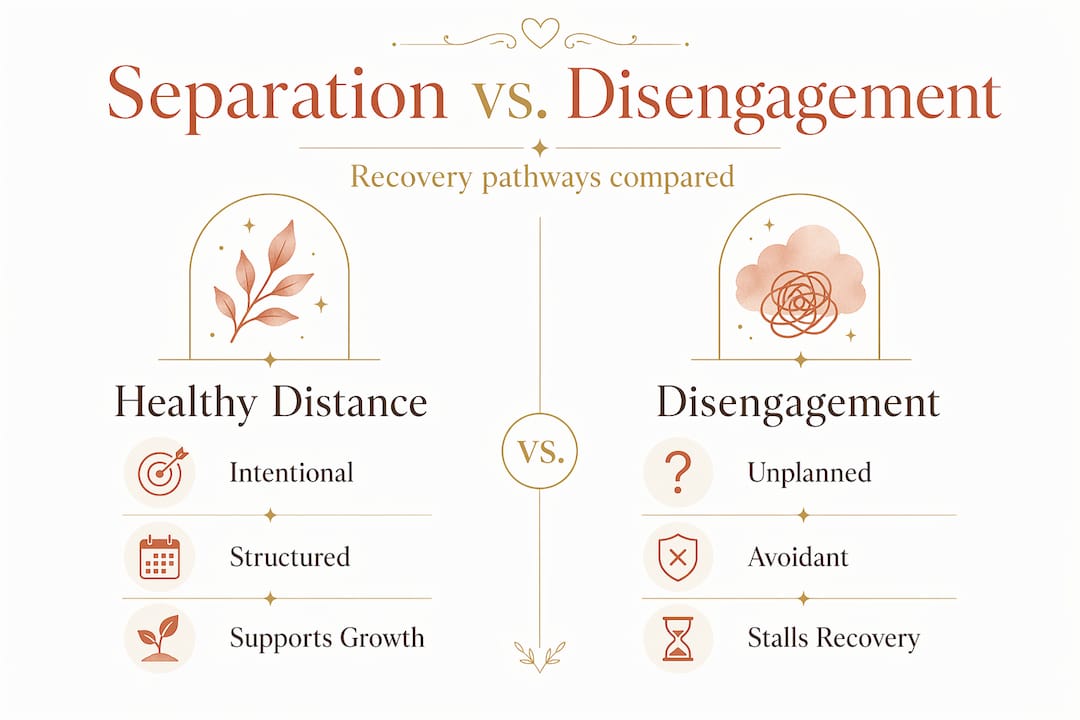
There is a significant difference between therapeutic separation and emotional abandonment. One is intentional and structured. The other is avoidance masquerading as space. Millions of adults live apart while maintaining strong, connected relationships, showing that separation is not inherently dysfunctional. The concept of Living Apart Together (LAT) challenges the assumption that proximity equals commitment.
| Healthy therapeutic separation | Disengagement and avoidance |
|---|---|
| Clear goals and defined timeline | No end point or purpose stated |
| Regular structured communication | Silence and unpredictable contact |
| Both partners in individual work | No therapeutic support or accountability |
| Reducing triggers while building safety | Running from the problem |
| Preparing for future repair conversations | Delaying inevitable conflict indefinitely |
| Supports identity and self-trust | Erodes connection and creates false closure |
When separation is used well, it also offers practical side benefits that support healing:
- Better sleep quality. Sleeping in separate spaces removes the hypervigilance that shared beds often trigger after betrayal
- Reduced daily friction. Small domestic triggers (a forgotten dish, a shared phone notification) no longer compound the emotional load
- Renewed sense of self. Time alone reconnects you to who you are outside the relationship
- Genuine novelty. When contact does occur, it can be intentional rather than passive and reactive
Building emotional resilience is much harder when your nervous system is on permanent alert in a shared space. Separation and emotional growth are not separate ideas. They are the same process, approached from two angles.
Applying separation wisely: practical steps for healing from infidelity trauma
Having explored theory and context, these practical strategies help you make separation a healing tool rather than a source of further stress.
Separation as one lever supports stabilization, but it requires sustained accountability and trauma-focused containment to avoid deepening grief. Separation without structure is not healing. It is just distance.
Here are six concrete steps to apply separation for healing:
- Define the terms before separating. Agree on contact frequency, topics allowed, and what each person is committing to do during this period. Write it down.
- Set a review date. Open-ended separation creates anxiety. Agree to reassess at a specific point, for example, in six weeks, with a therapist present.
- Begin individual therapy immediately. Separation works best when paired with personal therapeutic work. Both partners need support, not just the one who was betrayed.
- Limit impulsive contact. This is one of the hardest parts. Reactive late-night messages or unplanned confrontations undo nervous system regulation quickly.
- Use the time actively. Reconnect with your own routines, relationships, and values. Consult an infidelity recovery checklist to structure what you are working on.
- Track progress, not just pain. Journal what shifts over time. Notice when triggers ease, when sleep improves, when your own voice feels clearer. These are healing signals.
Working through trauma recovery steps during separation gives you a framework that turns the time apart from passive waiting into active repair.
Pro Tip: Share the terms of the separation with your individual therapist. Having a third party aware of the structure keeps both partners accountable and prevents the process from collapsing into chaos or silence.
Rethinking separation: why it’s not a failure but a foundation for real recovery
There is a cultural story we tell about couples who separate: that they have given up, that things have already fallen apart, that separation is the last stop before ending. That story is wrong, and it causes real harm to people in exactly the situations where separation could save them.
The couples who rush back into shared space immediately after discovery, who force conversations about the future before the trauma has stabilized, often end up doing more damage. Not because they lacked commitment, but because they skipped the foundation. Healing begins with rebuilding reality, safety, and self-trust, and only then is repair genuinely possible.
Separation says something courageous, actually. It says: I take what happened seriously enough to do this right. It refuses the shortcut of pretending things can return to normal before the work has been done. That is not defeat. That is integrity.
What we have seen consistently, both in clinical work and in the experiences shared with us, is that genuine repair, when it happens, is built on what each person did during the separation. Not what they promised in the heat of discovery. The separated period is where character is demonstrated. Where individual accountability is built. Where a person who was betrayed begins to trust their own reality again.
Separation reduces the confusion and emotional shutdown that come from trying to repair a relationship while still in active crisis. It separates two phases of recovery that need to stay separate: stabilization and repair. When people try to do both at the same time, they do neither well.
Real repair is earned after safety and trust are rebuilt, not before. Understanding this reframes separation entirely. It is not the relationship dying. It is the foundation being poured. If you are in this phase, using supportive coping strategies alongside structured distance is not managing decline. It is building something worth returning to.

Explore resources and support for healing with After the Affair
If you are navigating the aftermath of infidelity, you do not have to figure out the next step alone.
At After the Affair, we have developed structured, evidence-informed resources built specifically for each stage of recovery, from the earliest days of shock to the long work of decision-making and growth. Whether you are just trying to survive the first weeks or are further along and asking what comes next, our infidelity recovery checklist gives you a clear framework for the work ahead. For those rebuilding connection, our guidance on relationship growth after infidelity explores what genuine trust repair actually looks like. Therapists and counselors working with clients in betrayal trauma will also find practical clinical support through our resource on how to guide clients after infidelity. This is support designed around where you actually are, not where you are supposed to be by now.
Frequently asked questions
Why is separation recommended after infidelity?
Separation creates a safe space that reduces emotional triggers, allowing your nervous system to stabilize and begin healing from trauma. As betrayal-informed therapy makes clear, healing requires containment and pacing before repair is even possible.
Does separation mean the relationship is over?
Not necessarily. Separation can be a purposeful phase that enables healing and clearer decision-making, not a signal of relationship failure. Clinical recovery insight frames separation as a healing foundation rather than an ending.
How long should separation last for effective healing?
There is no single answer, but effective separation involves clear boundaries and a defined review point tailored to individual needs. Indefinite or ambiguous periods tend to increase anxiety rather than support recovery.
Can living apart help even without trauma?
Yes. Many adults choose to live apart while maintaining committed relationships, using the independence to strengthen connection, reduce friction, and prevent emotional burnout.
What role do therapy and accountability play during separation?
Therapy and sustained accountability ensure that separation supports healing rather than avoidance. Recovery requires trauma-focused containment and consistent accountability alongside distance to move toward genuine repair or honest closure.
Recommended
- How to Guide Clients After Infidelity for Healing – After the Affair Series
- Stages of Healing – After the Affair Series
- Effective tips for emotional healing after infidelity
- Effective tips for emotional healing after infidelity