TL;DR:
- Confronting a cheating partner involves a fact-based, deliberate conversation focused on honesty and clarity.
- Preparation, emotional regulation, and setting clear goals improve the chances of productive dialogue.
Confronting a cheating partner is defined as a deliberate, fact-based conversation aimed at seeking truth, accountability, and clarity about your relationship’s future. This is not about winning an argument or punishing your partner. It is about getting honest answers so you can make informed decisions. The guide to confronting a cheating partner that follows draws on current therapeutic frameworks, insights from licensed therapist Jacob Brown, MFT, and the evidence-informed resources at Aftertheaffair to walk you through every stage: preparation, the conversation itself, managing your partner’s response, and taking care of yourself afterward.
- What to prepare before confronting your partner about cheating
- How to conduct the confrontation conversation respectfully and effectively
- How do you handle your partner’s response during confrontation?
- What to do after confrontation: emotional self-care and next steps
- Key Takeaways
- What I’ve learned about confronting a cheating partner
- FAQ
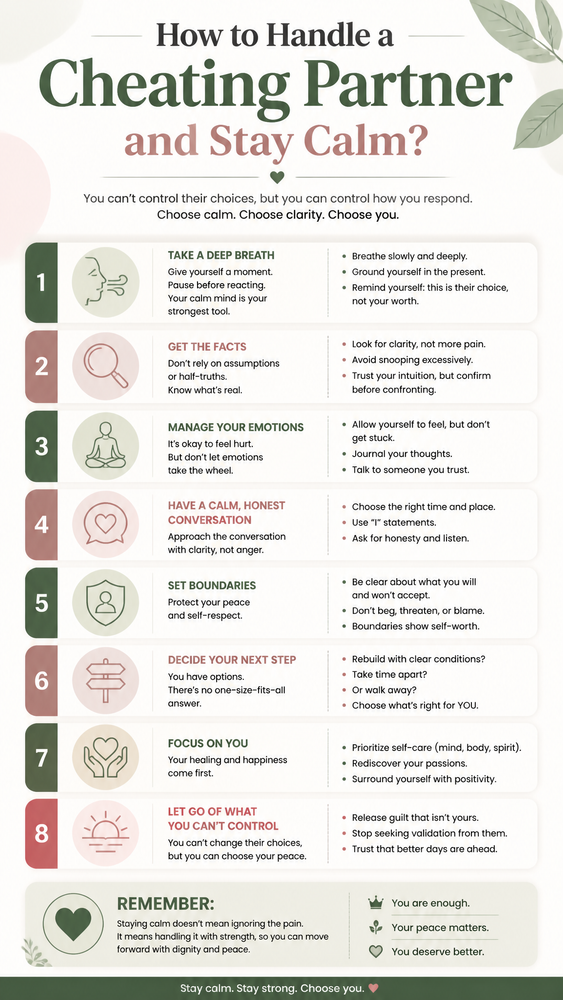
What to prepare before confronting your partner about cheating
Preparation is the single most important factor in how a confrontation unfolds. Walking in without a clear plan leaves you vulnerable to emotional derailment and makes it easier for your partner to deflect or deny.
Start by separating what you know from what you suspect. These are two different categories, and mixing them weakens your position. Write down specific, verifiable observations: dates, times, inconsistencies in schedules, or changes in phone habits. Specific, verifiable facts reduce defensive backlash far more effectively than vague accusations do. That means “I noticed you came home two hours late on three Tuesdays last month and gave different explanations each time” lands better than “I think you’ve been lying to me.”
Next, get clear on what you want from the conversation. Deciding your goal beforehand shapes your tone and approach and improves the chance of productive dialogue. Your goal might be truth, an acknowledgment of responsibility, a decision about the relationship, or simply confirmation of what you already sense. Knowing this prevents you from getting sidetracked.
Choose a private, calm setting with enough time and no interruptions. Avoid confronting your partner in public, at a family event, or right before one of you has to leave. A private, calm setting enhances the opportunity for honest dialogue and reduces the risk of escalation.
Finally, regulate your nervous system before you begin. Emotional flooding makes clear thinking nearly impossible. Grounding techniques like slow breathing, a short walk, or even splashing cold water on your face can bring your body back to a manageable state.
- Write down your specific observations before the conversation
- Identify your goal: truth, accountability, or a relationship decision
- Choose a private time and location with no time pressure
- Practice what you plan to say out loud at least once
- Have a support person available to call afterward
Pro Tip: Write your key points on a notecard and keep it with you during the conversation. If you feel flooded with emotion, glance at it to stay grounded in facts rather than feelings.
How to conduct the confrontation conversation respectfully and effectively
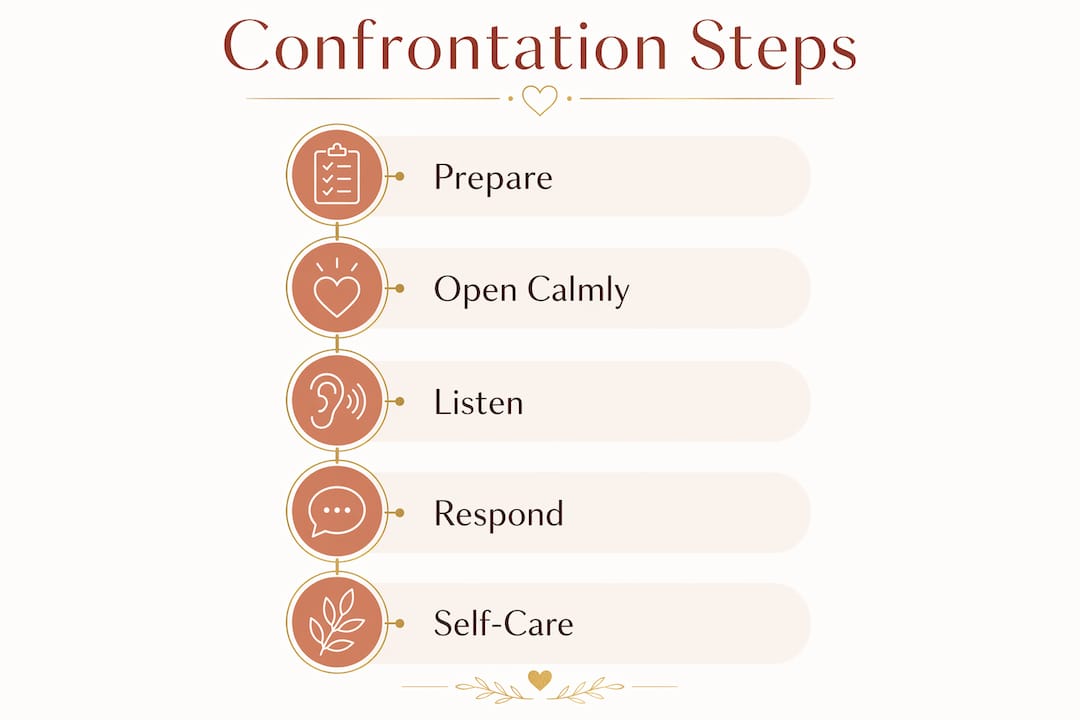
The opening moments of the conversation set the entire tone. A calm, factual opening gives you the best chance of getting honest answers. An accusatory opening almost always triggers defensiveness, which closes the door to truth.
Therapeutic approaches recommend using “I” statements and avoiding accusatory language to express feelings without blame. This method reduces defensiveness and keeps the conversation open. “I” statements shift the focus from what your partner did to what you experienced, which is harder to argue with.
Here is a practical framework for structuring the conversation:
- State your observation calmly. “I’ve noticed some things recently that concern me, and I need to talk about them.”
- Present your specific facts. “On these dates, this happened. Your explanation didn’t match what I found.”
- Express how it affected you. “I’ve been feeling anxious and disconnected, and I need to understand what’s going on.”
- Ask a direct question. “Are you having an affair, or is there something else happening that I don’t know about?”
- Give your partner space to respond. Resist the urge to fill silence or interrupt. Let them speak without jumping in.
- Listen without reacting immediately. Take a breath before responding to anything that surprises or upsets you.
Avoid insults, ultimatums delivered in anger, or bringing up unrelated past grievances. These escalate the conversation and shift the focus away from the truth you are seeking.
Pro Tip: If the conversation becomes heated, it is completely acceptable to say, “I need five minutes to collect myself before we continue.” Pausing is not weakness. It protects the integrity of the conversation.
How do you handle your partner’s response during confrontation?
Your partner’s response will likely fall into one of four categories: denial, partial admission, gaslighting, or full confession. Preparing a mental framework for each of these prevents you from being derailed emotionally in the moment. Each response requires a different approach.
Denial is the most common initial reaction. Stay calm and return to your documented facts. Do not argue about feelings or interpretations. Stick to what you observed. Denial does not mean the conversation is over. It often means your partner needs more time, or more evidence, before they feel safe enough to tell the truth.
Partial admissions are equally common. Unfaithful partners often use a “trickle truth” approach, admitting only what they believe you already know. This is not the full picture. Treat a partial admission as a starting point, not a conclusion. A patient, multi-stage approach to uncovering complete information is often necessary.
Gaslighting is when your partner attempts to make you doubt your own perceptions. You might hear phrases like “You’re imagining things,” “You’re being paranoid,” or “This is your insecurity talking.” Gaslighting during confrontation often escalates if challenged directly. The most effective response is to calmly restate your documented observation and, if the behavior continues, exit the conversation to protect your self-trust.
Confession brings its own complexity. When a partner admits to cheating, resist the urge to demand every detail immediately. Ask clarifying questions focused on what you need to make decisions, not questions that will cause additional pain without adding clarity.
“Unfaithful partners rarely reveal the full truth in one conversation. Expecting complete disclosure in a single sitting sets you up for frustration. A gradual, patient approach to uncovering the full picture is not a sign of weakness. It is a realistic strategy.”
- Stay anchored to your written facts when faced with denial
- Treat partial admissions as the beginning of a longer process
- Recognize gaslighting by its pattern: your reality is consistently questioned
- After a confession, pause before asking follow-up questions
- Give yourself permission to end the conversation and return to it later
What to do after confrontation: emotional self-care and next steps
The hours and days after a confrontation are often the hardest. Your nervous system has just processed a significant threat, and the emotional aftermath can feel destabilizing. The priority at this stage is not making decisions. It is stabilizing yourself.
Stabilization and containment of emotional overwhelm are critical in the early stages after betrayal, before deep processing or seeking full understanding. Trying to force clarity or resolution too quickly can deepen distress rather than relieve it. Grounding techniques, physical movement, and limiting isolation all help regulate the nervous system during this period.
Set boundaries that protect your emotional capacity. This might mean limiting conversations about the affair to specific times, asking your partner not to contact you for a defined period, or staying with a trusted friend. These are not permanent decisions. They are temporary measures that give your nervous system room to stabilize.
Forgiveness is not a prerequisite for healing, according to therapist Jacob Brown, MFT. Healing can occur without ever fully forgiving your partner. Forgiveness, when it comes, tends to be a byproduct of the healing process rather than a required first step. Releasing yourself from the pressure to forgive quickly is one of the most compassionate things you can do for yourself.
Professional support makes a measurable difference at this stage. Individual or couples therapy provides a structured space to process what happened, understand your options, and move forward without making reactive decisions. Individual therapy is particularly valuable in the early weeks, when your primary focus needs to be your own stability.
- Prioritize nervous system regulation over immediate decision-making
- Set temporary, specific boundaries to protect your emotional capacity
- Release the pressure to forgive on a timeline
- Seek individual therapy before couples therapy in the early stages
- Avoid making permanent relationship decisions within the first weeks
Rebuilding after betrayal, whether within the relationship or independently, is possible. Relationship growth after infidelity requires building a new foundation rather than restoring the old one. That shift in perspective changes what recovery looks like and what it demands from both people. Understanding how to rebuild trust after betrayal follows similar principles regardless of the specific betrayal involved: transparency, consistent behavior, and time.
Key Takeaways
Effective confrontation of a cheating partner requires specific facts, a clear goal, emotional regulation, and realistic expectations about your partner’s responses and your own healing process.
| Point | Details |
|---|---|
| Prepare with facts, not feelings | Write down specific, verifiable observations before the conversation to reduce defensiveness. |
| Know your goal before you start | Deciding whether you want truth, accountability, or a relationship decision shapes your entire approach. |
| Use “I” statements throughout | Expressing what you observed and felt reduces blame and keeps the conversation open. |
| Expect trickle truth, not full disclosure | Most partners admit only what they think you already know; plan for a multi-stage process. |
| Stabilize before deciding | Emotional regulation and containment come before any major relationship decisions post-confrontation. |

What I’ve learned about confronting a cheating partner
After working with people navigating infidelity, the pattern I see most often is this: people go into the confrontation expecting one conversation to resolve everything. They want the full truth, a clear explanation, and a decision about the relationship, all in one sitting. That expectation almost always leads to more pain.
The truth tends to come out in layers. Your partner may not even be fully honest with themselves yet, let alone ready to be honest with you. That is not an excuse for their behavior. It is a reality that changes how you need to approach the process. Patience in this context is not passivity. It is a deliberate strategy.
What I find most important is this: trust what you already know. If you are reading a guide to confronting a cheating partner, something has already shifted in your relationship. Your instincts brought you here. The preparation, the “I” statements, the grounding techniques, these are tools that help you access the truth you are already sensing. They do not replace your own judgment. They support it.
Prioritize your safety and emotional stability above everything else. A confrontation that ends without a full confession is not a failed confrontation. It is the beginning of a longer process. Give yourself credit for having the courage to start it.
— S.J.Howe
What Aftertheaffair offers for your next steps
Confronting a cheating partner is one of the hardest conversations you will ever have. What comes after it can feel just as difficult.
Aftertheaffair provides structured, evidence-informed resources designed specifically for this stage. The 7 Steps Infidelity Recovery Checklist gives you a clear framework for moving through recovery without getting stuck in reactive decisions or emotional flooding. For those working through the early weeks, the stages of healing after an affair resource maps what to expect at each phase so nothing catches you off guard. Whether you are deciding to stay, leave, or simply trying to understand what happened, Aftertheaffair’s guides meet you where you are.
FAQ
What should I say when confronting a cheating partner?
Open with a calm statement of specific observations, not accusations. Use “I” statements to describe what you noticed and how it affected you, then ask a direct question and give your partner space to respond.
How do I know if my partner is gaslighting me during confrontation?
Gaslighting follows a consistent pattern: your partner repeatedly questions your memory, calls your observations paranoid, or turns the conversation back on your insecurities. Return to your documented facts and exit the conversation if the behavior continues.
Do I need to forgive my partner to heal?
Forgiveness is not required for healing. According to therapist Jacob Brown, MFT, forgiveness tends to be a byproduct of the healing process rather than a prerequisite for it.
What if my partner only admits part of the truth?
Partial admissions are common. Unfaithful partners typically admit only what they believe you already know, a pattern known as “trickle truth.” Treat any partial admission as the start of a longer process, not a complete answer.
When should I seek professional support after confrontation?
Individual therapy is most valuable in the early weeks after confrontation, when stabilizing your nervous system takes priority over making relationship decisions. Couples therapy becomes relevant once both partners are emotionally stable enough to engage constructively.
Recommended
- After Cheated: Now What? – After the Affair Series
- Is Your Partner a Serial Cheater? Signs and Next Steps
- How to Guide Clients After Infidelity for Healing – After the Affair Series
- Forgiving after cheating steps: A guide to healing and trust