TL;DR:
- Affair recovery is a complex, non-linear process involving cycles of emotional connection and disconnection.
- Understanding these fluctuating stages and preparing for setbacks helps foster patience and deep healing over time.
Affair recovery is rarely the straight path people expect it to be. Most people assume that once the decision to work through infidelity has been made, healing moves forward steadily until trust is fully restored. The reality is far messier. Recovery after infidelity can involve constant swings between closeness and distance, meaning that even when both partners are genuinely committed, progress can feel frustratingly unpredictable. Understanding why this happens, and what it actually looks like in practice, is the first step toward healing that sticks.
Key Takeaways
| Point | Details |
|---|---|
| Healing is non-linear | Recovery after infidelity involves emotional highs and lows, not a straight path. |
| Trust takes time | Rebuilding trust requires repeated effort, honest conversations, and patience from both partners. |
| Setbacks are normal | Emotional setbacks are part of the process and do not signal failure. |
| Communication is crucial | Open, truthful dialogue about hurt, boundaries, and expectations helps healing. |
| Support aids recovery | Structured resources and guidance can make navigating complexity more manageable. |
Understanding why affair recovery is so complex
Most people walk into affair recovery expecting a clear sequence: crisis, apology, forgiveness, resolution. What actually happens is something very different. The relationship healing process tends to be chaotic rather than organized, and understanding why can make the confusion far less frightening.
There are two parallel tracks running during recovery. One is emotional, the other is practical. Practical recovery involves decisions, conversations, and behavioral changes. Emotional recovery involves processing grief, betrayal, shame, and fear, often on a much slower and more unpredictable timeline. Both tracks interact constantly. A practical breakthrough, like an honest conversation, can trigger intense emotional pain. An emotional connection on a good day can quickly unravel when a painful memory resurfaces unexpectedly.
Typical recovery cycles move through phases of hope, connection, doubt, and disconnection. You might feel genuinely close to your partner on a Tuesday and feel completely alienated by Thursday. Neither state is permanent, yet both feel absolute while you’re in them. This is disorienting for everyone involved.
“Recovery after infidelity can involve oscillation between connection and disconnection, indicating that progress may be non-linear and emotionally unstable even when both want to heal.”
Key reasons recovery is so psychologically demanding include:
- Betrayal trauma is real and deeply rooted. An affair doesn’t just break trust; it shatters the framework through which you understood your relationship. Rebuilding that framework takes time, not effort alone.
- Both partners are healing simultaneously but differently. The betrayed partner is processing shock and loss. The partner who had the affair is often managing guilt, shame, and fear of abandonment. These processes can collide in damaging ways.
- Triggers are everywhere and unpredictable. A song, a location, a casual comment, anything can pull you back into acute emotional pain without warning.
- Social pressure to “get over it” is enormous. Friends, family, and even therapists sometimes push for faster resolution than is realistic, adding guilt onto an already heavy emotional load.
Pro Tip: A setback in emotional recovery doesn’t mean the relationship is failing. It means healing is active. Relapses into distress are not signs that you’re doing it wrong; they’re signs that deep work is happening. Expect them, and plan for them.
The emotional cycle: Connection, disconnection, and uncertainty
Now that we’ve outlined the complexity, let’s dig deeper into how these cycles actually show up emotionally and within relationships day to day.
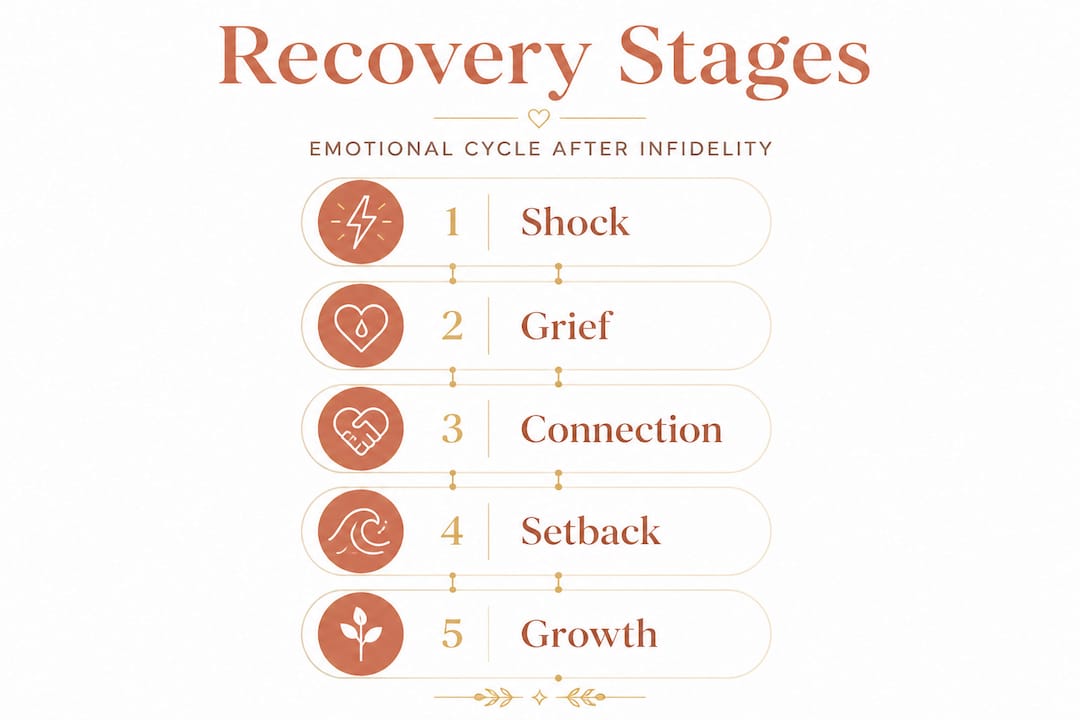
Research is clear that participants in affair recovery describe oscillating between closeness and distance, and that these cycles repeat throughout the recovery process rather than resolving once and for all. Understanding the emotional stages that cycle through can help you locate yourself within the process and resist the urge to interpret a hard day as evidence that recovery isn’t working.
Emotional stages commonly revisited in recovery
| Stage | Typical experience | Why it recurs |
|---|---|---|
| Shock and disbelief | Numbness, inability to process | New details or memories can re-trigger initial shock |
| Intense anger | Rage, injustice, helplessness | Anger resurfaces when trust is tested again |
| Conditional hope | Moments of genuine connection | Hope is fragile and dependent on consistent behavior |
| Grief and loss | Mourning the relationship you thought you had | Grief needs time, not just decisions |
| Rebuilding | Intentional effort, new patterns | Can be derailed by triggers or communication failures |
| Meaningful reconnection | Authentic closeness, renewed commitment | Not permanent until trust is deeply rebuilt |
Here are the stages most commonly revisited, even months into recovery:
- Initial shock. Even well into recovery, a new piece of information or an unexpected reminder can plunge you back into acute shock. This is normal.
- Anger. Anger rarely disappears early in recovery. It resurfaces every time a boundary is crossed or a trigger is encountered.
- Fragile hope. Hope tends to arrive in waves. A few good days do not mean the healing is complete.
- Grief. The relationship you thought you had is gone. That loss must be mourned, not simply decided away.
- Rebuilding trust. This stage requires consistent action over time. The trust rebuilding timeline is rarely quick, and progress is measured in months and years, not days.
- Renewed connection. Real reconnection is possible, but it comes after the harder stages have been genuinely processed, not bypassed.
The unpredictability of these cycles places significant strain on both partners. The betrayed partner may wonder whether any real progress is happening. The partner who caused the harm may feel defeated when a seemingly good period collapses back into conflict. Both reactions are understandable, and both are part of understanding trust after betrayal as a long-term process rather than a single event.
Preparing for setbacks as part of the plan, rather than as interruptions to the plan, changes everything. When you expect the emotional cycles to recur, they lose some of their power to derail you completely.
The challenges of talking, truth, and trust
Having seen how emotional cycles unfold, let’s look at the core pillars most challenged by an affair: honest communication, truth, and trust.
Affair recovery requires navigating talking, truth, and trust, often under conditions of profound ethical imbalance. The betrayed partner typically knows less than the partner who had the affair, which creates a fundamental power asymmetry in every conversation. It’s hard to communicate as equals when one person holds information the other desperately needs.
Common reactions vs. healing approaches in key conversations
| Situation | Common reaction | Healing approach |
|---|---|---|
| Asking for details about the affair | Obsessive questioning in cycles | Set intentional conversation windows with a counselor |
| Receiving partial truths | Escalating anger and mistrust | Request full transparency with agreed boundaries |
| Feeling flooded emotionally | Shutting down or explosive response | Practice a brief pause before responding |
| Hearing defensiveness from the partner | Feeling dismissed, re-traumatized | Redirect to the impact, not the intention |
| Moments of genuine remorse | Relief mixed with suspicion | Acknowledge the moment without pressure to resolve everything |
Common communication pitfalls in affair recovery include:
- Defensiveness from the partner who caused harm. This is perhaps the most damaging barrier to healing. When the betraying partner becomes defensive, it signals to the injured partner that their pain isn’t being fully acknowledged.
- Repeated questioning without resolution. Asking the same questions over and over often reflects unresolved trauma, not simply a need for information. The questions rarely get answered in a way that provides lasting relief.
- Shutting down under emotional pressure. When conversations become too intense, one or both partners may disengage. This protects them short-term but blocks genuine understanding.
- Rushing toward forgiveness before trust is earned. Forgiveness is a deeply personal process that cannot be forced or scheduled. Pushing for it prematurely undermines genuine reconciliation.
- Minimizing the betrayal. Phrases like “it didn’t mean anything” are intended to reassure but often deepen the wound by dismissing the significance of the breach.
Pro Tip: Focus on building transparency after betrayal before chasing forgiveness. Forgiveness may or may not come, and it can come slowly. Consistent honesty and openness, however, are actions that can begin immediately and that rebuild a foundation of predictability. That predictability is what actually restores a sense of safety. Following trust rebuilding steps that prioritize behavior over declarations will serve you far better than waiting for an emotional breakthrough.
Dealing with setbacks and emotional instability
Rebuilding trust isn’t a straight line. Setbacks tend to surface throughout the journey. So what do you do when hope is disrupted and discouragement rises?
First: recognize that setbacks are expected. Research confirms that even committed partners experience emotional instability throughout recovery, with ongoing oscillation between difficult and hopeful states. This is not an anomaly. It is the landscape.
Unexpected emotional triggers show up in specific ways:
- Anniversary reactions. The date of discovery, or the period when the affair was happening, can trigger intense emotional responses even a year or two later.
- Sensory triggers. A scent, a piece of music, or a type of restaurant can instantly transport you back to the acute pain of discovery.
- Similarity triggers. Seeing another couple argue, or hearing about someone else’s infidelity, can unexpectedly revive your own pain.
- Progress triggers. Ironically, moments of real connection can sometimes trigger fear and grief rather than joy, because they remind you of what was lost.
- Behavioral triggers. If the partner who caused harm slips into old patterns, such as vagueness about their whereabouts or protectiveness over their phone, old fears flood back immediately.
Recovery oscillation is a universal theme across recent research. It is not a sign that your relationship is unusually damaged or that you are unusually fragile. Both partners cycling through emotional instability is simply what recovery looks like.
Following a step-by-step betrayal recovery guide can give structure to a process that otherwise feels formless. Structure doesn’t eliminate emotional pain, but it can reduce the sense of chaos that makes setbacks feel catastrophic.
Pro Tip: When a setback arrives, respond with self-compassion before analysis. The instinct is to ask “what went wrong?” or “does this mean we can’t heal?” A better first question is “what do I need right now?” That shift moves you from self-criticism toward self-care, which is where recovery actually lives.
Knowing when to seek outside support is also critical. If communication has broken down entirely, if distress is interfering with daily functioning, or if the same destructive patterns keep repeating without resolution, professional support isn’t a last resort. It’s a smart, practical tool.

Why embracing complexity leads to real healing
Conventional wisdom pushes for quick fixes. Popular culture often frames affair recovery as a single dramatic turning point: the confession, the confrontation, the tearful apology, followed by resolution. That narrative is almost entirely unhelpful.
Real recovery doesn’t work like a scene from a movie. It works like physical rehabilitation after a serious injury. Progress is slow, sometimes invisible, occasionally reversible. There are good days and bad days, and both are meaningful. The hardest lesson we encounter in this work is this: the emotional turbulence of recovery is not the obstacle to healing. It is healing.
“Oscillation between connection and disconnection is part of the process, not a sign of failure.”
When you accept this, your relationship with setbacks changes entirely. Instead of experiencing a difficult week as evidence that recovery isn’t working, you start to see it as information. What is this setback telling you about what still needs attention? What need isn’t being met? What fear hasn’t been fully acknowledged yet?
Pro Tip: Treat every “step back” as data, not defeat. When you move from “this means we’re failing” to “this tells us something important,” you shift from a reactive stance to a reflective one. That reflective capacity is exactly what sustained recovery is built on.
The couples and individuals who heal most genuinely are rarely the ones who avoided the hard seasons. They’re the ones who moved through them with patience and honesty. Relationship growth after infidelity is genuinely possible, but it grows from the roots of complexity, not despite them.
Expecting simplicity from a complex process doesn’t protect you. It sets you up for unnecessary despair every time reality doesn’t match that expectation. Embracing complexity, by contrast, means you are never blindsided by the hard moments, because you always knew they were part of the territory.
Support for moving forward: Recovery resources
Navigating affair recovery alone, without structure or guidance, makes an already demanding process significantly harder. Having a clear framework helps you recognize where you are in the process, anticipate what comes next, and respond to difficult moments with intention rather than panic.
At After the Affair, we’ve built structured, evidence-informed resources specifically for this journey. Whether you’re just starting out and need practical grounding, or you’re further along and looking to rebuild connection more deeply, there are tools designed for your specific stage. Start with the infidelity recovery checklist for clear, actionable steps. If you’re focusing on longer-term reconnection, the healing after infidelity guide offers deeper, professionally grounded support. For those ready to look toward meaningful relationship growth after infidelity, structured pathways are available to help you move forward with both honesty and hope.
Frequently asked questions
Why does affair recovery feel like an emotional rollercoaster?
Research shows recovery involves repeated cycles of connection and disconnection, making emotions unpredictable even when both partners are genuinely committed to healing.
How long does the healing process usually take after an affair?
There’s no fixed timeline because recovery progress is non-linear, with emotional ups and downs continuing for months or even years depending on individual circumstances and the depth of support available.
Is it possible to rebuild trust fully after infidelity?
Full trust can be rebuilt, but it requires consistent, transparent behavior from the partner who caused harm, combined with patience and professional guidance when needed.
What should I do if I experience setbacks in recovery?
Respond first with self-compassion rather than self-criticism, and treat the setback as meaningful information about what still needs attention rather than as evidence that recovery has failed.
When should couples consider seeking professional support?
If communication has broken down completely, emotional distress is affecting daily functioning, or the same harmful patterns keep repeating, professional support should be considered sooner rather than later.
Recommended
- How to heal when the affair partner won’t leave: 5 steps
- Therapist tips for affair recovery: heal and rebuild trust
- How to Guide Clients After Infidelity for Healing – After the Affair Series
- How to build a healing workflow for couples: 5 steps