You did not choose to stay in a relationship with this person. Circumstances have kept you in one anyway.
TL;DR:
For many survivors of infidelity who separate from their partner, the relationship does not end at separation. It transforms into a co-parenting arrangement — which means ongoing contact with the person who caused the betrayal trauma, ongoing exposure to the source of the original harm, and the specific difficulty of having to manage that contact while also managing their own recovery. This article addresses parallel parenting specifically — the structured, minimal-contact approach to co-parenting that is often the most appropriate model when betrayal trauma is present — and explains what it looks like, why it works, and what the emotional reality of navigating it involves.
- Key Takeaways
- Why Standard Co-Parenting Advice Does Not Fit This Situation
- What Parallel Parenting Is and Why It Matters Here
- The Emotional Reality of Ongoing Contact With Your Betrayer
- Setting Up the Structure That Protects You
- Managing Triggers in the Co-Parenting Relationship
- The Children in the Middle: What They Need and What They Should Not Carry
- What Parallel Parenting Looks Like Over Time
- My Perspective
- FAQ
Key Takeaways
| Point | What this means for you |
|---|---|
| Standard co-parenting assumes a functional relationship between adults | When betrayal trauma is present, that assumption fails. Parallel parenting is the appropriate alternative. |
| Ongoing contact with your betrayer is a genuine trauma maintenance factor | It keeps the nervous system in a threat state and significantly complicates recovery. |
| Structure is protection, not rigidity | Clear, minimal, businesslike contact protocols protect your nervous system and your children. |
| You are allowed to set limits on how contact happens | You do not owe warmth, friendship, or flexibility beyond what the children’s wellbeing requires. |
| The children need two functioning parents, not two united ones | Parallel parenting produces better outcomes for children than forced co-operative parenting between people who cannot manage it. |
| Your recovery is not in conflict with your parenting | A more stable parent produces a more stable environment. The two are the same goal. |
Why Standard Co-Parenting Advice Does Not Fit This Situation
Most co-parenting advice — the books, the mediators, the family law system’s assumptions — is built around a model where two adults who are no longer in a romantic relationship can, with sufficient goodwill and communication skill, work together effectively for their children’s benefit.
That model assumes a relatively level emotional playing field. It assumes that both adults are operating from a position of basic stability. It assumes that the primary challenge of co-parenting after separation is logistical and communicative, and that those challenges can be addressed with the right tools.
When betrayal trauma is present, none of those assumptions hold.
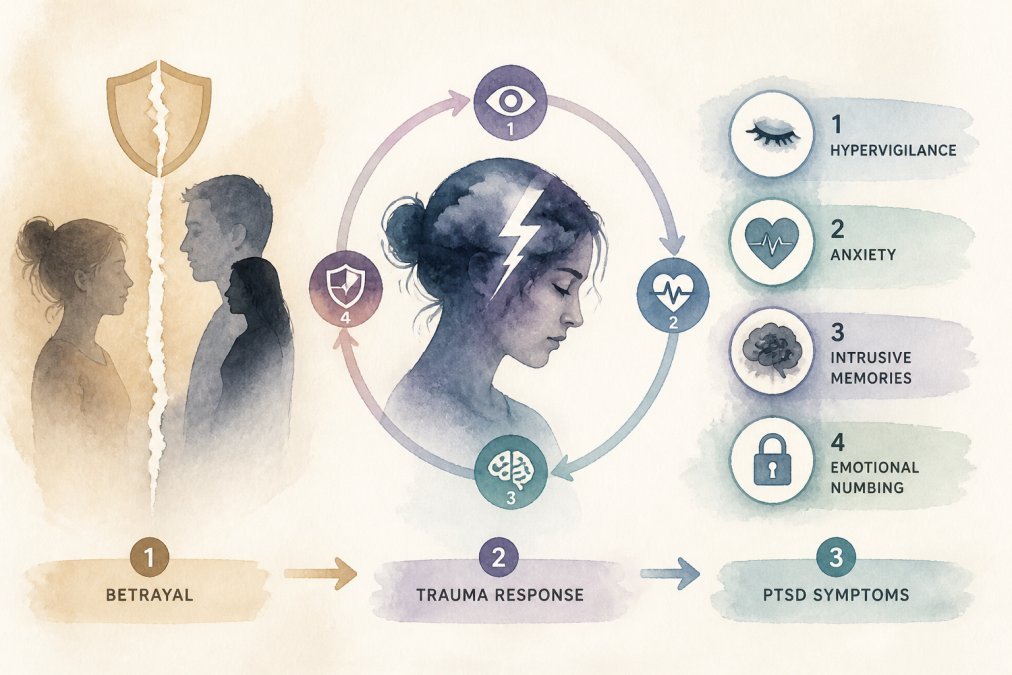
The betrayed parent is not operating from basic stability. They are managing a nervous system that has been seriously dysregulated by the very person they are now being asked to co-parent with. Every interaction with that person is a potential trigger. Every message carries the weight of what that person did. The smell of their car at pickup. The particular way they say a child’s name. The sight of a number appearing on a phone.
The advice to “communicate clearly and keep it focused on the children” is correct in principle. What it does not account for is what it costs a person in active betrayal trauma to execute that advice in the presence of the person who caused the trauma. That cost is real, significant, and worth building a structure around — rather than simply counselling the betrayed parent to manage it better.
What Parallel Parenting Is and Why It Matters Here
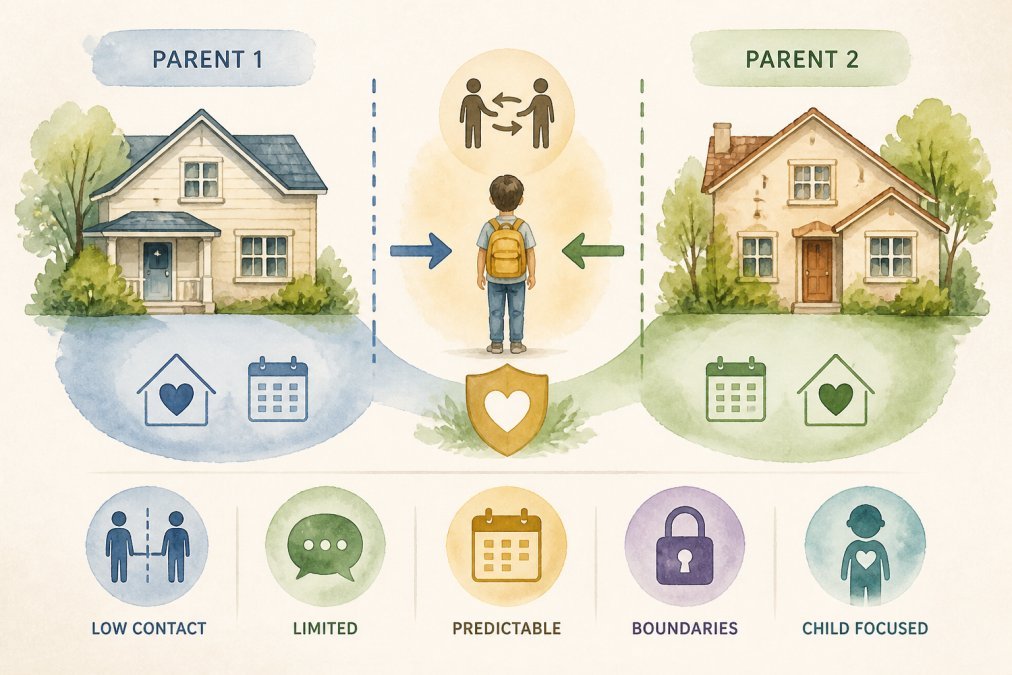
Parallel parenting is a co-parenting model designed for situations where the adults cannot maintain a functional co-operative relationship. Rather than expecting both parents to communicate flexibly and work together in real time, parallel parenting structures the arrangement so that each parent functions largely independently within their own time, with contact between the parents kept to a minimum and conducted through defined, low-friction channels.
In practice, this means:
Handovers that are brief, structured, and as low-contact as practically possible. Communication that happens primarily in writing — text or email — rather than in person or by phone, which removes the real-time emotional exposure of voice and face-to-face contact. A defined agreement about how decisions are made and what requires consultation versus what each parent handles independently in their own time. An expectation that both parents are competent to parent without the other’s ongoing involvement or approval.
The research on parallel parenting is clear: for children whose parents cannot maintain a co-operative relationship, parallel parenting produces better outcomes than forcing a co-operative model that neither adult can sustain. Children benefit from having two parents who are each functioning reasonably well in their own sphere, significantly more than they benefit from children of parents who are in regular conflict under the banner of co-operation.
Parallel parenting is not a consolation prize for a failed co-parenting arrangement. It is the appropriate, clinically supported model for this specific situation.
The Emotional Reality of Ongoing Contact With Your Betrayer
It is worth naming this directly, because it is almost never named in co-parenting discussions: ongoing contact with the person who caused your betrayal trauma is a significant complicating factor in your recovery.
The nervous system’s threat response does not automatically extinguish when a relationship ends. It was calibrated in the context of that relationship, and the person at the centre of it remains, for the nervous system, associated with threat. Ongoing contact means ongoing exposure to a trigger that is not abstract — not a smell or a location — but a living person who requires your attention and your functional competence at regular intervals.
This is why many betrayal trauma survivors in co-parenting arrangements describe their recovery as significantly slower and harder than they expected. They are not recovering in a context of distance from the source of the trauma. They are recovering while continuing to have regular contact with it. That is a harder ask, and it requires more specific support, not simply more willpower.
The specific emotional experiences that parallel parenting contact tends to produce include:
Activation at anticipated contact points. The anxiety that builds in the hours or days before a handover. The hypervigilance that spikes when a message arrives. The emotional crash that sometimes follows contact, when the nervous system has been held together through the interaction and then releases.
Grief at the ordinariness of the arrangement. Watching the children be collected by the person who broke the family. The particular pain of having to function normally in what is an entirely abnormal situation.
Rage that has nowhere useful to go. Contact with the person who caused the harm tends to activate the anger of the betrayal trauma. In the context of a handover or a logistical message, that anger usually cannot be expressed, processed, or acknowledged. It gets carried instead.
The cognitive cost of managing the interaction. Keeping messages businesslike, keeping handovers brief and civil, keeping the children’s experience clean of adult conflict — all of this requires significant cognitive and emotional resource. It is a form of performance, and performance is exhausting.

Setting Up the Structure That Protects You
The most effective thing you can do for your own recovery and your children’s wellbeing in a parallel parenting arrangement is to invest early and seriously in the structure. The clearer and more defined the framework, the less cognitive and emotional resource is required to execute it.
Written communication as the default. Voice calls and in-person conversations require real-time emotional regulation in the presence of a trigger. Text and email allow you to read a message, sit with it, regulate your response, and reply when you are ready. They also create a record, which has practical value. Unless there is a genuine emergency, written communication should be the norm.
Response windows, not instant availability. You do not need to respond to a co-parenting message within minutes of receiving it. Setting a reasonable response window — within 24 hours for non-urgent matters — removes the hypervigilance associated with waiting for messages and reduces the pressure of instant availability to someone your nervous system is treating as a threat source.
Handovers that are brief and structured. The handover is the highest-risk point for emotional activation because it involves in-person contact. Brief, businesslike, and if possible conducted somewhere neutral — a school, a public space — is significantly easier to manage than a doorstep conversation that can extend and escalate. Some parallel parenting arrangements use a third party for handovers in the early period. This is a legitimate and clinically supported approach when direct contact is too activating.
A defined scope for what requires communication. Not everything needs to be discussed or agreed. Each parent can handle the ordinary decisions of their own parenting time independently. Defining clearly what genuinely requires consultation — significant medical decisions, school issues, travel — and what does not, reduces the volume of necessary contact and the associated emotional cost.
Managing Triggers in the Co-Parenting Relationship
Even with a well-structured parallel parenting arrangement, contact will produce activation. This is normal, expected, and not a sign that the arrangement is failing or that recovery is not progressing.
Before contact: A short grounding practice before a scheduled handover or before reading a message does more than nothing. It does not need to be elaborate. Five slow breaths. A brief physical movement. Something that brings the nervous system slightly back from its anticipatory activation before the interaction begins.
During contact: The goal during a handover or a necessary conversation is not to feel fine. It is to manage the interaction at the minimum required level and exit it cleanly. Brief, civil, focused on the children. You do not need to be warm. You do not need to be punishing. You need to be functional, and then finished.
After contact: The activation that follows contact needs somewhere to go. Some people find physical movement helps — a walk, exercise, anything that discharges the physiological arousal rather than sitting in it. Some find contact with a trusted person helps. Some find that named acknowledgment — “that was hard, and I got through it” — is enough to allow the nervous system to settle.
What tends to make post-contact activation worse is rumination — replaying the interaction, rerunning what was said, imagining what should have been said differently. This is the brain’s attempt to process an incomplete threat response, and it does not work as a processing mechanism. Naming it as rumination and redirecting attention elsewhere is more effective than following it.
The Children in the Middle: What They Need and What They Should Not Carry
Children in parallel parenting arrangements need specific things from both parents, and there are specific things they should not be asked to carry.
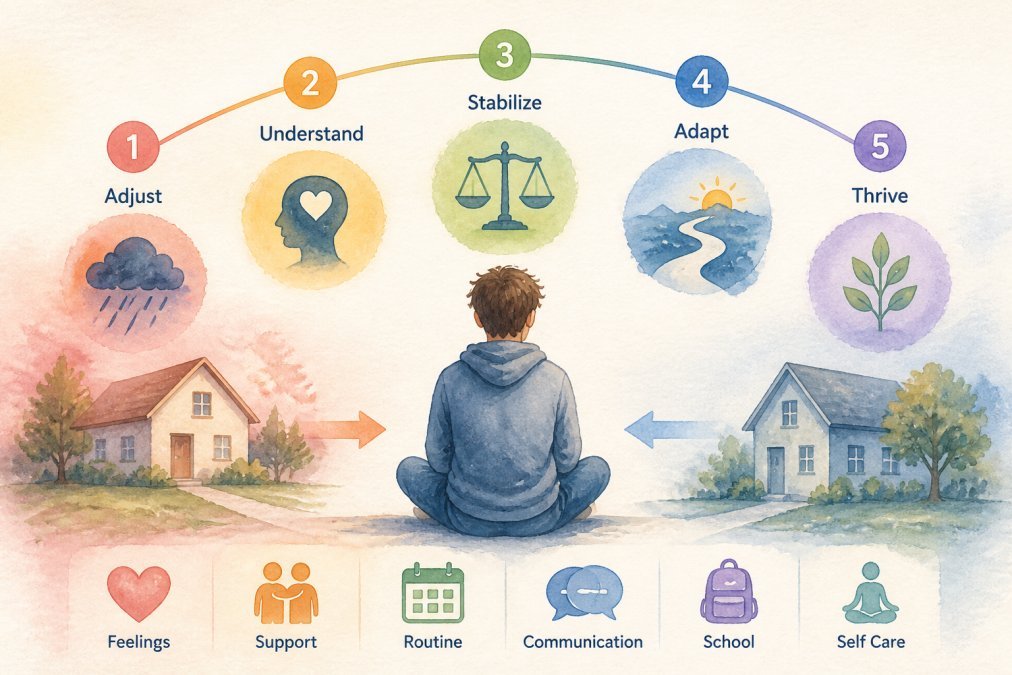
What they need: Consistent, loving care in each parent’s time. Permission to love both parents without guilt. The absence of adult conflict in their presence. Age-appropriate honesty that something changed in the family, accompanied by consistent reassurance that both parents love them and that they are safe.
What they should not carry: Messages between parents. Information about one parent’s feelings about the other. The weight of loyalty decisions. Details of what happened between the adults. The role of emotional support for either parent’s distress about the situation.
The specific temptation in a parallel parenting context — where communication with the other parent is limited and the children are the most consistent connection point — is to use the children as a communication channel. “Tell your dad that…” “Ask your mum whether…” This places the child in the middle of an adult arrangement in a way that has documented negative effects on children’s wellbeing and their own sense of safety. Communication between parents goes through the adults, however difficult that channel is.
What Parallel Parenting Looks Like Over Time
The early period of a parallel parenting arrangement is usually the hardest. The structure is new. The activation is high. The grief of the family change is acute alongside the betrayal trauma. The children may be unsettled. Everything requires more effort than it should.
Over time, several things tend to shift.
The structure becomes habitual, which means it requires less conscious management. The nervous system accumulates enough experience of surviving the contact points that the anticipatory activation reduces slightly. The children tend to stabilise as the arrangement becomes predictable. The grief and the trauma, with appropriate support, gradually lose some of their acute weight.
Parallel parenting does not require the adults to like each other, to forgive each other, or to have reached any particular emotional resolution. It requires them to be competent within their own parenting time, to communicate the minimum necessary in a businesslike way, and to keep the children out of the adult story. That is achievable even when everything else feels impossible.
It is worth saying clearly: some parallel parenting arrangements, over years, and with both adults doing their own work, develop into something more co-operative. Some do not, and that is also fine. The measure of success is not the relationship between the adults. The measure is whether the children are thriving in two households where each parent is functioning well.
My Perspective
What strikes me most about parallel parenting after betrayal trauma is how often survivors are asked to manage it without any acknowledgment of what it actually costs.
The family law system assumes functional communication. The mediators propose co-operative models. Well-meaning people suggest that the priority is the children, implying that prioritising the children means somehow setting aside the reality of the trauma. And the betrayed parent goes away and tries to do what is being asked of them, while carrying a nervous system injury that nobody has named or supported.
I want to say clearly: the structure matters. Your own stabilisation matters. The support you access for yourself is not in competition with your parenting or your co-parenting. It is the thing that makes both possible.
You did not choose this arrangement. You did not choose to remain in ongoing contact with the person who harmed you. You are doing so because of the children, which is an act of enormous commitment. That commitment deserves acknowledgment, and it deserves the specific support it requires — not just the general advice to manage it better.
Parallel parenting is hard. It is also survivable. And the parent on the other side of it — the one whose nervous system has settled, whose recovery has progressed, who has built a life that is genuinely their own — tends to look back and find it was worth every difficult handover.
— S.J.Howe
FAQ
Is parallel parenting better for children than co-operative co-parenting? When the adults genuinely cannot maintain a co-operative relationship without conflict, yes. Research consistently shows that children do better with two independently functioning parents than with two parents who are nominally co-operating but in regular conflict. The goal is not parental unity. It is parental stability in each household.
My ex uses co-parenting communication to continue to have access to me emotionally. How do I manage this? This is common and it is worth naming as a boundary issue. Written communication with a defined response window, focused exclusively on the children’s logistics, is the appropriate framework. Messages that are emotionally loaded, that reference the affair, or that are attempting to re-engage you in a personal relationship can be acknowledged briefly — “I’ll focus on the children’s arrangements in this channel” — without being engaged with directly.
How do I handle handovers when seeing my ex activates the trauma response? Brief, structured, and if possible at a neutral location. Some people find it helps to have a script — a handful of predictable, neutral sentences that cover the necessary handover information — so the interaction does not require real-time improvisation. If direct contact is genuinely too activating in the early period, a third-party handover is a legitimate option.
My children come home from their other parent’s house unsettled. What do I do? Some unsettlement after transitions is normal, particularly in the early period of a new arrangement. Give them time and a low-demand re-entry into your home — familiar food, familiar space, no immediate demands. If unsettlement is consistent and significant, it is worth exploring whether something specific is happening, but it is important to do this in a way that does not implicitly invite the children to report on the other household.
When does parallel parenting become appropriate to shift toward something more co-operative? When both adults have done enough of their own work that direct communication is no longer significantly activating, and when the children’s needs are creating genuine occasions for collaborative decision-making. This tends to be years rather than months. There is no obligation to move toward co-operation before it is genuinely manageable. The structure is there to protect the children and both adults for as long as it needs to be.