TL;DR:
- Infidelity is a deliberate choice driven by internal needs such as anger, low self-esteem, and a desire for variety. Betrayers manage perception through strategic deception and internal justifications, often displaying conflicting details and emotional concealment. Recognizing these behaviors and understanding the internal motivators can help betrayed partners focus on healing and reclaiming their sense of safety.
Infidelity is a deliberate act, not an accident. When you ask how could they look you in the eyes and still cheat, the answer lies in psychology, not circumstance. Cheaters make a series of conscious choices to deceive, and those choices are driven by internal needs rather than anything you did or failed to do. Research confirms that infidelity stems from internal motivators such as anger, low self-esteem, and the desire for variety. Understanding this is not just reassuring. It is the first step toward reclaiming your clarity and sense of self.
- How could they look you in the eyes and still cheat?
- Why do people cheat? The internal motivators behind betrayal
- How do cheaters maintain eye contact and manage deception?
- What emotional impact does this kind of betrayal have on you?
- How does taking responsibility shape healing and recovery?
- Key Takeaways
- FAQ
How could they look you in the eyes and still cheat?
The short answer is that cheating is an intentional act, and betrayers are often skilled at managing perception. Clinicians use the term betrayal trauma to describe the specific psychological injury that occurs when someone you depend on for safety causes you harm. The confusion you feel is not weakness. It is a rational response to an irrational situation.
Affairs arise from a series of intentional choices made by the betrayer, even when they claim “it just happened.” Every step, from the first private conversation to the sustained deception, required a decision. The betrayer chose to continue. That pattern of choice is what makes the deception so disorienting for the person who trusted them.
The psychological term for what cheaters experience is cognitive dissonance, the mental tension of holding two conflicting realities at once. Betrayers resolve this tension not by stopping the affair, but by reframing their behavior to themselves. They tell themselves the relationship was already broken, or that they deserve happiness, or that you would never find out. These internal justifications are what allow them to sit across from you at dinner and act as though nothing has changed.
Why do people cheat? The internal motivators behind betrayal
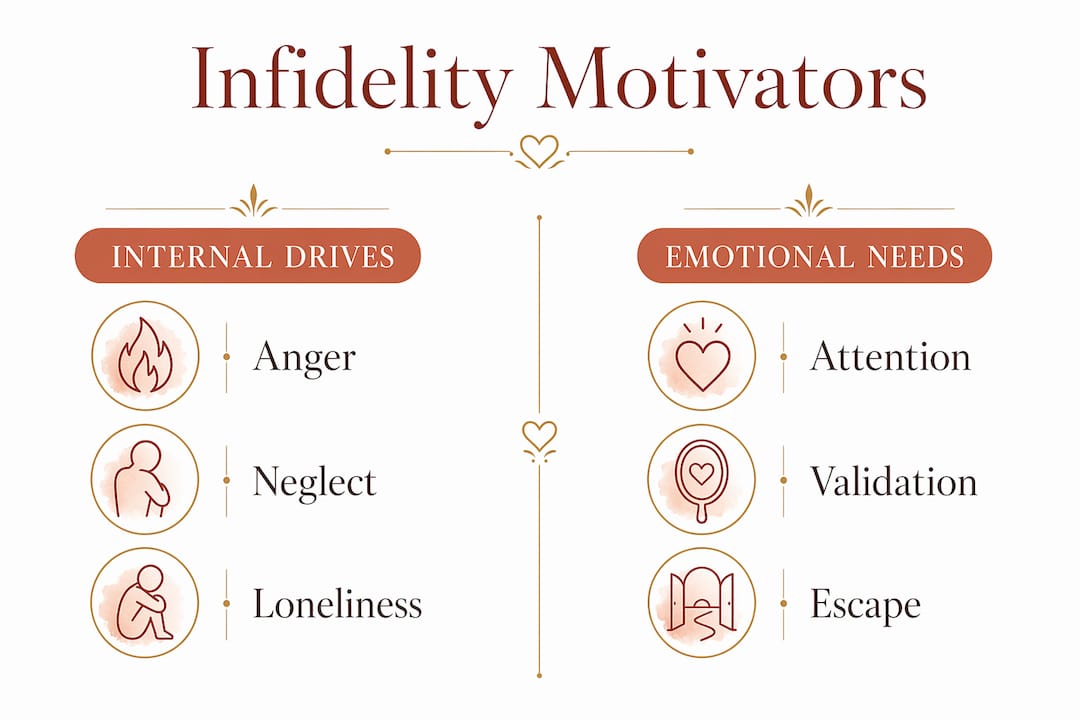
Cheating is rarely about the partner. A study of 495 people identified eight distinct motivators for infidelity: anger, low self-esteem, lack of love, low commitment, desire for variety, neglect, sexual desire, and situational factors. That list tells a clear story. Most of those motivators are internal states, not external relationship conditions.
The most counterintuitive finding is that infidelity is often linked to a betrayer’s need to feel listened to and emotionally valued, not primarily to sexual desire. Cheaters frequently seek emotional validation more than physical satisfaction. This matters because it dismantles the myth that a more attentive or attractive partner would have prevented the affair.
Understanding the psychology of infidelity also means recognizing the difference between emotional and physical cheating. Emotional cheating involves forming a deep, intimate bond with someone outside the relationship, often without any physical contact. Physical cheating involves sexual activity. Both are deliberate. Both cause betrayal trauma. And both are driven by the same internal unmet needs.
Pro Tip: If you keep asking “what did I do wrong,” redirect that question. The research is clear: the motivators for cheating live inside the betrayer, not inside the relationship you built together.
Here are the eight motivators identified in research, grouped by type:
- Emotional needs: anger toward a partner, feeling neglected, low self-esteem, desire to feel emotionally valued
- Relational disengagement: lack of love, low commitment to the relationship
- Desire-driven: sexual desire, desire for variety
- Situational: opportunity combined with lowered inhibition
Recognizing which motivator drove your partner’s behavior does not excuse it. It does help you stop blaming yourself for something that was never yours to own.
How do cheaters maintain eye contact and manage deception?
Betrayers do not simply lie once and hope for the best. Cheaters maintain conflicting details, anticipate questions, and pivot from guilt to offense upon discovery to avoid responsibility. This is strategic reality management, and it is far more calculated than most betrayed partners initially realize.
The table below compares passive versus strategic betrayal behaviors, showing how active the deception process actually is.
| Behavior type | What it looks like |
|---|---|
| Passive concealment | Avoiding topics, staying vague about whereabouts |
| Active misdirection | Volunteering false details before questions arise |
| Preemptive deflection | Accusing you of jealousy or insecurity to shift focus |
| Offense after discovery | Turning confrontation into an argument about your behavior |
| Compartmentalization | Keeping the affair emotionally separate from home life |
Betrayers commonly manage their partner’s perceived reality meticulously to protect their deception, often becoming defensive or offensive when confronted. This is why so many betrayed partners walk away from early confrontations feeling like they were the ones who did something wrong. The cheater’s offense is a defense mechanism, not evidence of your error.
Compartmentalization is the most psychologically sophisticated tool in a cheater’s arsenal. It allows them to experience genuine warmth and affection toward you while simultaneously maintaining the affair. This is not sociopathy in most cases. It is the human brain’s capacity to wall off incompatible realities, especially when the stakes feel high.
Pro Tip: If your partner became suddenly aggressive or turned the conversation back on you when you raised concerns, that pattern is a recognized behavioral signal. It is called DARVO: Deny, Attack, Reverse Victim and Offender. Naming it helps you trust your own perception.
What emotional impact does this kind of betrayal have on you?
Betrayal trauma is a specific and serious psychological injury. It differs from general relationship grief because the source of the harm is the same person you relied on for safety and comfort. The result is a profound disruption of your ability to trust your own judgment, which is often more destabilizing than the loss of the relationship itself.
Regression or feeling like starting over is part of trauma healing, not failure. Many betrayed partners report feeling fine for weeks, then being blindsided by a wave of grief triggered by a song, a smell, or a date on the calendar. This non-linear pattern is normal. It does not mean you are broken or that healing is not happening.
The coping strategies after betrayal that work best address both the emotional and cognitive dimensions of the injury. Betrayal trauma affects how you think, not just how you feel. Intrusive thoughts, hypervigilance, difficulty concentrating, and disrupted sleep are all common responses. They are symptoms of trauma, not signs of weakness.
Common emotional responses to betrayal trauma include:
- Obsessive replaying of past interactions, searching for missed signs
- Sudden loss of self-worth or identity confusion
- Difficulty trusting your own perceptions and memories
- Physical symptoms including fatigue, appetite changes, and chest tightness
- Grief that alternates with anger, numbness, and disbelief
General therapy can unintentionally minimize the acute betrayal trauma and leave victims feeling blamed. This is why therapists trained in infidelity trauma produce better outcomes for betrayed partners than general counselors who lack that specialization. The injury is specific. The treatment should be too.
Rebuilding trust after betrayal follows a similar trajectory regardless of the type of betrayal involved. The core work is always the same: restoring your sense of safety, reclaiming your judgment, and deciding what you want your life to look like going forward.
How does taking responsibility shape healing and recovery?
The cheater’s response after discovery is one of the strongest predictors of whether healing is possible. Perpetrators who take responsibility, rather than blaming their partner or the relationship, produce better outcomes post-betrayal. This finding from june 2026 research is significant. It means the path forward depends heavily on whether the betrayer can move from self-protection to genuine accountability.
When a cheater blames you, the relationship, or external circumstances, they extend your trauma. You are forced to defend your reality while also processing the loss. When they accept full responsibility, the dynamic shifts. You can focus on your own healing instead of fighting to be believed.
For betrayed partners in the early aftermath, the steps below provide a grounded starting point:
- Stabilize first. Prioritize sleep, food, and basic safety before making any major decisions.
- Avoid permanent choices. Experts recommend waiting several months before making decisions about divorce or major financial moves.
- Find specialized support. Seek a therapist trained specifically in infidelity trauma, not general couples counseling.
- Limit disclosure. Be selective about who you tell. Oversharing in acute distress can complicate your options later.
- Reconnect with your own values. Clarify what you need, independent of what your partner does next.
Professional help is most beneficial when intrusive thoughts are disrupting daily function, when you feel unable to make basic decisions, or when physical symptoms are persistent. Therapy types designed for infidelity trauma include EMDR, trauma-focused CBT, and somatic approaches. CBT-based couples therapy can also support partners who choose to work through the breach together, provided both people are genuinely committed to the process.

Key Takeaways
Cheating is a deliberate, internally motivated act, and understanding that fact is the foundation of every effective recovery strategy.
| Point | Details |
|---|---|
| Cheating is intentional | Affairs result from a series of conscious choices, not accidents or relationship failures. |
| Internal needs drive betrayal | Research identifies eight motivators, most of which are the betrayer’s internal states, not your actions. |
| Deception is strategic | Betrayers actively manage perception, anticipate questions, and use offense as defense after discovery. |
| Betrayal trauma is specific | General therapy often misses the mark; seek professionals trained in infidelity-related trauma. |
| Accountability accelerates healing | Betrayers who accept full responsibility produce better recovery outcomes for both partners. |
The question that actually matters
I have worked with many people who arrive at the same place: they are not really asking how their partner maintained eye contact while lying. They are asking whether they were ever truly known, truly loved, or truly safe. That is the wound underneath the question.
The uncomfortable truth I have observed is that most betrayed partners already sensed something was wrong. They noticed the small inconsistencies, the emotional distance, the moments that did not quite add up. What shook them was not the discovery itself, but the realization that their instincts were right all along and they had been persuaded to doubt them. Reclaiming that internal compass is the real work of recovery.
Forgiveness is not a requirement for healing. Clarity is. You do not owe your betrayer absolution. You do owe yourself an honest accounting of what happened, why it happened, and what you want your life to look like now. The shift from “how could they” to “what do I need” is not a small one. It is the pivot point where recovery actually begins.
Self-care after an affair is not indulgent. It is the structural foundation of everything else. The people who recover most fully are not the ones who forgive fastest or decide quickest. They are the ones who take their own experience seriously and get the right support for it.
— S.J.Howe
Aftertheaffair resources for infidelity recovery
Knowing why cheating happens does not make the pain smaller. What it does is give you a clearer starting point for recovery.
Aftertheaffair offers structured, evidence-informed resources built specifically for people at every stage of this process. The 7-step infidelity recovery checklist gives betrayed partners a concrete framework for the first weeks and months, covering everything from emotional stabilization to decision-making. For those who want to understand the full arc of recovery, the stages of healing after an affair resource maps the non-linear process with honesty and precision. Whether you are trying to survive the first week or rebuild something new, the support is there.
FAQ
Why can cheaters look their partner in the eyes while lying?
Cheaters use compartmentalization to keep the affair emotionally separate from home life, which allows them to feel genuine warmth toward their partner while sustaining the deception. This is a learned psychological defense, not evidence that the relationship meant nothing.
Is cheating always a deliberate choice?
Yes. Research confirms that even affairs described as “just happening” arise from a series of intentional decisions made by the betrayer. Each step, from the first private contact to ongoing concealment, required an active choice.
What are the most common emotional cheating signs?
Emotional cheating signs include a partner becoming secretive about their phone, forming an intense bond with a specific person outside the relationship, pulling back emotionally at home, and becoming defensive when that person is mentioned.
How long does betrayal trauma take to heal?
Healing is non-linear and varies by individual, but regression and setbacks are a normal part of the process, not signs of failure. Specialized trauma support significantly shortens the recovery timeline compared to no treatment or general therapy.
Should I make major decisions right after discovering infidelity?
Experts recommend waiting several months before making permanent decisions such as divorce or major financial changes. Acute betrayal trauma impairs clear judgment, and decisions made in that state are often regretted later.
Recommended
- Why Do Cheaters Stay? The Truth About What Your Spouse Really Wants – After the Affair Series
- Why Do Cheating Men Still Sleep With Their Wives
- Why People Cheat: Psychology of Infidelity Explained
- Are Certain Personality Types More Likely to Cheat?