- Signs of Emotional Abuse in Co-Parenting: Recognize & Respond
- What Counts as Emotional Abuse in Co-Parenting
- Recognizing Toxic Co-Parenting Signs in Daily Interactions
- How Parental Conflict Impacts Child Development and Wellbeing
- Documenting Co-Parenting Abuse for Legal Protection
- Parallel Parenting vs. Co-Parenting: When to Separate
- Protecting Your Child and Seeking Legal Intervention
- Healing and Moving Forward After High-Conflict Co-Parenting
- Additional Resources
- Frequently Asked Questions
Signs of Emotional Abuse in Co-Parenting: Recognize & Respond
Last Updated: July 24, 2026
When a relationship ends, emotional abuse often continues through co-parenting, taking forms harder to identify than physical harm yet equally damaging to children. Understanding these signs is essential for protecting your children’s wellbeing and your own mental health. At After the Affair Series, we help parents navigate high-conflict dynamics with specific frameworks and actionable strategies. This guide covers warning signs, patterns indicating abuse, and concrete steps to document and respond to harmful behavior.
What Counts as Emotional Abuse in Co-Parenting
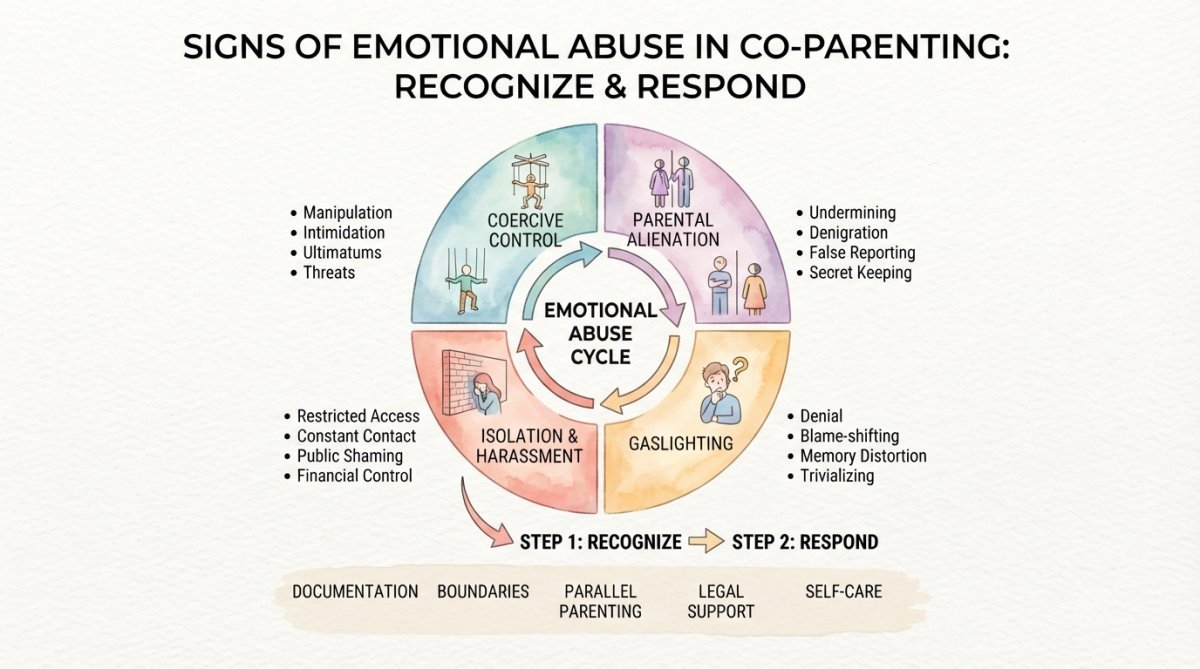
Emotional abuse in co-parenting centers on control, manipulation, and systematic erosion of another person’s sense of reality and worth. It operates through text messages, email, custody arrangements, and interactions with children themselves, creating a documentation trail that didn’t exist during the relationship.
Gaslighting and Reality Distortion
Gaslighting happens when one parent consistently denies events, rewrites shared history, or makes the other parent question their own memory. A co-parent might claim they never agreed to a custody arrangement or deny saying something despite text evidence.
The impact on children is particularly damaging. They witness one parent contradicting the other’s account of reality, developing confusion about what’s true and internalizing that their own perceptions can’t be trusted. Documentation is critical. Keep records of agreements, conversations, and plans using court-ordered communication apps that create automatic timestamps and searchable records.
Screenshot text messages and emails immediately after receiving them, storing copies in a separate folder with dates. This creates a verifiable timeline that courts recognize.
Coercive Control and Decision-Making
Coercive control manifests as one parent making unilateral decisions about the child’s life, medical care, education, religious upbringing, extracurricular activities, without consulting the other parent despite legal agreements requiring shared decision-making. The message sent to the child is that one parent’s authority supersedes the other’s, undermining respect for both parents and creating anxiety about whose rules matter.
Recognizing Toxic Co-Parenting Signs in Daily Interactions
Signs of emotional abuse emerge in patterns rather than single incidents. What matters is recognizing when behavior becomes systematic, intentional, and designed to control, humiliate, or alienate.
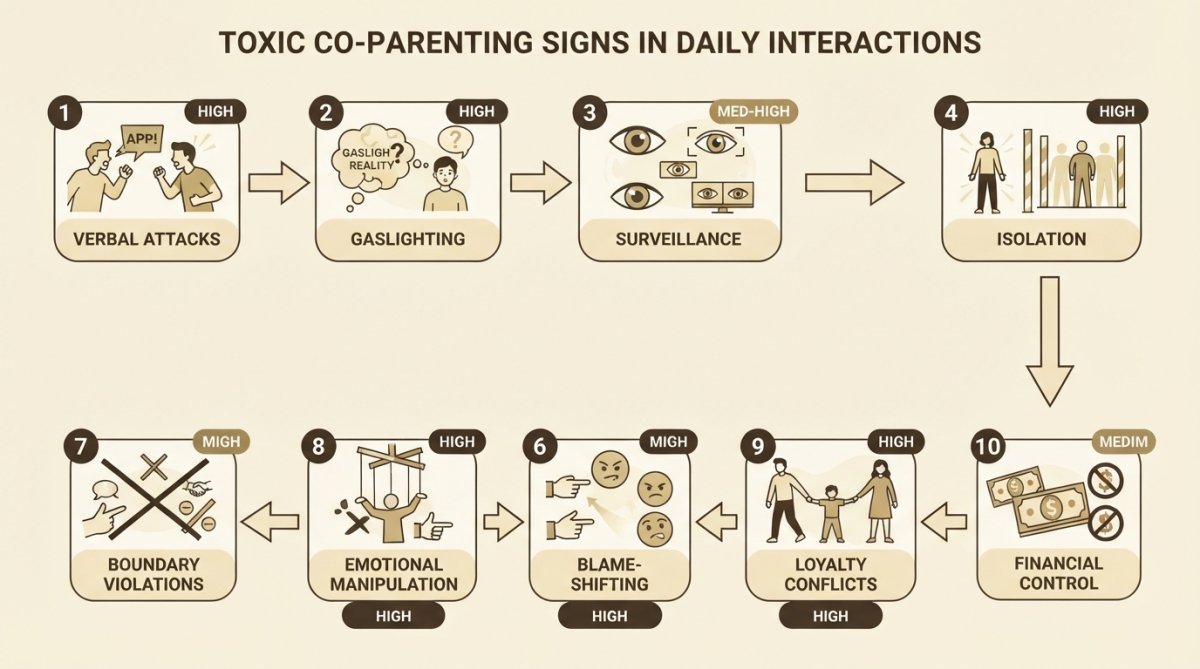
Verbal Attacks and Contempt
Verbal attacks take several forms: direct insults, public humiliation, contemptuous remarks about the other parent, and hostile tone in all communication. A parent might call the other parent “incompetent” or “a bad parent” in front of children or send hostile text messages.
Contempt is particularly corrosive because it signals complete lack of respect. Research shows contempt is one of the strongest predictors of ongoing conflict. In co-parenting, it teaches children that disrespect is normal communication and models contempt as acceptable behavior.
If a co-parent directs verbal attacks at you in front of your child, calmly remove yourself and your child from the situation without engaging. Document the incident with date, time, location, and specific words used. Repeated incidents create a pattern courts recognize as emotional abuse.
Isolation and Surveillance Tactics
Isolation happens when one parent systematically limits the child’s contact with the other parent beyond what custody orders require. This might include refusing to answer calls, not passing messages, or scheduling activities during the other parent’s time.
Surveillance tactics include monitoring the child’s phone, demanding detailed reports of the other parent’s time, or constant location tracking. While some monitoring is age-appropriate, surveillance crosses the line when excessive, punitive, or designed to gather ammunition against the other parent. Both tactics send children the message that they can’t be trusted and that normal parent-child relationships are suspicious.
How Parental Conflict Impacts Child Development and Wellbeing
Damage from emotional abuse in co-parenting extends far beyond immediate conflict. Children’s developing brains respond to threat and stress, and ongoing parental conflict acts as a chronic stressor affecting multiple developmental domains.
Emotional Regulation and Trauma Responses
Children exposed to high-conflict co-parenting struggle with emotional regulation, having difficulty identifying emotions, calming themselves when upset, or swinging between extremes. Trauma responses are common, including hypervigilance, avoidance of discussing the other parent, or intrusive thoughts about conflict.
Chronic stress from parental conflict affects the prefrontal cortex (decision-making and impulse control), the amygdala (emotional processing), and the hippocampus (memory formation). Recovery requires consistent safety, predictability, and emotional support from at least one stable adult. After the Affair Series provides essential tools, teaching parents how to create safety for children even within high-conflict dynamics using specific communication frameworks.
Loyalty Conflicts and Parental Alienation
Loyalty conflicts arise when children feel they must choose between parents, or when expressing love for one parent feels like betraying the other. Parental alienation is systematic effort to turn a child against the other parent through manipulation, false allegations, and emotional pressure.
Children caught in alienation feel trapped, complying with the alienating parent’s demands to maintain approval while experiencing guilt, confusion, and grief about the damaged relationship. Many develop deep resentment toward the alienating parent once old enough to recognize what happened, but years of relationship damage have occurred.
Documenting Co-Parenting Abuse for Legal Protection
Documentation is your most powerful tool in addressing emotional abuse in co-parenting. Courts make decisions based on evidence, and your documentation creates the objective record demonstrating a pattern of harmful behavior.
Creating a Documentation Log and Digital Records
Start a detailed log immediately. For each incident, record the date, time, location, what happened, who witnessed it, and the impact on your child. Be specific: instead of “ex was hostile,” write “At 4 PM custody handoff on March 15, ex told child, ‘Your mom doesn’t care about you,’ in front of two neighbors.”
Use a dedicated notebook, spreadsheet, or app organized chronologically. Include direct quotes when possible, distinguishing between exact quotes and paraphrased summaries. Screenshot text messages and emails with full context (sender, recipient, date, time). Save in multiple locations: cloud storage, external hard drive, and email to yourself.
The most credible documentation combines multiple evidence types: written communication, witness accounts, professional records (medical, educational), and detailed logs. A pattern across multiple sources becomes undeniable.

Using Court-Ordered Communication Apps
Many family courts require separated parents to use specific communication platforms designed for high-conflict situations. Apps like OurFamilyWizard and Talking Parents automatically timestamp all messages, prevent deletion, and create searchable records presentable to courts.
These apps discourage hostile language because conversations are recorded and eliminate “he said, she said” disputes with objective records. Using a court-ordered app demonstrates compliance with orders and good-faith communication efforts. Document any attempts to circumvent the app through text messages, phone calls, or emails sent outside the platform.
Parallel Parenting vs. Co-Parenting: When to Separate
When emotional abuse is present, traditional co-parenting, requiring ongoing communication, shared decision-making, and cooperation, becomes impossible and potentially harmful. Parallel parenting becomes necessary.
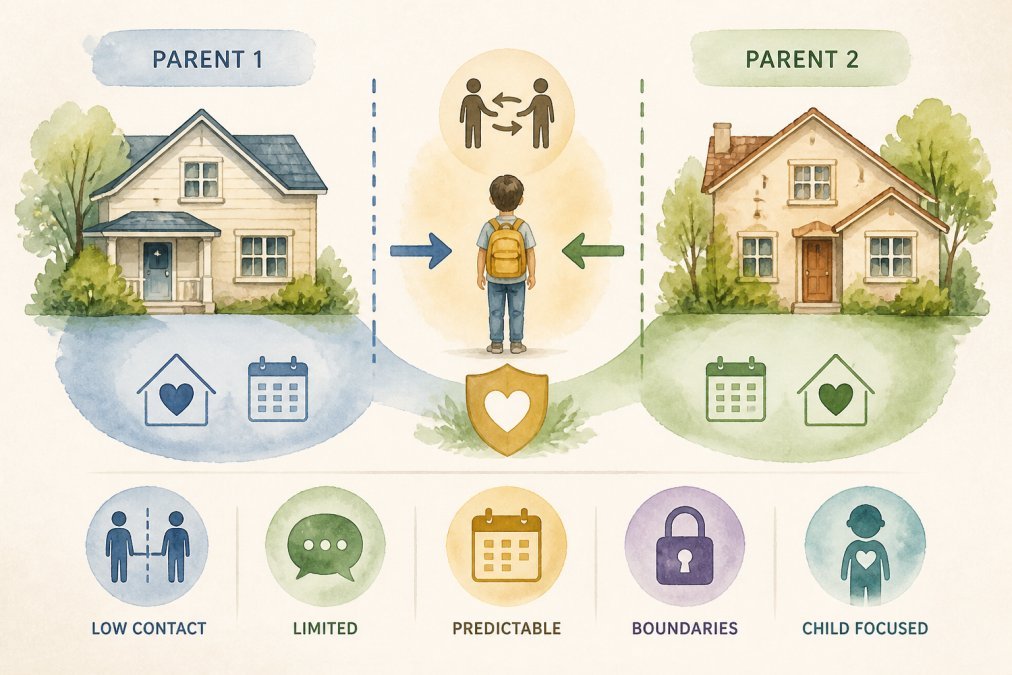
Parallel parenting is a structured approach where each parent operates independently during custodial time, making decisions without requiring agreement from the other parent. Communication is minimal, formal, and limited to essential logistics. The shift removes the opportunity for manipulation and protects children by reducing conflict exposure.
Setting Boundaries and Using the Grey Rock Method
Boundaries are essential in parallel parenting. Clear rules about what you will and won’t engage with might include: only discussing child-related logistics, no personal attacks, and no discussion of the other parent’s personal life.
The Grey Rock Method is a boundary-setting technique where you respond to conflict attempts with boring, emotionless, factual responses. If a co-parent sends a hostile message, respond with a brief, neutral fact: “Pickup is at 3 PM on Saturday as scheduled.” This method works because it removes the reward from conflict.
Practice Grey Rock responses in advance. Write out standard responses you can use: “I’ll discuss that with my attorney,” “That’s handled,” “I’m not discussing this.” Having these prepared makes it easier to stay calm when emotionally triggered.
Protecting Your Child and Seeking Legal Intervention
When documentation and boundary-setting aren’t enough, when abuse involves threats, severe manipulation, or clear harm to your child, legal intervention becomes necessary.
The Role of the Guardian ad Litem in Custody Cases
In many custody disputes involving abuse allegations, the court appoints a Guardian ad Litem (GAL), an independent advocate whose role is investigating the situation and making recommendations based on the child’s best interests. The GAL is not an attorney for either parent; they’re an officer of the court representing the child.
The GAL typically interviews both parents, the child, teachers, therapists, and other relevant people. They review documentation, medical records, and school records. Having a GAL involved can work in your favor if you’ve documented abuse carefully. Your detailed logs, preserved communications, and witness statements become part of the GAL’s investigation.
If you believe a GAL will be appointed, prepare your documentation now. Organize it chronologically and by category, highlighting the most serious incidents.
When to File for a Protective Order
A protective order (also called a restraining order or order of protection) is a legal document prohibiting specific behaviors. In co-parenting abuse, it might prohibit threatening communications, contacting you outside the court-ordered app, or coming within a certain distance of your home.
Consider filing for a protective order when the other parent has made threats of violence, there’s a pattern of harassment or intimidation, you have reasonable fear for your safety or your child’s safety, or the abuse is escalating. To file, go to your local courthouse and complete a petition describing specific incidents with dates and details, explaining why you believe you’re in danger.
Document everything supporting a protective order application: threatening messages, incidents of intimidation, escalating behavior, and professional assessments documenting the impact on you or your child.
Healing and Moving Forward After High-Conflict Co-Parenting
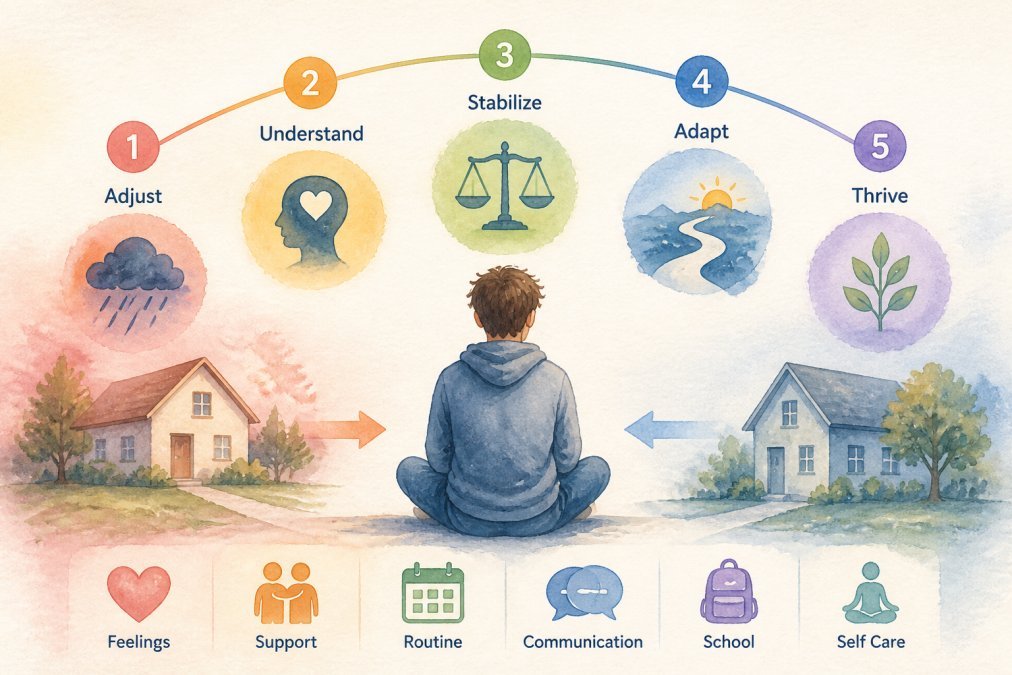
Recovery from emotional abuse in co-parenting is a process involving healing for both you and your child. For children, healing often requires professional support from a trauma-informed therapist who understands the specific dynamics of parental alienation and emotional abuse.
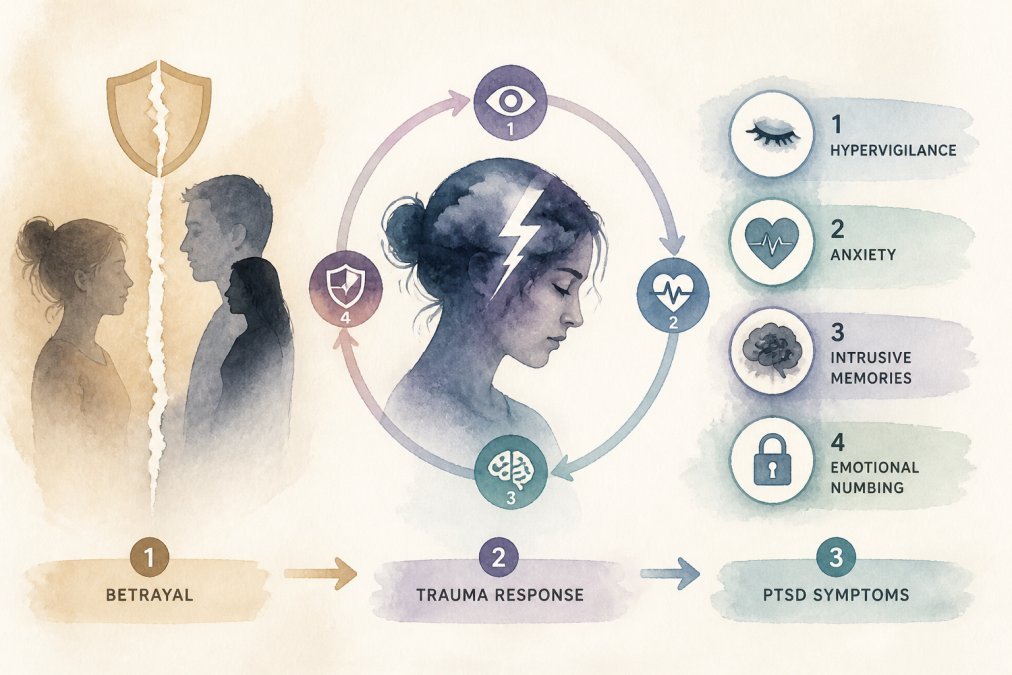
For yourself, healing involves processing your own trauma from the relationship and ongoing conflict. Working with a therapist specializing in betrayal trauma or high-conflict relationships helps rebuild your sense of safety and develop healthy boundaries.
Creating stability and predictability for your child is crucial. In parallel parenting, each parent can create a calm, consistent environment during their time. Minimize conflict exposure, maintain consistent routines, and focus on meeting your child’s emotional needs rather than winning arguments.
After the Affair Series provides structured frameworks specifically designed for high-conflict situations. Rather than generic parenting advice, the platform offers concrete scripts for difficult conversations, strategies for protecting children from loyalty conflicts, and tools for managing your own emotional response to ongoing provocation. The 23-point assessment helps you understand where you stand in the conflict and what specific interventions are most urgent.
Recognizing signs of emotional abuse in co-parenting is the first step toward protecting your child and yourself. Patterns of gaslighting, coercive control, verbal attacks, and manipulation create lasting damage when left unaddressed. With careful documentation, clear boundaries, and when necessary, legal intervention, you can interrupt these patterns and create a safer environment for your child. If you’re navigating high-conflict co-parenting and need specific, actionable strategies beyond general parenting advice, After the Affair Series offers structured frameworks and scripts designed for exactly these situations. Take the free 23-point assessment to understand your specific situation and access targeted tools for managing difficult interactions while protecting your child’s emotional wellbeing.
Additional Resources
National Domestic Violence Hotline resources on emotional abuse
American Psychological Association guidance on parental conflict and child development
Family Court guidance on documenting abuse for custody proceedings
Child welfare best practices for high-conflict custody situations
Research on parental alienation and its long-term effects on children
Frequently Asked Questions
What is considered emotional abuse in co-parenting relationships?
Emotional abuse in co-parenting includes gaslighting, coercive control, verbal attacks, isolation tactics, and psychological manipulation designed to undermine the other parent or damage the parent-child relationship. It involves patterns of behavior that demean, intimidate, or control rather than isolated incidents. Examples include denying events that occurred, monitoring all communications, threatening custody loss, or constantly criticizing the other parent to the child. Recognizing these signs of emotional abuse in co-parenting is the first step toward protection.
How does parental conflict impact a child’s emotional development?
High-conflict co-parenting and emotional abuse between parents directly affects children’s emotional regulation, self-esteem, and ability to form healthy relationships. Children exposed to parental conflict often experience anxiety, depression, behavioral problems, and difficulty concentrating at school. They may develop loyalty conflicts, feeling forced to choose sides. Trauma-informed research shows that the impact of parental conflict on child wellbeing extends into adulthood, affecting attachment patterns and conflict resolution skills. Children benefit when parents use parallel parenting or establish clear boundaries that shield them from adult conflict.
How do I document emotional abuse for a family court custody evaluation?
Create a detailed documentation log with dates, times, specific incidents, and direct quotes of abusive behavior. Include screenshots of text messages, emails, or court-ordered communication app records. Note the context and impact on you and your child. Save all records in a secure location with backup copies. Use court-ordered communication apps like OurFamilyWizard or similar platforms designed for neutral documentation. When documenting co-parenting abuse, focus on patterns rather than single incidents, courts look for evidence of ongoing coercive control or psychological abuse. Provide this documentation to your family law attorney before any custody evaluation.
What’s the difference between parallel parenting and co-parenting when dealing with an abusive ex?
Co-parenting requires active collaboration and communication; parallel parenting minimizes direct contact and allows each parent independent decision-making in their own household. Parallel parenting vs co-parenting becomes critical when one parent displays narcissistic traits, coercive control, or emotional manipulation. In parallel parenting, you use the BIFF method (brief, informative, friendly, firm) for essential communications and avoid unnecessary interaction. This approach reduces opportunities for abuse while protecting children by limiting exposure to conflict. Many high-conflict situations require a shift toward parallel parenting as a trauma-informed boundary-setting strategy.