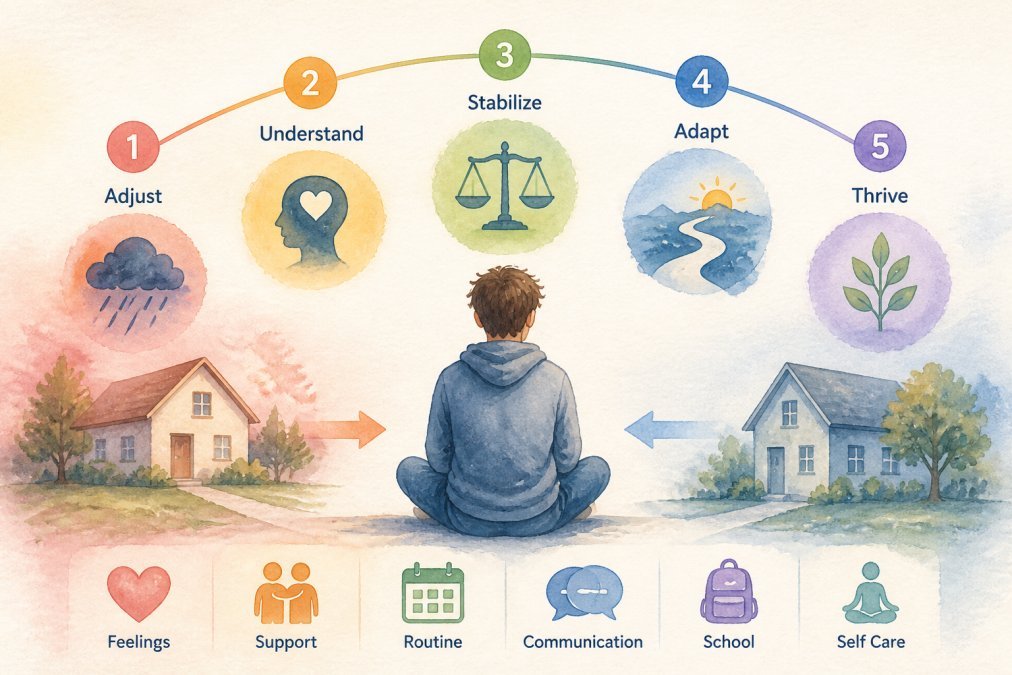
- Defining parallel parenting and core concepts
- Key characteristics of parallel parenting plans
- Parallel parenting versus traditional co-parenting
- Practical guidelines and example arrangements
- Potential risks, benefits, and common mistakes
- Find Peace and Stability with Structured Support for Parallel Parenting
- Frequently Asked Questions
Trust can shatter overnight when infidelity enters a relationship, leaving both parents struggling to co-exist for the sake of their children. For those finding open communication impossible or even painful, parallel parenting offers a structured path forward in high-conflict situations. This approach lets you support your child’s stability while protecting yourself from unnecessary emotional setbacks. Here, you will discover clear explanations and practical concepts to help you set boundaries, reduce conflict, and prioritize your family’s healing.
Key Takeaways
| Point | Details |
|---|---|
| Parallel Parenting Framework | Parallel parenting minimizes direct communication, allowing parents to function independently while raising their children in high-conflict situations. |
| Emphasis on Structure | A detailed parenting plan with clear roles and responsibilities reduces conflict by providing predictability and limiting the need for direct negotiation. |
| Focus on Child Wellbeing | The primary goal is the wellbeing of the child, ensuring both parents are involved without the stress of constant conflict. |
| Use of Mediators | Engaging a mediator for disputes helps maintain a professional distance and prevents emotional escalation during disagreements. |
Defining parallel parenting and core concepts
Parallel parenting emerges as a structured alternative when co-parenting isn’t working. Unlike traditional co-parenting, which assumes parents will communicate openly and make decisions together, parallel parenting operates on a fundamentally different model designed for high-conflict situations.
What is parallel parenting?
Parallel parenting is a co-parenting arrangement where parents maintain minimal contact and operate independently in raising their children. Each parent manages their own household, rules, and daily decisions without requiring input from the other. Communication stays limited to essential child-related matters, usually handled through digital channels rather than face-to-face interaction.
This approach works best when direct communication consistently triggers conflict or trauma responses. If every conversation with your co-parent becomes an argument or reopens wounds from the infidelity, parallel parenting can protect both you and your children from that ongoing tension.
Core principles that define the method:
- Minimal direct communication between parents (primarily digital)
- Each parent operates independently in their household
- Major decisions handled through a neutral third party when needed
- Clear, written agreements on custody, schedules, and finances
- Focus on child wellbeing rather than parental relationship repair
- Emotional disengagement from the co-parent relationship
Why structure matters so much
Parallel parenting relies on structure and emotional separation to reduce opportunities for conflict. When expectations are crystal clear and written down, there’s less room for misunderstandings or triggers. You don’t have to interpret tone through text messages or wonder what the other parent meant by a comment.
The method acknowledges a hard truth: sometimes parents cannot cooperate, and that’s okay. The goal shifts from partnership to parallel operation. Your children benefit from having two involved parents who rarely fight, rather than two parents constantly in conflict trying to cooperate.
How it differs from traditional co-parenting
Traditional co-parenting assumes regular communication, shared decision-making, and mutual respect. Parallel parenting abandons those assumptions. You’re not trying to be friends or even friendly. You’re functioning as separate units that happen to parent the same children.
This distinction matters deeply if infidelity fractured your ability to trust or communicate with your co-parent. You don’t need to repair that relationship. You simply need boundaries.
Key features you’ll implement
- Separate households with independent rules and routines
- Handoff schedules that minimize personal interaction
- Digital communication tools (email, parenting apps, or shared calendars)
- Pre-arranged agreements on major issues (school, health, expenses)
- Mediator involvement for disputes instead of direct negotiation
Parallel parenting isn’t about perfect communication—it’s about minimal communication done well, preventing conflict from harming your children while you both heal.
Pro tip: Set up a dedicated parenting app or email address for all communication with your co-parent from day one. This creates a clear boundary between your personal healing space and co-parenting logistics, making it easier to stay emotionally neutral.
Key characteristics of parallel parenting plans
Effective parallel parenting plans share specific structural elements that prevent conflict and protect children. These characteristics create predictability and reduce the need for parents to interact or negotiate constantly.
Communication remains limited and documented
Limited communication confined to child logistics forms the foundation of every parallel parenting plan. You’re not texting about feelings or relationship issues. Every message focuses on schedules, health concerns, or school updates.
Written communication through email or parenting apps creates a paper trail. This prevents misunderstandings and gives you distance from emotional conversations. The digital barrier helps you stay objective and calm when discussing difficult topics.
Clear roles and defined responsibilities
Each parent operates in their own lane without overlapping authority. You decide rules for your house. Your co-parent decides rules for theirs. You handle doctor appointments during your custody time. They handle appointments during theirs.
This clarity eliminates constant negotiation. You don’t need permission to make daily decisions about bedtime, screen time, or what your child eats at your house. Independence reduces conflict because there’s nothing to argue about.
Structured schedules that minimize interaction
- Fixed custody schedules with zero flexibility (unless truly emergencies)
- Handoffs at neutral locations or through a third party
- Calendar sharing so everyone sees dates without texting
- Clear pickup and drop-off times (no waiting, no chatting)
- Backup plans for missed pickups that don’t require negotiation
Detailed written agreements covering major decisions
Parallel parenting plans include clearly defined roles and boundaries for major issues like school selection, medical decisions, and religious upbringing. Instead of deciding these together, your parenting plan specifies who decides what.
Sometimes the plan says: “Each parent makes educational decisions for their household.” Other times it says: “Parent A chooses the school; Parent B handles medical decisions.” The specificity removes ambiguity.
Third-party involvement for disputes
When disagreements arise, a mediator steps in rather than you hashing it out directly. This professional barrier keeps emotions from escalating.
Emotional disengagement as a core trait
You’re not pretending to be friends. You’re not trying to understand the other parent’s perspective on everything. You accept that you don’t like each other right now, and that’s fine.
This disengagement isn’t cold toward your children. You stay warm, present, and engaged with them. You simply maintain professional distance from your co-parent.
Successful parallel parenting plans spell out everything in writing so neither parent has to ask permission, make exceptions, or negotiate constantly—reducing conflict by design.
Pro tip: Create a shared calendar showing custody days, school events, and appointments so both of you see schedules without needing to communicate directly—use Google Calendar or a parenting app like OurFamilyWizard for automated notifications.
Parallel parenting versus traditional co-parenting
These two approaches sit at opposite ends of the parenting spectrum. Understanding the differences helps you recognize which model fits your situation after infidelity has fractured your co-parenting relationship.
Traditional co-parenting assumes cooperation
In traditional co-parenting, parents work as a team. You communicate frequently, make decisions together, and present a united front to your children. Both households follow similar rules so kids experience consistency wherever they are.
This model works beautifully when parents respect each other and can set aside personal conflict. It requires vulnerability, compromise, and regular conversations about parenting strategies.
Parallel parenting accepts separation
Co-parenting entails cooperative decision-making and consistent rules across households, while parallel parenting operates independently with minimal communication. You’re not trying to align your households. Your rules, your values, your approach—these belong to you alone.
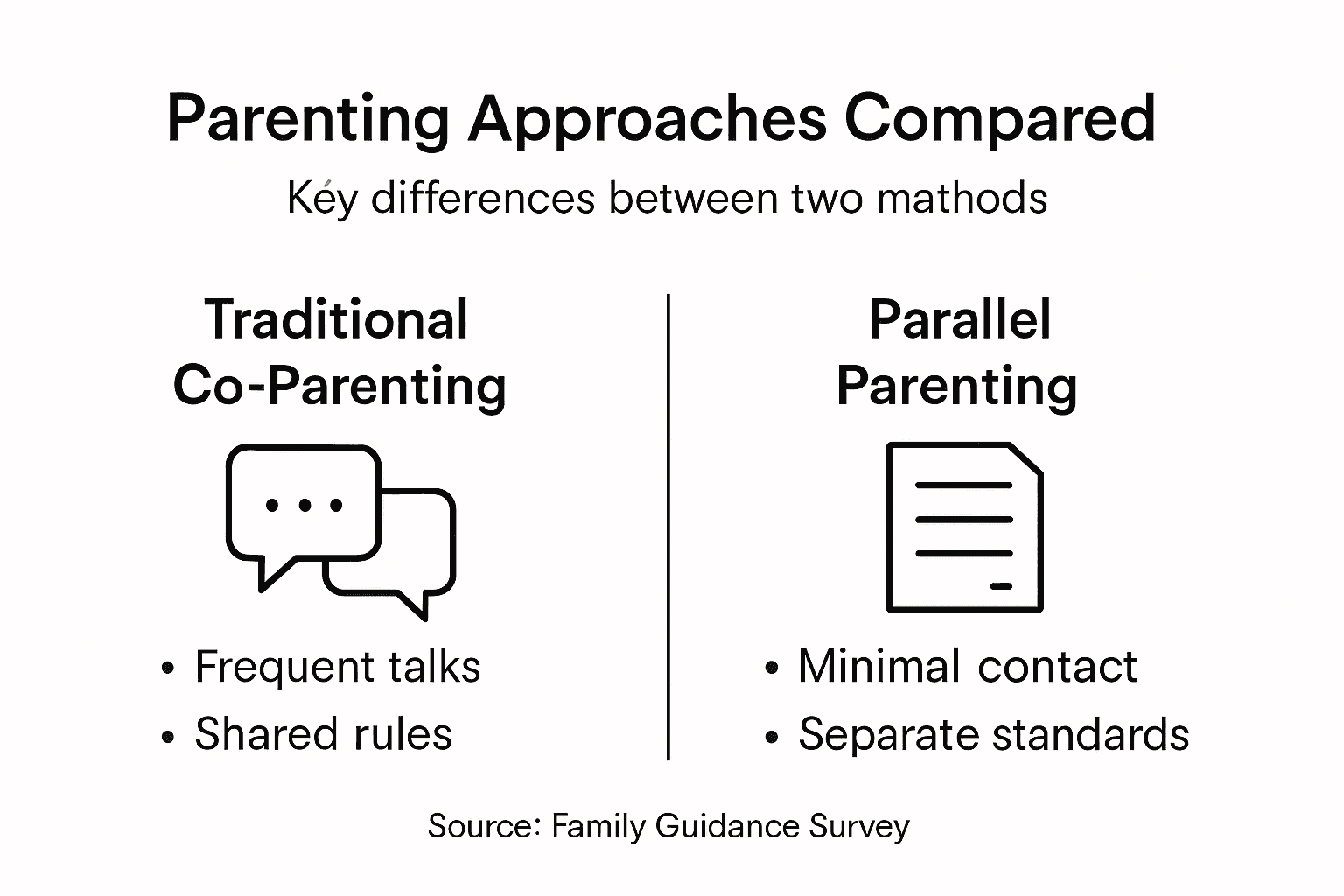
Parallel parenting acknowledges a hard reality: some separations prevent healthy communication. When infidelity destroyed trust, constant negotiation becomes painful rather than productive.
Key differences at a glance
| Aspect | Traditional Co-Parenting | Parallel Parenting |
|---|---|---|
| Communication | Frequent and collaborative | Limited and child-focused |
| Decision-making | Joint decisions | Each parent decides independently |
| Household rules | Consistent across both homes | Varies by household |
| Parental relationship | Cooperative and friendly | Professional and distant |
| Conflict resolution | Direct negotiation | Third-party mediator |
| Best for | Low-conflict separations | High-conflict situations |
Communication patterns differ dramatically
Traditional co-parents text regularly about parenting matters. They discuss what happened at school, weekend plans, behavior concerns. Parallel parents communicate only when absolutely necessary—schedule changes, medical appointments, major issues.
For someone healing from infidelity betrayal, constant communication with your co-parent can retraumatize you. Every text feels loaded. Every conversation risks reopening wounds.
Decision-making authority shifts
Traditional co-parenting involves collaboration and joint decision-making, while parallel parenting divides authority strictly. In traditional co-parenting, you debate school choices together. In parallel parenting, the plan specifies: Parent A chooses schools.
This clarity prevents endless negotiation and the painful back-and-forth that keeps you emotionally entangled with your co-parent.
Household consistency matters differently
Traditional co-parenting emphasizes consistent rules. Bedtime is 8 PM at both houses. Screen time limits match. Consequences align.
Parallel parenting lets each parent set their own standards. Your child has different rules at your house—and that’s acceptable. Kids adjust to different environments constantly (school versus home, grandparent’s house versus yours). They can manage two different sets of house rules.
When to choose each approach
Choose traditional co-parenting if you and your co-parent can communicate respectfully and manage your emotional triggers around each other.
Choose parallel parenting if direct communication causes conflict, triggers trauma responses, or keeps you stuck in the past.
Parallel parenting isn’t a failure of co-parenting—it’s a realistic acknowledgment that your situation requires different boundaries to protect everyone’s healing.
Pro tip: Assess your tolerance for contact with your co-parent before deciding. If every interaction leaves you exhausted, anxious, or angry, parallel parenting likely serves your family better than forcing cooperation.
Practical guidelines and example arrangements
Implementing parallel parenting requires concrete systems and clear expectations. Generic agreements fail because they leave room for interpretation and conflict. Real arrangements spell out exactly who does what, when, and how.
Build a detailed parenting plan from the start
Establishing detailed parenting plans with clear schedules and responsibilities prevents constant negotiation and reduces conflict opportunities. Your written agreement should cover custody schedules, financial responsibilities, communication methods, decision-making authority, and how disputes get resolved.
Specific beats vague. Instead of “reasonable visitation,” write: “Parent A has custody Monday through Wednesday at 6 PM, and Friday 6 PM through Sunday 6 PM.” Instead of “mutually agreed healthcare,” write: “Parent A decides routine medical care; Parent B decides major procedures and specialists.”
Practical scheduling arrangements
- Fixed weekly custody schedule (minimal flexibility)
- Neutral location handoffs (school parking lot, community center)
- Calendar sharing via app so both see dates without texting
- Holiday rotation established years in advance
- Summer schedule determined each January
- Birthday celebrations happen separately at each household
Communication protocols in writing
Designate one channel for all co-parenting communication. Email or a parenting app, never phone calls or texts. Include response time expectations: “Parent receives email by 6 PM same day; replies within 24 hours.”
Put boundaries around topics: “Communication limited to scheduling, health, school, safety. Personal matters excluded.”
Event attendance example arrangements
Example arrangements minimize direct parent-to-parent interaction at events. One approach: you attend sports events on odd weeks, your co-parent attends even weeks. School performances happen twice—once when each parent attends.
Alternatively, both attend but sit separately. You arrive early, sit in the back. Your co-parent arrives later, sits elsewhere. You leave before they do.
This prevents the awkward tension of sitting together while children perform and allows kids to enjoy their accomplishments without sensing parental stress.
Household rules and discipline
Each household operates independently. At your house, bedtime is 8 PM, screen time ends at 7 PM, homework before play. At your co-parent’s house, rules differ—and that’s fine.
Your parenting plan states: “Each parent sets household rules for their custody time. Rules need not be consistent between households.”
Financial responsibility divisions
Specify exactly: who pays for school, extracurriculars, medical expenses, clothing, and childcare. Write: “Parent A pays for public school; Parent B pays for extracurricular activities under $200 per semester; both split medical costs over $500.”
This eliminates surprise bills and disputes over who owes what.
Practical parallel parenting works because it removes decision-making from the moment. Everything is predetermined, documented, and agreed upon in writing.
Pro tip: Use a parenting app like Our Family Wizard or 2Houses to automate schedules, expense tracking, and communication—this keeps everything documented, reduces misunderstandings, and provides a record if disputes arise.

Potential risks, benefits, and common mistakes
Parallel parenting works well for many families, but it’s not perfect. Understanding both the advantages and pitfalls helps you implement it effectively and avoid sabotaging your own healing.
Real benefits that matter
Reduced conflict and sustained parental involvement improve child outcomes through stability. When parents stop fighting constantly, children experience noticeable relief. They sleep better, focus at school, and feel less anxious.
Parallel parenting also keeps both parents actively involved. Your children still have two invested parents—you just operate separately. This matters deeply for their identity and sense of belonging.
To better understand the practical benefits of parallel parenting, here’s a summary of how child wellbeing is impacted:
| Benefit for Children | How Parallel Parenting Helps | Long-Term Impact |
|---|---|---|
| Reduced exposure to conflict | Limits parental arguments | Improves emotional health |
| Stable parental involvement | Both parents stay engaged | Builds sense of belonging |
| Clear boundaries | Children know what to expect | Lowers anxiety levels |
| Adaptation to different rules | Exposure to varied environments | Greater resilience |
Benefits specifically for healing
- Less exposure to parental hostility and conflict triggers
- Reduced need to justify yourself or defend past actions
- Clear boundaries that protect your emotional recovery
- Decreased likelihood of retraumatization through contact
- Space to process betrayal without constant reminders
- Freedom to parent according to your values without negotiation
Legitimate risks you should know about
Parallel parenting risks include limited flexibility and coordination challenges. When something unexpected happens—your child gets sick, a schedule conflict emerges—you can’t easily adjust with your co-parent. Rigid adherence to plans sometimes creates real hardship.
Another risk: children navigate different rules at each house. Most kids adapt fine, but some find the inconsistency confusing or frustrating. They might test boundaries by saying, “But at Mom’s house I can…”
Common mistakes that undermine the method
Poor boundary-setting tops the list. You agree to minimal communication but then text about your feelings or try to explain your perspective. Boundaries only work if both parents actually maintain them.
Other frequent mistakes:
Here is a quick reference table of common parallel parenting mistakes and how to prevent them:
| Mistake | Impact on Family | How to Avoid |
|---|---|---|
| Vague agreements | Causes disputes | Make agreements specific |
| Direct negotiation of disputes | Escalates conflict | Use a professional mediator |
| Frequent plan changes | Reduces predictability | Schedule annual reviews only |
| Ignoring emotional boundaries | Reopens wounds | Limit communication strictly |
- Writing agreements too vague (“reasonable” schedules, “fair” contributions)
- Refusing to use mediators when disputes arise (trying to negotiate directly)
- Changing the plan frequently because it feels too rigid
- Avoiding professional support (therapist, parenting coach, mediator)
- Failing to update the agreement as children age and circumstances change
The inflexibility trap
Parallel parenting’s strength—removing negotiation—becomes its weakness when circumstances genuinely change. Your child’s school moves to a different district. A job transition affects your availability. A medical emergency requires immediate cooperation.
Plans need review annually and adjustment when major life changes occur. Build this into your agreement: “Plan reviewed each January; either parent can request modification with 30 days notice through mediator.”
How children respond to inconsistency
Most children handle different household rules without trauma. They already live with inconsistency everywhere—school rules differ from home rules, grandparent’s house differs from yours. Kids are remarkably adaptable.
The key: you’re not undermining each other’s authority. Your child knows you won’t criticize their other parent’s rules. You’re simply operating independently.
Parallel parenting succeeds when you commit to the structure, maintain boundaries faithfully, and invest in professional support when conflicts arise—not when you try to make it work through willpower alone.
Pro tip: Schedule an annual agreement review with a mediator rather than trying to renegotiate directly; this prevents old conflicts from resurging and keeps the plan aligned with your family’s evolving needs.
Find Peace and Stability with Structured Support for Parallel Parenting
If you are struggling with the challenges of parallel parenting after infidelity, you are not alone. This method requires strict boundaries, clear communication, and emotional distance to protect your healing and your children’s wellbeing. Many parents face the pain of minimal contact with their co-parent and managing different household rules while trying to create stability for their family.
Co-Parenting Support – After the Affair Series offers compassionate guidance designed to help you navigate these exact struggles with evidence-informed strategies. Whether you want to reduce conflict, enforce boundaries, or understand how to support your children through change, our resources provide practical advice rooted in real experience.
Take control of your parallel parenting journey now by accessing expert tools and insights at our Resource Library. Explore Helping Your Children – After the Affair Series to learn how to shield your children from trauma while you heal. Start building a healthier and more peaceful parenting plan today.
Frequently Asked Questions
What is parallel parenting?
Parallel parenting is a co-parenting arrangement where parents maintain minimal contact and operate independently in raising their children, managing their own households and decisions without needing input from each other.
How does parallel parenting differ from traditional co-parenting?
Unlike traditional co-parenting, which involves regular communication and joint decision-making, parallel parenting operates independently, focusing on individual household rules and minimal direct communication, typically limited to essential child-related matters.
What are the key benefits of parallel parenting for children?
Parallel parenting reduces exposure to conflict, ensuring a more stable environment for children. It allows both parents to stay actively involved while minimizing conflict, ultimately improving the child’s emotional health and sense of belonging.
How can I effectively implement a parallel parenting plan?
To implement a parallel parenting plan, create a detailed written agreement covering custody schedules, decision-making authority, communication methods, and conflict resolution processes, ensuring clarity and reducing the potential for misunderstandings.
Recommended
- The Long-Term Emotional Impact of Parallel Parenting on Children
- Parallel Parenting Success Stories: Real Families, Real Healing
- Parallel Parenting 101: When Co-Parenting Isn’t Possible