Finding out your partner has had an affair can feel like the ground disappearing beneath your feet. In a single moment, your sense of safety, your understanding of the past, and your vision of the future can all collapse at once. If you are searching for betrayed partner coping strategies, you are probably in the middle of that collapse, and the fact that you are looking for a way through is already a meaningful step. This article draws on evidence-based psychology to offer both short-term stabilisation tools and longer-term emotional healing strategies, for wherever you are in the process.
- Why Betrayal Hits So Hard: Understanding the Psychological Impact
- Short-Term Betrayed Partner Coping Strategies for the First Weeks
- Processing Betrayal: Making Sense of What Happened
- Long-Term Emotional Healing Strategies for Rebuilding Identity
- Self-Care After Infidelity: Body, Mind, and Social Support
- When Coping Strategies Aren't Enough: Getting Professional Help
Why Betrayal Hits So Hard: Understanding the Psychological Impact
The Trauma Response to Infidelity
Attachment researchers describe infidelity as an attachment injury, a rupture in the primary bond that can produce trauma symptoms indistinguishable from PTSD, including hypervigilance, intrusive thoughts, and emotional numbing. This framework, rooted in the work of John Bowlby and later developed by Sue Johnson in Emotionally Focused Therapy, explains why a discovered affair is not simply an emotional upset. It is a threat to the foundational relationship your nervous system treats as a safe base.
Clinicians now use the term Post-Infidelity Stress Disorder (PISD) to describe this cluster of symptoms. Research published in the Journal of Marital and Family Therapy confirms that betrayed partners frequently meet the clinical threshold for trauma responses, not as an exaggeration, but as a predictable neurological and psychological reaction to a genuine threat.
Why Managing Emotions After an Affair Feels Impossible at First
When the brain detects a serious threat, the amygdala activates the fight-flight-freeze response. Managing emotions after an affair is so difficult at first because your threat-response system is doing exactly what it was designed to do: keeping you on high alert. The prefrontal cortex, which handles rational thought and emotional regulation, goes partly offline. This is why intrusive thoughts loop, concentration disappears, and even basic decisions feel overwhelming.
People arriving at AfterTheAffair.uk consistently describe those first weeks as dominated by shock, obsessive rumination, and a desperate need to understand why. That response is not weakness. It is a predictable feature of processing betrayal at a neurological level.
Short-Term Betrayed Partner Coping Strategies for the First Weeks
The goal in the first days and weeks is stabilisation, not resolution. You do not need to have decided anything. You do not need to have forgiven anyone. You just need to get through the day in a way that does not make things worse.
For practical, step-by-step guidance during this acute phase, what to do immediately after discovering an affair can help you navigate the earliest decisions.
Stabilising Your Nervous System
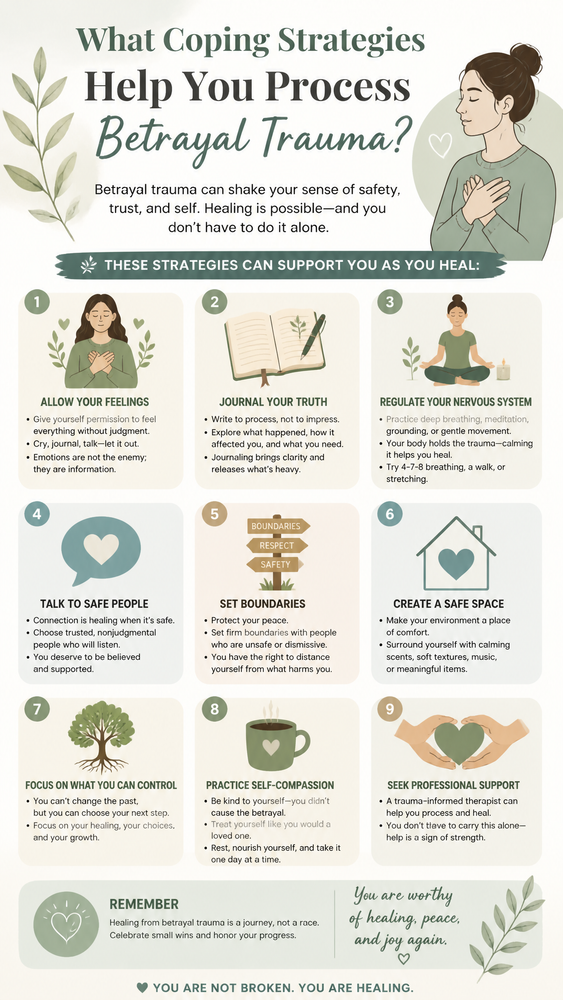
Grounding techniques work by interrupting the brain’s threat loop and bringing attention back to the physical present. The 5-4-3-2-1 method, naming five things you can see, four you can touch, three you can hear, two you can smell, one you can taste, is simple, requires nothing, and can be used anywhere. Slow diaphragmatic breathing (inhaling for four counts, holding for four, exhaling for six) activates the parasympathetic nervous system and reduces physiological arousal within minutes.
Physical movement also helps. Even a 20-minute walk changes the neurochemical environment your distress lives in. It does not need to be exercise in the traditional sense, it just needs to move your body.
Sleep and food matter more than they seem. Trauma disrupts both, and their disruption amplifies every emotional reaction. Prioritise small, regular meals and consistent sleep times, even when appetite and tiredness feel unpredictable.
Setting Boundaries to Protect Your Mental Health After an Affair
Obsessive searching, combing through phone records, social media, messages, is one of the most common early behaviours, and one of the most damaging. Each new piece of information re-traumatises the brain before it has had a chance to begin processing the last. An information diet is a legitimate, evidence-supported coping tool: deciding what you need to know to make safe decisions, and stopping there.
Identify two or three trusted people you can speak to honestly. Not everyone needs to know. Having safe contacts reduces isolation without creating a social situation that later becomes hard to manage. For a deeper look at surviving the aftermath of discovery, including how to pace what you take in, that resource covers this phase in more detail.
Processing Betrayal: Making Sense of What Happened
Once the acute shock begins to lift slightly, usually after a few weeks, though timelines vary, processing betrayal becomes both possible and necessary. Understanding the story of what happened does not mean excusing it. It means building a coherent narrative, because the brain cannot begin to heal from a trauma it has not been able to sequence and make sense of.
Managing infidelity triggers is closely related to this phase. As your narrative becomes clearer, triggers tend to become less unpredictable.
Journalling and Expressive Writing as Emotional Healing Strategies
James Pennebaker’s foundational research on expressive writing shows that structured emotional disclosure over multiple sessions measurably reduces psychological distress and produces physical health benefits, including improved immune function and reduced medical visits. The effect holds across a wide range of traumatic experiences, and replications in Health Psychology and Psychological Science have confirmed it consistently.
The method is straightforward: write for 15–20 minutes on three or four consecutive days, focusing on your deepest thoughts and feelings about what happened. Do not edit. Do not worry about grammar. The goal is to move the experience from raw sensation into language, because language is how the brain encodes and files memory as past rather than present threat.
Structured reflection is a variation that works well alongside expressive writing. This involves asking yourself questions, what do I actually know? What am I assuming? What do I need? and writing responses rather than just emotion. Both approaches are emotional healing strategies you can use at home, at any hour.
Knowing When to Seek Professional Support
Expressive writing and self-reflection are powerful tools, but they are not substitutes for therapy when symptoms are severe. A trained therapist can hold a space that a journal cannot. Emotionally Focused Therapy, developed by Sue Johnson, includes a specific protocol for treating attachment injuries like infidelity. This is meaningfully different from generic couples counselling and is worth seeking out specifically.
Long-Term Emotional Healing Strategies for Rebuilding Identity
Infidelity does not only damage the relationship. It attacks identity. Many betrayed partners report questioning their attractiveness, their judgment, their worth, and their version of their own life story. Long-term emotional healing strategies need to address this directly.
Understanding the stages of affair recovery can help you place where you are now within a broader arc, which itself reduces the fear that the pain will never lift.
Reclaiming Your Sense of Self
Values clarification is one of the most practical tools here. When identity feels shattered, reconnecting with what genuinely matters to you, independent of the relationship, provides a stable anchor. This might mean writing out your core values, then looking at which relationships, activities, and commitments in your life reflect them and which do not.
Self-compassion researcher Kristin Neff argues that treating yourself with the same kindness you would offer a close friend, rather than turning inward with self-criticism, is a core predictor of resilience after interpersonal betrayal. Self-compassion is not self-pity or excuse-making. It is recognising that you are a person in pain, that pain after betrayal is a normal human response, and that you deserve care.
Practically, this means noticing self-critical thoughts (“How did I not see this?”, “What’s wrong with me?”) and actively replacing them with what you would say to someone you love in the same position.
Rebuilding Trust, in Yourself and Others
One of betrayal’s most lasting effects is damage to self-trust. Many betrayed partners stop trusting their own perceptions. Rebuilding that trust is a gradual process, and it applies whether you stay in the relationship or leave it.
Both paths are valid. Deciding whether to stay or leave after an affair is one of the most significant decisions you may face, and it deserves careful, supported consideration. What matters from a coping perspective is that the decision emerges from your own values and wellbeing, not from panic, pressure, or shame.
Self-Care After Infidelity: Body, Mind, and Social Support
Self-care after infidelity is often the first thing dismissed (“I can’t think about exercise right now”) and the first thing that would help. The physical and psychological are not separate systems. Chronic stress elevates cortisol, disrupts sleep architecture, impairs memory consolidation, and worsens mood, all of which make every coping strategy harder to use.
Regular aerobic exercise is one of the most well-supported interventions for depression and anxiety, both of which are common after betrayal. Even moderate activity, three or four sessions of 30 minutes per week, produces meaningful changes in mood regulation over weeks. Sleep hygiene matters: consistent wake times, limiting screens before bed, and reducing alcohol, which fragments sleep architecture even when it initially feels sedating.
Alcohol and other substances deserve a direct mention. Using them to blunt emotional pain is understandable, but they reliably worsen anxiety and depression over time and can quickly become their own problem during a period of crisis.
Social support buffers the isolation that betrayal creates. Leaning on two or three trusted people, those who will listen without turning the situation into gossip or pushing you toward decisions you’re not ready for, is protective. Peer support communities, including structured online forums specifically for betrayed partners, can add an additional layer, particularly for people whose social networks feel complicated by the affair’s fallout.
When Coping Strategies Aren’t Enough: Getting Professional Help
Self-guided coping is valuable and appropriate for many people, much of the time. It is not sufficient for everyone. There are clear signs that professional support is needed rather than optional.
Seek professional help if you are experiencing:
- Intrusive thoughts or flashback-like memories that do not reduce over time
- An inability to carry out basic daily functions, work, parenting, eating, weeks after discovery
- Persistent hypervigilance (feeling unsafe, unable to relax, constantly scanning for threat)
- Emotional numbing or dissociation
- Thoughts of self-harm
These are symptoms of clinical trauma, not signs of personal failure. They indicate that your nervous system needs more support than self-care alone can provide.
In the UK, specialist affair recovery counselling is available through trained therapists who work specifically with infidelity and attachment trauma, a different skill set from general counselling. The British Association for Counselling and Psychotherapy (BACP) maintains a therapist directory where you can filter by speciality.
If you are not yet ready for a full therapeutic commitment, a free affair recovery assessment can help you understand where you are in the process and what kind of support would serve you best right now. It is a low-pressure starting point, and starting somewhere is what matters.
Betrayed partner coping strategies are not about bouncing back quickly or performing recovery. They are about building, slowly, imperfectly, honestly, a path back to yourself.