
Last Updated: August 1, 2026
Managing custody disputes after an affair presents one of the most emotionally charged legal and parenting challenges a family can face. At After the Affair Series, we understand that this requires emotional regulation, clear boundaries, and a framework that protects your children while preserving your own mental health. Below, we’ll walk you through five concrete steps to navigate this terrain with clarity and confidence.
- Understanding How Infidelity Affects Child Custody Laws After Adultery
- Step 1: Document Evidence and Build Your Legal Foundation
- Step 2: Establish Structured Communication for Co-Parenting After Infidelity
- Step 3: Choose Your Path, Mediation for Co-Parenting After Infidelity vs. Litigation
- Step 4: Manage Emotional Triggers and Protect Your Peace During Custody Disputes
- Step 5: Support Your Child's Wellbeing Through the Process
- Common Mistakes to Avoid When Managing Custody Disputes After an Affair
- Conclusion: Moving Forward With Clarity and Confidence
- Frequently Asked Questions
Understanding How Infidelity Affects Child Custody Laws After Adultery
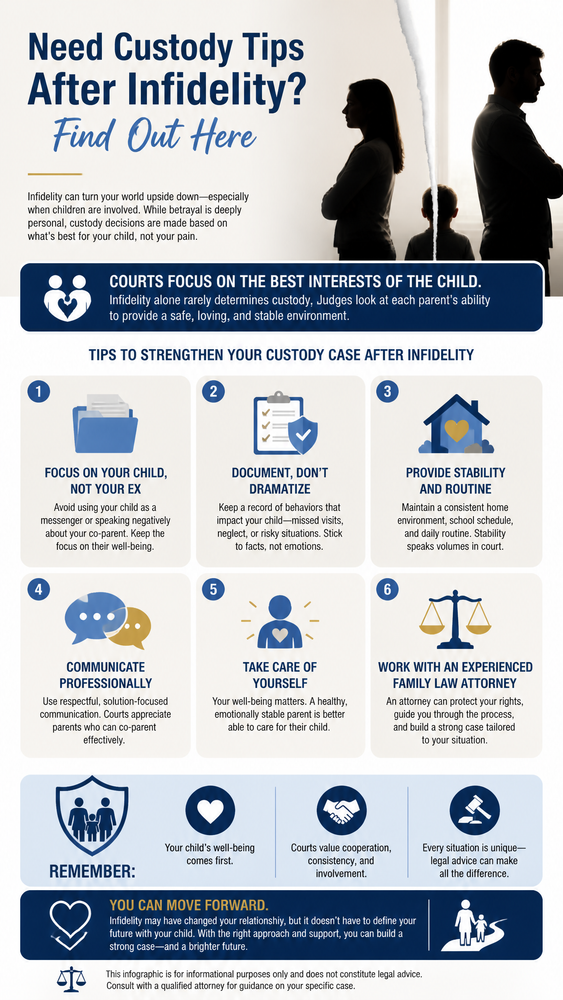
Infidelity itself is not a direct determinant in custody decisions across most U.S. states, but it matters more than many people realize. Courts apply the best interests of the child standard, which means judges evaluate custody arrangements based on what serves the child’s wellbeing, not on punishing parental behavior. However, the circumstances surrounding the affair, whether it exposed the child to inappropriate situations or affected the parent’s ability to care for the child, can influence the outcome.
Infidelity as a Factor in Custody Decisions
The affair becomes relevant when it demonstrates poor judgment, dishonesty, or behavior that directly harms the child. If a parent conducted the affair in ways that exposed the child to the other person, created instability in the home, or consumed time and emotional resources needed for parenting, a judge may view this as evidence of diminished parental capacity. Some states allow judges to consider “moral fitness” as part of the best interests analysis, which can include infidelity when it shows a pattern of deception or recklessness.
What matters most in court is not the affair itself, but what it reveals about your reliability as a parent. A parent who had an affair but maintained consistent caregiving, honesty about the separation, and a focus on the child’s needs will fare better than one who used the affair as an excuse for neglect or emotional withdrawal.
The Best Interests of the Child Standard in Custody Cases
The best interests of the child standard is the legal framework judges use to make custody determinations. This standard considers the child’s relationship with each parent, home stability, each parent’s involvement in the child’s life, the child’s preferences (depending on age), and any evidence of abuse, neglect, or substance abuse. Courts look for evidence that a parent can separate their personal pain from their parenting role. A parent who is transparent about the separation, maintains routines, follows through on commitments, and avoids speaking negatively about the other parent demonstrates fitness.
Step 1: Document Evidence and Build Your Legal Foundation
Before you take any action in a custody dispute, you need a clear record of what has happened. Documentation protects you legally by creating a factual timeline and forces you to separate emotion from fact.
What to Document and How
Create a detailed record of specific incidents with the date, time, location, what happened, who was present, and any impact on the child. If your ex-partner failed to show up for a scheduled pickup, document the date, time, how long you waited, and how the child reacted. Keep this documentation in a secure, password-protected location. Do not share it on social media or discuss it with your child. Photographs, text messages, emails, and calendar records are powerful evidence.
Digital Safety and Privacy During Custody Disputes
Change all passwords immediately, including email, banking apps, cloud storage, and social media. Enable two-factor authentication on all accounts. Be extremely cautious about what you say in text messages and emails. Assume every message will be read by a judge. Do not vent about your ex-partner or make threats. Stick to factual, neutral communication: “I will pick up the child at 3 p.m. on Saturday” is safe.
Consider using a co-parenting app like OurFamilyWizard that creates a timestamped record of all communication.
Step 2: Establish Structured Communication for Co-Parenting After Infidelity
One of the hardest parts of managing custody disputes after an affair is communicating with someone who has deeply betrayed you. Yet you must communicate regularly about your child’s schedule, health, education, and emotional needs. Structured communication becomes essential.
Using Communication Apps and Written Records
The Gray Rock Method is a communication technique for high-conflict relationships. You provide only necessary information, do not share personal details, do not engage with emotional provocations, and keep responses brief and factual. When your ex-partner sends a message, respond with necessary information only or do not respond if the message does not require one. If they write, “I can’t believe you’re already dating someone new, you’re going to traumatize the kids,” respond with: “I’m available to pick up the child on Saturday at 3 p.m. as scheduled.”
Use written communication whenever possible. Text, email, or a co-parenting app gives you time to respond thoughtfully instead of reacting emotionally. If you must speak by phone, keep calls brief. If your ex-partner becomes hostile, end the call: “I’m going to hang up now so we can both cool down. Let’s email about this instead.”
Set a rule for yourself: no important communications when you’re emotionally activated. Write the email if you need to, but save it as a draft. Wait 24 hours. Read it again. Then decide whether to send it.
Gray Rock Method and Boundary Scripts
Boundary-setting protects your peace and your child’s wellbeing. When you set a boundary, you tell your ex-partner what you will and will not tolerate, and what the consequence will be if they cross that line.
Boundary: No discussion of the affair or your personal life
“I understand you’re upset. Our focus now is on co-parenting. Let’s keep our conversations about the child’s schedule, health, and needs.”
Boundary: No introducing the affair partner to the child without agreement
“I’m not comfortable with [affair partner’s name] being present during parenting time until we’ve had time to adjust. Let’s discuss this with our mediator.”
Boundary: No hostile communication in front of the child
“I noticed you raised your voice during the exchange. I need you to keep exchanges calm and civil for the child’s sake.”
Boundary: No last-minute schedule changes
“I can’t accommodate schedule changes with less than 48 hours’ notice. If you want to make changes, let me know at least two days in advance.”
Enforce boundaries with consistency. The first time you let your ex-partner cross a boundary, they will test it again.
Step 3: Choose Your Path, Mediation for Co-Parenting After Infidelity vs. Litigation

One of the most important decisions you’ll make is whether to resolve your custody dispute through mediation or litigation.
When Mediation Works and When It Doesn’t
Mediation is a process where a neutral third party helps you and your ex-partner reach an agreement on custody, visitation, and parenting matters. Mediation works best when both parents are willing to cooperate, neither parent is trying to punish the other, and both genuinely want to minimize conflict for the child’s sake. Mediation is significantly less expensive than litigation and moves much faster.
However, mediation does not work when one parent is unwilling to negotiate in good faith, when there is a history of abuse, or when one parent is using the process to manipulate.
If you have any history of abuse, physical, emotional, or financial, be extremely careful about mediation. An abuser may use mediation to appear cooperative while continuing to control the narrative. Consider having an attorney present during mediation, and do not agree to anything that compromises your safety or your child’s safety.
Preparing for Court and Working With Legal Counsel
If mediation is not possible or has failed, you will need to prepare for court. An experienced family law attorney will help you present your case, cross-examine your ex-partner’s claims, and advocate for an arrangement that serves your child’s best interests. Before meeting with an attorney, gather all documentation: the timeline of events, text messages, emails, photos, and records of your involvement in your child’s life.
In court, the judge will evaluate both parents based on the best interests of the child standard. Demonstrate that you are a stable, involved parent who prioritizes your child’s wellbeing by showing up on time, presenting yourself professionally, avoiding hostile language about your ex-partner, and focusing on your child’s needs.
(/effective-coparenting-after-infidelity) vs. Litigation]
Step 4: Manage Emotional Triggers and Protect Your Peace During Custody Disputes
Managing custody disputes after an affair is emotionally exhausting. You are grieving the loss of your relationship, processing betrayal, navigating legal uncertainty, and trying to be a present parent while your nervous system is in survival mode. Without tools to manage your emotional state, you will make decisions you regret and communicate in ways that damage your case.
Recognizing and Managing Emotional Dysregulation
Emotional dysregulation happens when your nervous system is triggered and you lose access to your rational brain. The moment you notice signs of dysregulation, chest tightness, heat in your face, racing thoughts, shaking hands, or an urge to act, pause. Do not send that email. Do not make that phone call.
The 5-4-3-2-1 method works well: identify five things you can see, four things you can touch, three things you can hear, two things you can smell, and one thing you can taste. This engages your senses and pulls you out of the trauma response. Box breathing also helps: breathe in for four counts, hold for four counts, breathe out for four counts, hold for four counts. Repeat five times. Physical movement helps discharge nervous system activation. A 10-minute walk, stretching, or shaking your body vigorously can help.
Setting Boundaries With Your Ex-Partner
Boundaries protect your peace and your child’s wellbeing. The most important boundary is around your own emotional availability. You are not responsible for your ex-partner’s feelings or for explaining your choices. You are responsible for being a present, consistent parent and for protecting your own mental health.
If your ex-partner tries to draw you into arguments about the affair, say: “I’m not going to discuss this. My focus is on co-parenting.” If they try to use the child as a messenger, say: “Our child is not involved in our adult issues. Please don’t put them in that position.” If they show up unannounced, say: “I need you to stick to our agreed schedule. If you want to make changes, let’s discuss it through our mediator.”
Enforcing boundaries requires consistency. The first time you let your ex-partner cross a boundary, they will test it again. But eventually, they will learn that the boundary is real and stop testing it.
Step 5: Support Your Child’s Wellbeing Through the Process
Your child did not cause the affair and should not bear the emotional cost of the custody dispute. Yet children are deeply affected by parental conflict, infidelity, and separation. Your job is to shield your child from adult conflict while being honest about what is happening.
The Psychological Impact on Children of Infidelity-Based Divorce
Children experience the discovery of a parent’s infidelity as a betrayal of trust and stability. They may feel confused, angry, or responsible. The long-term psychological impact depends largely on how parents handle the situation. Children whose parents engage in high conflict, use them as messengers, or force them to choose sides experience significantly more anxiety, depression, and behavioral problems. Children whose parents manage conflict respectfully, keep them out of adult issues, and maintain consistent relationships with both parents show better emotional outcomes.
Your child needs to know that the affair was not their fault, both parents love them and will continue to be involved in their life, the separation is about the adult relationship, not about them, and their feelings are valid.
Age-Appropriate Communication and Professional Support
How you talk to your child about the affair and separation depends on their age. Young children (ages 4-8) need simple, honest explanations: “Mom and Dad are not going to live together anymore, but we both love you very much and will spend time with you.” They do not need details about infidelity.
School-age children (ages 8-12) may ask more direct questions. You can be honest without oversharing: “Mom made a choice that hurt our family, and we decided it was best to separate. This is not your fault, and you don’t have to choose between us.” Avoid badmouthing the other parent.
Regardless of age, consider professional support for your child. A therapist who specializes in children and family dynamics can help your child process their feelings, maintain healthy relationships with both parents, and develop coping skills.
The single most protective factor for children going through parental separation is knowing that both parents love them and that the conflict is between the adults, not about them. Protect this knowledge fiercely.
Common Mistakes to Avoid When Managing Custody Disputes After an Affair
Legal and Communication Pitfalls
The most common mistake parents make is using the child as a weapon or messenger. Do not ask your child to spy on the other parent, do not badmouth the other parent in front of your child, and do not use your child to send messages. This damages your child and damages your case. Courts view parental alienation as a serious form of harm.
Another critical mistake is oversharing on social media. If you post angry messages about your ex-partner, photos of yourself having a great time while your child is with the other parent, or details about the affair, you are creating evidence that will be used against you. Keep your social media private, keep your posts positive or neutral, and never post anything about the custody dispute or the other parent.
Do not lie to the court, do not hide assets, and do not violate court orders. These are not minor infractions; they are contempt of court and can result in losing custody, paying fines, or jail time.
Financial Implications of Custody Battles Involving Infidelity
Custody battles are expensive. Attorney fees, court costs, expert witnesses, and mediation services add up quickly. One way to reduce costs is to settle as much as possible outside of court. If you can agree on custody, visitation, and support through mediation or negotiation, you avoid the expense and trauma of trial. Be realistic about what you can afford and what is worth fighting for.
| Mistake | Impact on Case | How to Avoid |
|---|---|---|
| Using child as messenger or spy | Court views as parental alienation; damages custody case | Communicate directly with ex-partner; keep child out of adult issues |
| Oversharing on social media | Posts used as evidence against you; shows poor judgment | Keep social media private; avoid posting about custody dispute or ex-partner |
| Lying to court or hiding assets | Contempt of court; loss of custody; fines or jail time | Be honest with attorney and court; disclose all information requested |
| Violating court orders | Contempt of court; judge may modify custody against you | Follow all orders; request modification through court if circumstances changes |
| Emotional communication with ex | Escalates conflict; creates negative paper trail for court | Use Gray Rock Method; communicate in writing when possible; wait 24 hours before sending important messages |
| Badmouthing other parent to child | Damages child’s relationship with other parent; harms your case | Keep your feelings about ex-partner separate from your parenting; never criticize other parent to child |
Conclusion: Moving Forward With Clarity and Confidence
Managing custody disputes after an affair is one of the hardest things you will ever do. You are navigating grief, legal complexity, parenting stress, and your own emotional healing all at the same time. The path forward requires you to separate your personal pain from your parenting role, to communicate with clarity and boundaries, and to make decisions based on what your child needs, not on what you’re angry about.
After the Affair Series provides structured frameworks and communication scripts specifically designed for this situation. Rather than offering generic co-parenting advice, After the Affair Series delivers age-appropriate communication templates, boundary-setting scripts, and step-by-step protocols for managing hostile interactions. The platform also includes a free 23-point assessment that helps you identify your specific challenges and provides scored results so you know exactly where to focus your energy. With After the Affair Series, you move from decision paralysis and emotional reactivity to a clear, actionable plan. Take the free 23-point assessment and start protecting your peace and your child’s wellbeing today.
Frequently Asked Questions
Does infidelity affect child custody in the US?
Infidelity can influence custody decisions, but its impact varies by state. Most courts focus on the best interests of the child standard rather than punishing the unfaithful parent. However, if infidelity created an unsafe environment, affected parenting ability, or impacted the child directly, it may be considered. Courts examine whether the affair demonstrates poor judgment affecting parental responsibility or if it disrupted the child’s stability. Working with legal counsel helps you understand how your state’s family law treats infidelity in custody disputes.
How should I document evidence for a custody battle involving infidelity?
Maintain detailed, contemporaneous records of parenting interactions, missed visits, concerning behavior, and communications with your ex. Use timestamped photos, written messages, and calendar entries. Avoid emotional commentary, stick to facts. Digital safety is critical: secure your devices, use password protection, and consider a separate communication app designed for co-parenting that creates automatic records. Keep originals safe and back up copies. Never fabricate evidence, as courts penalize dishonesty. Consult legal counsel about what documentation strengthens your specific case.
What is the best interests of the child standard in custody cases involving infidelity?
The best interests of the child standard is the legal framework courts use to determine custody arrangements. Judges evaluate factors including each parent’s relationship with the child, stability, ability to meet the child’s physical and emotional needs, the child’s preferences (depending on age), and any history of abuse or neglect. Infidelity alone rarely outweighs other factors unless it directly harmed the child or demonstrates poor parental judgment. Courts prioritize the child’s safety, continuity of relationships, and emotional wellbeing over parental misconduct. This standard emphasizes what serves the child, not what punishes the unfaithful parent.
Can using communication scripts during custody disputes backfire legally?
Structured communication scripts and tools like the Gray Rock Method are not legally risky when used appropriately. They document your efforts to maintain professional, child-focused communication, which courts view favorably. However, avoid scripts that appear manipulative, dismissive of the child’s relationship with the other parent, or designed to provoke. Courts reward consistent, respectful communication that prioritizes co-parenting. Using documented communication apps (not private texts) further protects you by creating a clear record. When in doubt, review scripts with your legal counsel to ensure they align with your jurisdiction’s expectations.