Table of Contents
- What High-Conflict Co-Parenting Looks Like
- Parallel Parenting vs Co-Parenting: Which Path Works for You
- Setting Firm Boundaries and Protecting Your Peace
- BIFF Communication Method Examples for Hostile Interactions
- Co-Parenting Communication Apps and Documentation Tools
- When to Involve a Parenting Coordinator Role in Your Dispute
- Managing Your Own Stress and Building Resilience
- Conclusion
Last Updated: August 10, 2026
What High-Conflict Co-Parenting Looks Like
High-conflict co-parenting involves ongoing hostility, poor communication, and constant disputes between separated parents that directly impact children’s emotional safety. Unlike typical co-parenting challenges, these dynamics feature regular escalation, refusal to cooperate on basic decisions, and sometimes deliberate attempts to undermine the other parent’s relationship with the children.
Hallmarks include conversations that turn into arguments within seconds, written messages filled with accusations, refusal to discuss non-parenting matters, and a persistent sense that every interaction is a battle. A critical realization: you cannot change your ex’s behavior through better explanations. Once you accept this, you can focus on what you control: your own responses, your boundaries, and protecting your children from the fallout.
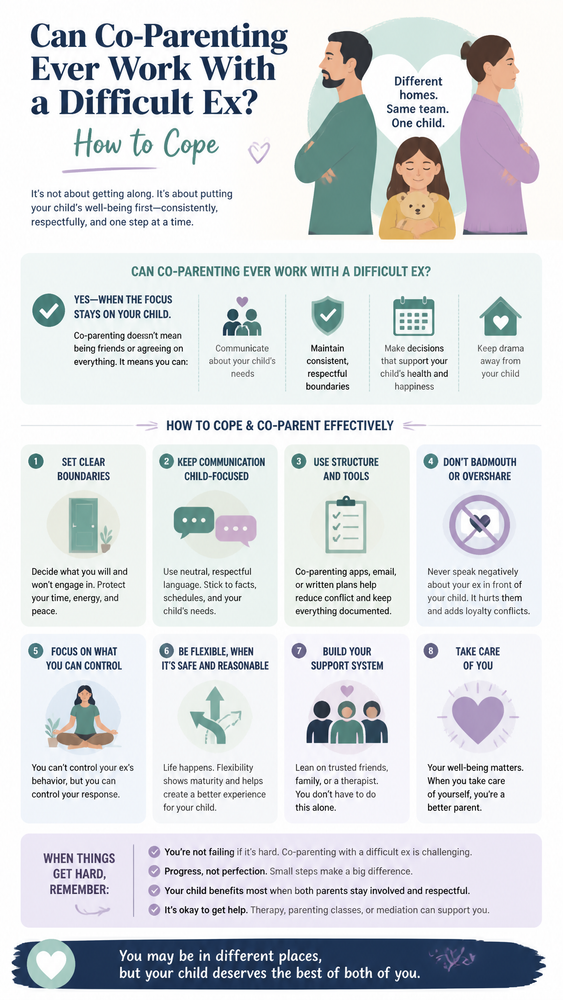
According to research on co-parenting conflict from the American Psychological Association, children exposed to ongoing parental hostility experience measurable increases in anxiety, behavioral problems, and difficulty regulating emotions. The stress comes from unpredictability and the burden of managing adult emotions they shouldn’t carry.
This guide addresses specific tools and frameworks that help parents in high-conflict situations protect their peace and their children’s wellbeing, focusing on actionable methods, structured communication techniques, and boundary-setting strategies that work even when the other parent refuses to cooperate.
High-conflict co-parenting requires tactical approaches, not better communication. You cannot change your ex’s behavior, but you can control your responses and protect your children from ongoing hostility.
Parallel Parenting vs Co-Parenting: Which Path Works for You
The distinction between parallel parenting and co-parenting is fundamental to your strategy.
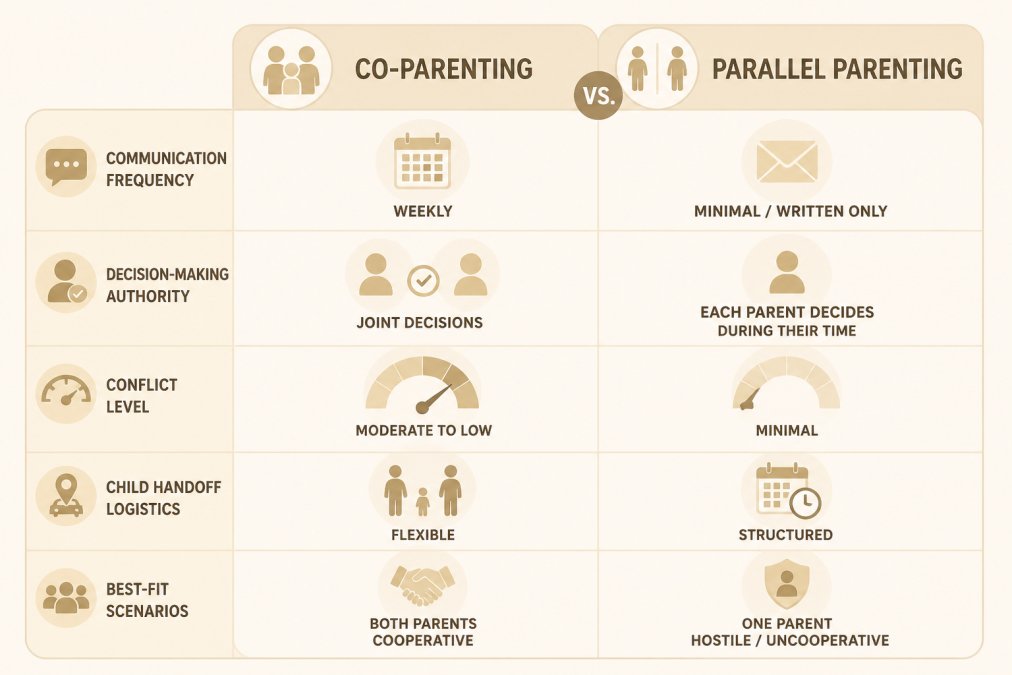
Co-parenting assumes both parents are willing to collaborate, communicate regularly, and make joint decisions about parenting matters. It requires flexibility, good faith effort, and shared commitment to the children’s wellbeing above personal conflict.
Parallel parenting is a structured approach where each parent operates independently within their own custody time. Communication is minimal and transactional, limited to essential logistical information. Major decisions are either pre-determined by court order or handled by a neutral third party. Parallel parenting doesn’t require trust, agreement, or civility, it requires clear boundaries and documentation.
In high-conflict situations, parallel parenting is almost always the better choice. It removes the expectation that you’ll negotiate, agree, or be pleasant with each other. If your ex refuses to discuss your child’s school struggles without attacking your parenting, parallel parenting means you handle academics during your time, they handle it during theirs. If they escalate every conversation about schedules, you communicate via a documentation app, not phone calls.
Many parents resist parallel parenting because it feels like “giving up” on cooperation. It’s not. It’s acknowledging reality and building a system that works within that reality. Court orders often reflect this by specifying parallel parenting arrangements for high-conflict cases.
If your ex uses information against you, refuses to discuss your child’s needs, or regularly escalates conversations, parallel parenting is not a compromise, it’s the structure that actually works.
Setting Firm Boundaries and Protecting Your Peace
Boundaries in high-conflict co-parenting are not about being nice or fair. They’re about protecting yourself and your children from ongoing harm. A boundary is a clear limit on what you will and won’t tolerate, with consequences when violated.
Many parents struggle with boundaries because they feel guilty about the shared child and obligated to accommodate. That guilt is often weaponized: “You’re being unreasonable.” “The kids need both of us to get along.” These statements are designed to make you doubt your boundaries.
Firm boundaries in high-conflict situations look like this:
- Communication boundaries: “I respond to messages about the children within 24 hours. Messages containing personal attacks or non-parenting matters go unanswered.”
- Decision boundaries: “During my parenting time, I make decisions about bedtime, meals, and activities. Major decisions about school, medical care, or extracurricular activities follow the court order process.”
- Emotional boundaries: “Conversations stay focused on the children. I don’t discuss our relationship or personal matters.”
- Availability boundaries: “I’m available for emergencies. Non-urgent matters wait until the scheduled communication window.”
These boundaries stop the cycle of escalation. When every message is answered with engagement, it signals that hostility works. When you accommodate every request, you teach them that pressure works.
Setting boundaries often triggers escalation, a predictable, temporary test. Your ex may increase hostility or involve the children. If you abandon your boundary under pressure, you’ve taught them that escalation works. If you hold firm, they eventually adjust.
Documentation becomes essential when you have firm boundaries. Every violation, hostile message, and missed exchange is recorded. This protects you legally if the situation escalates to court and gives you clarity based on facts, not memory.
A common mistake is setting a boundary but not enforcing it. If you say you won’t respond to personal attacks but then respond anyway, you’ve undermined your boundary. Consistency matters more than perfection.
BIFF Communication Method Examples for Hostile Interactions
The BIFF method is a structured approach to written communication in high-conflict situations. BIFF stands for Brief, Informative, Friendly, and Firm.
Brief: Keep messages short, one or two sentences about the actual issue. Long explanations invite argument.
Informative: Include only facts relevant to the children or logistics. No personal commentary or references to past conflicts.
Friendly: Use a neutral, professional tone. Think “business email,” not hostile or overly warm.
Firm: State what will happen, not what you hope will happen. “I’ll pick up at 5pm” not “Can you be ready by 5pm?”
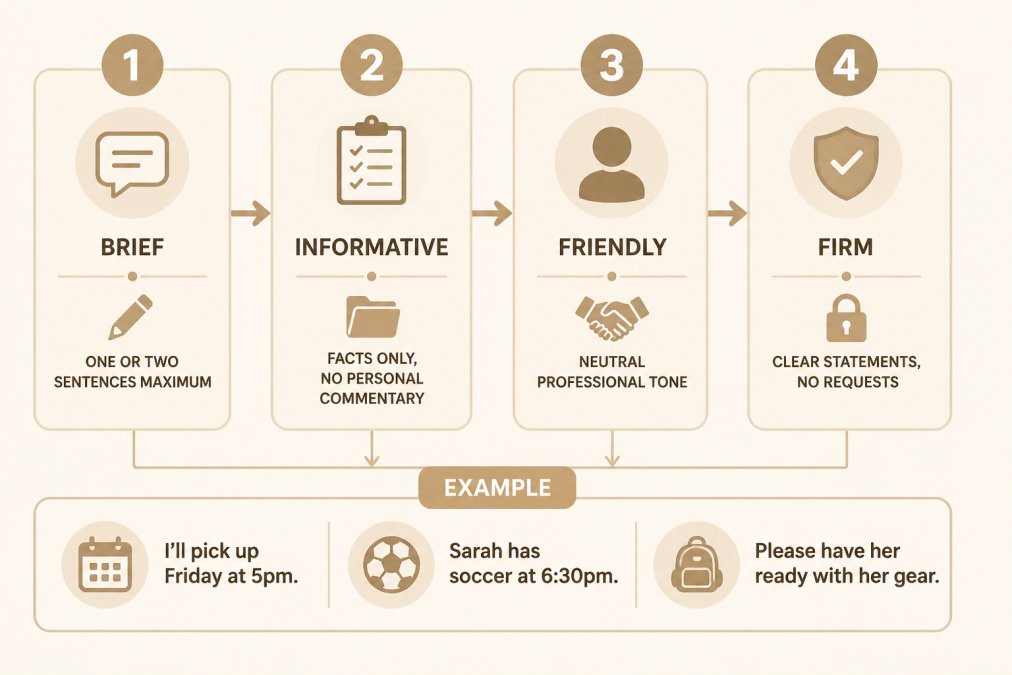
Here’s a real example of a BIFF response to a hostile interaction:
Hostile message from ex: “You’re ruining our daughter’s life by keeping her away from me. You’re selfish and only care about control. I’m getting a lawyer.”
BIFF response: “Sarah’s schedule is in the court order. I’ll continue following it. If you want to discuss changes, contact your attorney.”
Notice: no defense, no explanation, no engagement with accusations. Just a factual statement and a boundary.
Another example:
Take the free 23-point assessment →
Hostile message: “You bought her that expensive gift to make me look bad. You’re trying to turn her against me.”
BIFF response: “I’ll send you the school calendar and the extracurricular schedule by Friday.”
BIFF works because it removes emotion from the interaction. Your ex can’t escalate something with no emotional content. Over time, they adjust their communication because hostile messages don’t get the reaction they’re seeking.
BIFF removes the reward your ex gets from provoking you. No drama, no emotion, no fuel for conflict.
Co-Parenting Communication Apps and Documentation Tools
In high-conflict situations, written communication through a neutral platform is essential. It creates a record, removes tone-based escalation, and keeps conversations focused on logistics.
Several platforms exist specifically for co-parenting documentation. They allow you to log messages, schedule exchanges, track expenses, and maintain a clear record of all communication. This documentation is valuable if the situation escalates to court.
What matters in a co-parenting communication app:
- Neutral platform: Both parents log in to the same system. Messages are documented automatically with timestamps.
- Tone monitoring: Some apps flag messages for hostile language before they’re sent.
- Expense tracking: Log shared costs, medical bills, or extracurricular expenses.
- Schedule coordination: Shared calendar for custody exchanges, appointments, and activities.
- Legal protection: Your communication history is organized and available for court proceedings.
The benefit is the discipline of written, documented communication. When you know every message is recorded and visible to both parties, you’re more intentional and focused on facts.
Many parents also use email for documentation, which creates a time-stamped record. The advantage of a dedicated co-parenting app is that it’s specifically designed for this purpose and both parents are expected to use it.
The goal of documentation isn’t to “win” arguments or prove the other parent wrong. It’s to have a clear, objective record if the situation escalates.
When to Involve a Parenting Coordinator Role in Your Dispute
A parenting coordinator is a neutral professional, often a therapist, mediator, or attorney, appointed by the court to help parents in high-conflict situations make decisions and resolve disputes.
The parenting coordinator’s role is to:
- Make decisions when parents cannot agree on non-major issues (schedule adjustments, extracurricular activities, minor medical decisions)
- Help parents communicate more effectively
- Develop a detailed parenting plan that addresses high-conflict dynamics
- Make recommendations to the court if the situation doesn’t improve
When should you consider a parenting coordinator?
- Your ex refuses to discuss important decisions about your children
- You’re spending thousands on legal fees because every disagreement goes to court
- You and your ex cannot communicate without escalation
- The children are being pulled into adult conflicts or asked to carry messages
The parenting coordinator doesn’t replace the court; they work within the court’s authority. The judge appoints them and gives them specific powers. They can make binding decisions on certain issues, which removes the need for both parents to agree.
The cost varies by location and professional background. If your case is severely high-conflict, the cost of a parenting coordinator is often far less than ongoing litigation.
A parenting coordinator is not appropriate for situations involving abuse, domestic violence, or stalking. The court needs to know about this context when considering whether to appoint one.
Managing Your Own Stress and Building Resilience
High-conflict co-parenting is chronic stress. Without active stress management, you’ll burn out.
The foundation of resilience is recognizing that you cannot control your ex’s behavior, only your response. Every time you think “If only they would…”, you’re placing your peace in their hands.
What you can control:
- Your response to hostile messages (delay, use BIFF, don’t engage)
- Your boundaries (what you will and won’t tolerate)
- Your communication method (written, documented, neutral)
- Your focus (your children’s wellbeing, not winning arguments)
- Your self-care (sleep, exercise, therapy, time away from conflict)
Practical stress management:
- Set communication windows: Check messages once in the morning, once in the evening. This prevents reactive states all day.
- Separate your identity from the conflict: You are not defined by your ex’s behavior or accusations.
- Build a support system: Therapist, trusted friends, support groups for parents in high-conflict situations.
- Create rituals that restore you: Time with your children away from logistics, exercise, time away from parenting responsibilities.
- Track patterns, not individual incidents: One hostile message is an incident. A pattern is data that helps you stay objective.
Individual therapy is often essential in high-conflict situations. A therapist can help you process trauma, manage anxiety about your children’s wellbeing, and develop emotional regulation when triggered.
According to the American Psychological Association’s guidelines on parental stress, parents in high-conflict situations experience anxiety and depression rates comparable to those with chronic health conditions. Self-care is not selfish, it’s essential to protecting your children.
The “Grey Rock” method: respond to hostility with the emotional engagement of a grey rock, boring, neutral, unhelpful for escalation. “Okay,” “Got it,” “I’ll handle that during my time.” This removes the reward your ex gets from provoking you.
Conclusion
High-conflict co-parenting requires a fundamentally different approach than typical co-parenting challenges. You’re not trying to build a collaborative relationship. You’re building a system that protects your children and your peace while minimizing the damage of ongoing hostility.
After the Affair Series provides specific frameworks, BIFF communication scripts, boundary-setting protocols, and documentation systems designed for parents navigating exactly this situation. Rather than generic advice about “better communication,” the toolkit delivers structured methods that work even when the other parent refuses to cooperate. Take the free 23-point assessment to understand your specific situation and get targeted guidance for your circumstances.