Last Updated: August 28, 2026
- Co-Parenting After Infidelity- Understanding Challenges and Reality
- How Betrayal Trauma Breaks the Foundation of Traditional Co-Parenting
- Parallel Parenting vs Co-Parenting: Why One Works When the Other Fails
- High-Conflict Co-Parenting Scripts That Protect Your Boundaries
- How to Protect Children From Divorce Conflict Without Alienation
- Co-Parenting Communication Tools Built for High-Conflict Situations
- Managing Emotional Triggers and Setting Accountability Boundaries
- Frequently Asked Questions
Co-Parenting After Infidelity- Understanding Challenges and Reality
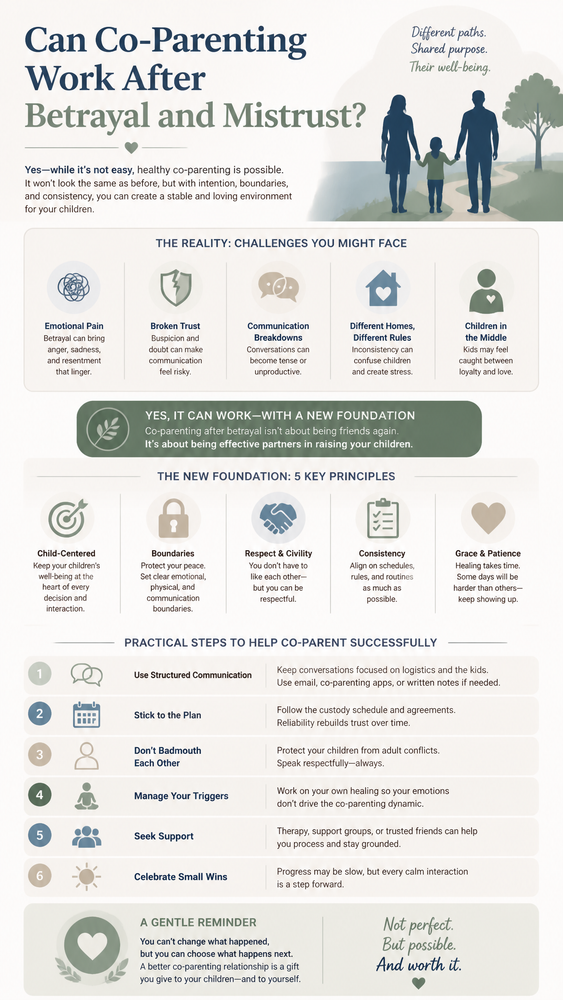
Standard co-parenting advice fails after infidelity because it assumes mutual respect, shared values, and the ability to separate parental partnership from personal hurt, a foundation that shatters with betrayal. The betrayed partner experiences trauma that rewires how they process interactions with their ex. The unfaithful partner cycles between defensiveness, minimization, and guilt. Neither can access the emotional regulation needed for traditional co-parenting frameworks.
Generic scripts like “put the children first” and “don’t speak negatively about their other parent” are incomplete. They don’t account for betrayal trauma, the neurobiological impact of deception, and legitimate safety concerns when trust is destroyed.
Parallel parenting and high-conflict communication tools address this. They’re not Band-Aids, they’re a different system entirely, designed for situations where traditional co-parenting cannot exist because the conditions that make it possible don’t.
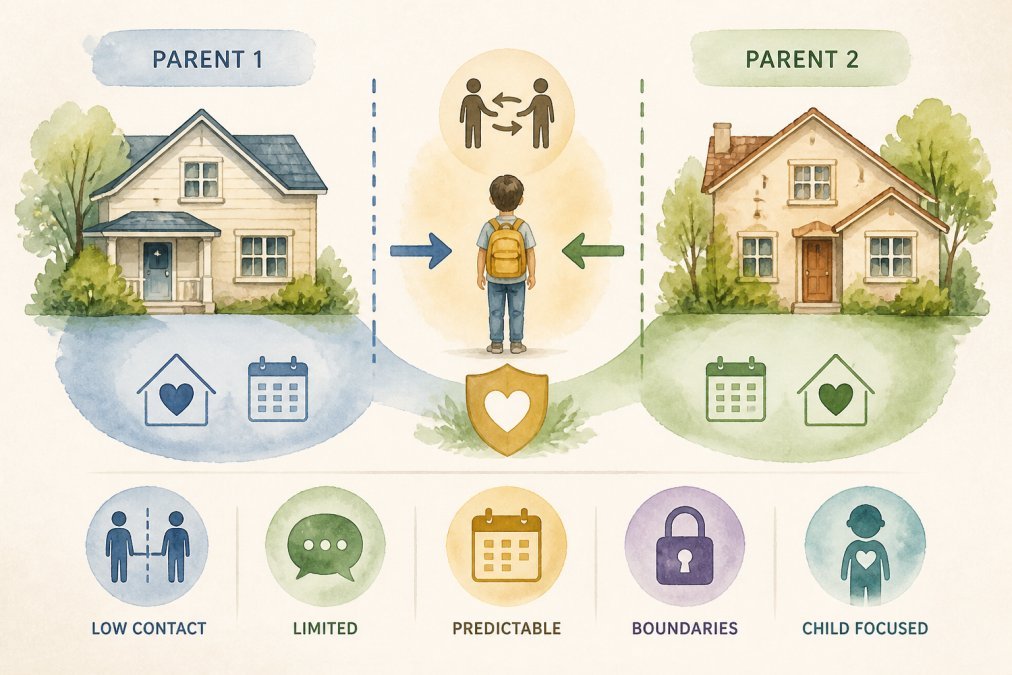
Children in high-conflict post-infidelity situations don’t benefit from parents forcing civility they don’t feel. They benefit from parents with clear boundaries, predictable communication protocols, and the ability to shield them from parental conflict.
Co-parenting after infidelity requires a fundamentally different framework than traditional co-parenting. Betrayal trauma, broken trust, and ongoing emotional triggers make standard advice not just ineffective, it can backfire, escalating conflict and harming children’s sense of safety.
How Betrayal Trauma Breaks the Foundation of Traditional Co-Parenting
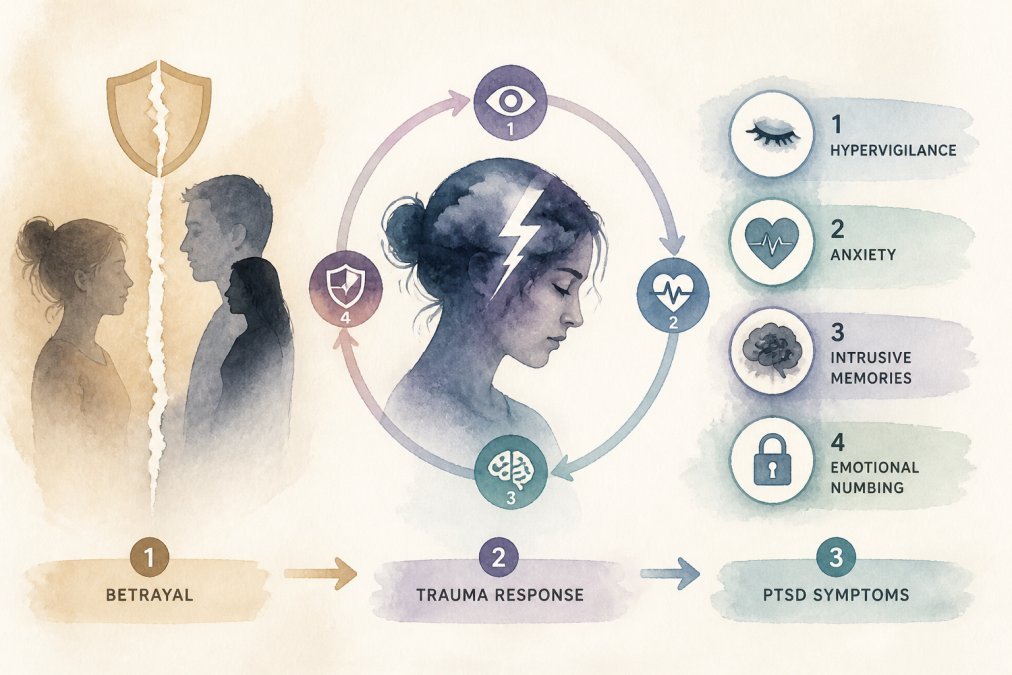
Betrayal trauma is a specific neurobiological response to discovering deliberate deception from someone you trusted (apa.org). The brain’s threat-detection system goes into overdrive. Every interaction with the unfaithful partner becomes loaded with potential emotional danger.
When a parent operates from betrayal trauma, they cannot engage in the reciprocal trust that traditional co-parenting requires. They may follow the scripts, but underneath they’re scanning for threats, interpreting ambiguity as deception, and struggling to regulate their nervous system when their ex makes decisions about the children.
The unfaithful partner experiences a different but equally disruptive dynamic. They may feel shame, defensiveness, or a desperate need to prove they’ve changed. This can manifest as boundary violations, over-explaining decisions, seeking reassurance, or attempting to use co-parenting conversations to address the affair itself. These behaviors trigger the betrayed partner’s trauma response.
The children exist in the middle of two dysregulated nervous systems. They pick up on tension, unspoken anger, and forced politeness masking contempt. Research shows children are more distressed by unresolved, simmering conflict than by honest acknowledgment of difficulty (peer-reviewed research). When parents pretend to co-parent while internally experiencing rage or fear, children sense the disconnect.
Attempting traditional co-parenting while in active betrayal trauma can escalate conflict. The betrayed parent’s nervous system interprets neutral statements as hostile. The unfaithful parent’s defensiveness triggers the betrayed parent’s rage. Both parents end up more dysregulated, and children absorb that chaos.
Traditional co-parenting advice assumes emotional safety exists. After infidelity, it doesn’t. Until that changes through time, therapy, and sometimes legal boundaries, the framework itself is incompatible with the actual emotional reality.
Parallel Parenting vs Co-Parenting: Why One Works When the Other Fails
Parallel parenting is a structured separation of parental duties designed for high-conflict situations where traditional co-parenting cannot function. Each parent makes decisions in their domain. Communication is documented, minimal, and focused only on logistics.
Traditional co-parenting assumes parents will discuss major decisions together, present a unified front, and maintain an ongoing partnership. This works when both parents are emotionally regulated and trust each other’s judgment.
Parallel parenting assumes they cannot. It protects children by removing them from parental conflict, protects the betrayed parent by reducing exposure to triggers, and protects the unfaithful partner by setting clear boundaries on what’s up for discussion.
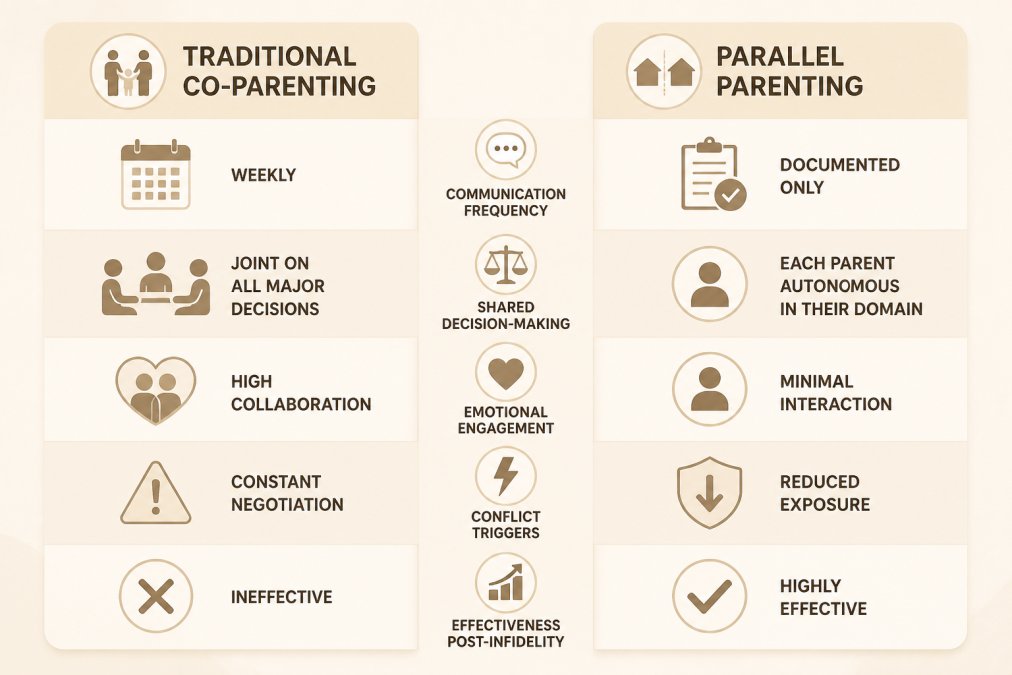
The shift from co-parenting to parallel parenting is not failure, it’s recognizing what’s actually possible given the current emotional landscape. In a parallel parenting structure, one parent might handle school-related decisions and medical appointments while the other handles extracurricular activities and weekend logistics. Communication happens through a co-parenting app or email. Handovers are brief and structured.
This doesn’t mean parents never speak, only when necessary, about only what’s necessary, with emotional distance built into the protocol. Over time, some parents transition back toward collaboration. Others maintain parallel parenting indefinitely. Both are valid.
The transition to parallel parenting often feels like giving up. It’s actually the opposite. It’s acknowledging that the old framework broke and building one that works with the actual people and emotions involved.
Reading this won’t change tomorrow’s message
You Know the Tactic Now. Do You Know What You’ll Actually Do When It Lands?
Understanding grey rock is not the same as doing it at 9pm when your phone buzzes. Most parents can explain the theory perfectly and still bite the bait every single time. The gap between the two is exactly what the free self-check measures.
Get Your Ex Out of Your Head \→5 scenarios \· scored result \· 4 minutes \· free
High-Conflict Co-Parenting Scripts That Protect Your Boundaries
When communicating with an ex who has betrayed your trust, every interaction carries risk. Scripts provide a framework that removes the need for in-the-moment decisions about what’s safe to say.
Script 1: Redirecting Blame or Accusation
Your ex says: “You’re the reason the kids are struggling. You’ve poisoned them against me.”
Your response: “I’m not interested in discussing blame. What I can do is focus on what the kids need from me this week. I’ll make sure they’re ready for your pickup on Friday at 4 PM.”
This acknowledges you heard them without validating the accusation, sets a boundary on what you’ll discuss, and redirects to actionable logistics.
Script 2: Responding to Boundary Violations
Your ex says: “I need to talk to you about what happened between us…”
Your response: “That’s not something we discuss. If you have concerns about parenting, I’m available. Otherwise, I’ll need to end this conversation.”
This is direct without being hostile. It names the boundary and offers an alternative.
Script 3: Handling Scheduling Disputes
Your ex says: “I need to move the kids’ time to Tuesday instead of Wednesday. You should be able to make it work.”
Your response: “I can’t accommodate that change. Wednesday works for my schedule. If you need to discuss adjustments to the custody schedule, we can email about that.”
This doesn’t require explanation or open negotiation on short notice. It offers a formal process for future changes.
Parents who struggle with emotional triggers during interactions with their ex. Scripts work best when prepared in advance and referenced during stressful moments.
How to Protect Children From Divorce Conflict Without Alienation
Protecting children from parental conflict and protecting them from parental alienation are not the same. Alienation is deliberately turning a child against the other parent. Protection is shielding them from adult dysfunction while maintaining their relationship with both parents.
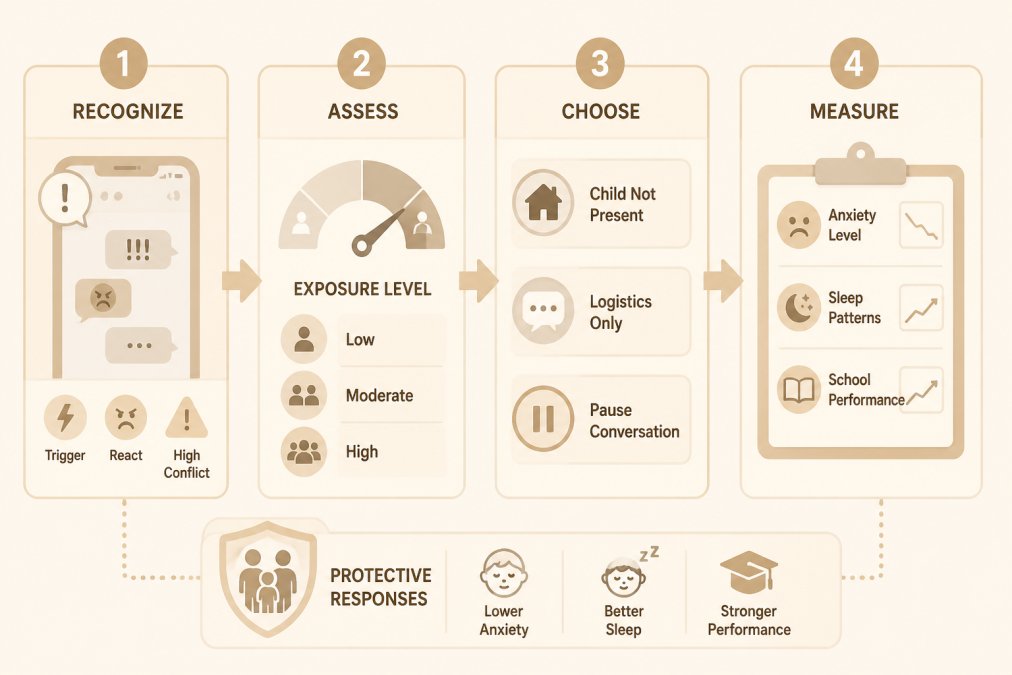
Keep adult conflict out of children’s presence. If you’re angry or dysregulated, wait until children are not present. If conflict arises during handover, end it immediately. “I need to go. I’ll email you about this.”
Don’t use children as messengers. Never ask a child to relay information to their other parent, report on the other home, or carry emotional weight about the affair. This damages their sense of safety.
Acknowledge reality without burdening them. Children know something is wrong. You can say, “Your mom and I are working through some difficult things, and we’re both committed to being good parents to you.” Don’t say, “Your mom betrayed our family.”
Don’t ask them to choose. Custody is a parental decision, not a child’s burden. Your arrangement should be clear, predictable, and not negotiable in front of the children.
Monitor for signs of triangulation. If your child is anxious before handovers, withdrawn after time with their other parent, or asking about the affair, address it directly with the other parent. “I’ve noticed the kids seem anxious around transitions. I’d like to keep these handovers brief and low-stress.”
Co-Parenting Communication Tools Built for High-Conflict Situations
When communicating with someone who has betrayed your trust, the medium matters. In-person conversation, phone calls, and texting create opportunities for misunderstanding, manipulation, and escalation.
Documented written communication is foundational. Email or co-parenting apps create a record. If your ex misrepresents what you said, you have evidence. The formality also makes people more careful about what they write.
Co-parenting apps offer features designed for high-conflict situations: read receipts, restricted communication (logistics only), and templates for common messages. The app’s structure itself enforces boundaries.
The Gray Rock Method involves responding to attempts at engagement with minimal, boring information. Your ex tries to pull you into conversation about the affair. You respond with logistics: “I’ll have the kids ready for pickup at 4 PM on Friday.” No elaboration. No emotion. Just facts. This removes the reward for engagement.
Structured handover protocols minimize face-to-face interaction. Children are ready, transitions are quick, and discussion stays to immediate logistics. Anything needing discussion happens through documented channels later.
These tools protect your nervous system and your children’s sense of safety. When communication is structured, predictable, and emotionally distant, everyone knows what to expect.
Noticing the pattern is not the same as proving it
You Can Feel the Pattern. Can You Prove It to a Judge?
A diary of what happened reads as emotional venting. A structured, timestamped record reads as evidence. Most parents lose that distinction until it costs them. The free checklist shows you exactly what to document today, before the evidence window closes.
Get the Free Red Flag Checklist \→3 categories \· 5 minutes \· free
Managing Emotional Triggers and Setting Accountability Boundaries
Your ex says something that lands exactly wrong, echoing something from the affair, using a triggering tone, or telling a small lie about logistics. Your nervous system floods with adrenaline.
This is a trigger. It’s a normal response to betrayal trauma, not a character flaw.
Managing triggers requires awareness and a protocol. First, recognize when you’re triggered. What does it feel like in your body? Racing heart? Tight chest? Rage? Learn your signals.
Second, develop a protocol that doesn’t involve responding in that moment. Text-based communication helps. If triggered during in-person interaction, excuse yourself: “I need to step away. I’ll email you about this.” If triggered by an email, wait until your nervous system settles before responding.
Accountability boundaries are lines you draw about what you will and won’t tolerate. “I will not accept late pickups without advance notice.” “I will not discuss the affair.” “I will not tolerate name-calling.”
These boundaries protect you, not punish your ex. When your ex crosses them, you enforce them with consequence, not anger. “You were 20 minutes late without notice. That’s the second time this month. If it happens again, I’ll need to adjust the custody arrangement.”
Accountability is not forgiveness. You can set boundaries with someone you don’t trust and don’t forgive. Forgiveness is personal and happens in your own time, if at all. Accountability is what you require to maintain a functional structure.
Setting boundaries without enforcing them teaches your ex that your boundaries aren’t real. Enforcement is what makes a boundary real.
Co-parenting after infidelity requires acknowledging that the standard playbook doesn’t work. The betrayal has changed the dynamic too fundamentally. What works is adapting your structure to match what’s actually possible and building communication systems that protect both you and your children.
After the Affair Series offers a structured toolkit, including the 23-point assessment, age-appropriate scripts, and high-conflict communication protocols, designed specifically for this situation. Rather than generic co-parenting advice, you get frameworks built for the actual emotional reality you’re navigating. The assessment helps you understand where you are in healing and what tools you need most. The scripts give you language when your nervous system is flooded. The communication tools create distance and documentation that protect you legally and emotionally.
The path forward isn’t forcing traditional co-parenting to work. It’s building a system that works for the family you have now, with the emotional reality that exists, and with boundaries that keep everyone safe. Research on high-conflict parenting outcomes shows that structured, emotionally distant co-parenting produces better outcomes for children than forced civility masking ongoing conflict.
Take the free 23-point assessment to understand your current situation and identify which tools will serve you most. You don’t have to navigate this alone.

Frequently Asked Questions
Why does standard co-parenting advice often backfire after an affair?
Traditional co-parenting assumes mutual respect, shared goals, and emotional safety, none of which exist after infidelity. Standard advice emphasizes open communication and joint decision-making, but these create opportunities for manipulation, gaslighting, or re-traumatization when one parent has broken trust. High-conflict co-parenting after betrayal requires structured boundaries, minimal contact, and emotional disengagement rather than transparency and collaboration.
Is parallel parenting a better alternative to co-parenting after betrayal?
Yes, for many families. Parallel parenting minimizes direct communication, keeps parental spheres separate, and reduces emotional triggers by limiting unnecessary contact. Instead of joint decisions, each parent manages their own household independently. This model eliminates the expectation of trust and cooperation that makes traditional co-parenting fail. It’s particularly effective when one parent has demonstrated deception or when emotional regulation around the other parent is impossible.
How can you protect children from the emotional fallout of infidelity without damaging their relationship with the other parent?
Protection means age-appropriate honesty without burdening them with adult details, consistent emotional availability without triangulation, and neutral language that doesn’t weaponize the betrayal. Children need to know the separation isn’t their fault and that both parents love them, but they don’t need to know about infidelity unless age and circumstance demand it. Shielding them from parental conflict while maintaining their bond with both parents requires clear boundaries about what topics are off-limits during exchanges and what emotional support looks like.
What makes high-conflict co-parenting scripts different from just ‘being nice’ to your ex?
Scripts aren’t about niceness, they’re about predictability and emotional protection. They remove the need to improvise responses during triggering moments, prevent you from oversharing or defending yourself, and keep communication strictly functional. Scripts follow the Gray Rock Method (boring, brief, business-focused) or similar frameworks that don’t invite manipulation or argument. They work because they remove the expectation of emotional reciprocity that makes traditional advice fail in high-conflict situations.
Willpower was never the problem
You’ve Said No Contact Before. What Made It Fail Last Time?
It usually isn’t willpower. It’s a loophole nobody accounted for, a second number, a mutual friend, a platform nobody thought to block. This free audit maps all 47 known workarounds so the boundary holds on its own, without relying on you to be strong enough every single time.
Get the Free Loophole Elimination Matrix \→47-point audit \· instant download \· free